A single missed bill payment can cost you $35 in late fees, a ding on your credit report that takes seven years to fall off, and the vague sense that you are not on top of your life. Multiply that by a few times a year and you are looking at hundreds of dollars in avoidable charges plus real damage to your ability to get approved for a mortgage, car loan, or even a new apartment.
The frustrating part is that most missed payments are not caused by a lack of money. They are caused by a lack of systems. The bill was due on the 15th, you got paid on the 17th, and by the time the money landed, you had already forgotten about it. Or you had the money all along, but you simply did not remember that your insurance premium hits quarterly instead of monthly.
The solution is not to try harder. It is to build systems that make forgetting impossible.
The Real Cost of Missed Payments
Before diving into solutions, it is worth understanding what a missed payment actually costs you.
Late fees are the obvious hit. Credit cards charge up to $41 for a late payment. Utilities, rent, and loan servicers have their own penalties. The average American household pays around $150 a year in late fees alone, and that number is probably conservative because it only counts the ones people report.
Credit score damage is the less visible but more expensive consequence. A single 30-day late payment can drop your credit score by 90 to 110 points. That lower score translates into higher interest rates on every future loan you take out. Over the life of a mortgage, the difference between a 720 and a 680 credit score can cost you tens of thousands of dollars in extra interest.
Compounding effects make things worse. One missed payment can trigger a penalty APR on your credit card, sometimes jumping from 20% to nearly 30%. If you carry a balance, that higher rate applies to everything, not just the missed payment.
All of this from simply forgetting that a bill was due.
System 1: Autopay Everything Possible
The single most effective thing you can do is remove yourself from the equation. Set up autopay for every bill that offers it.
Start with the bills that have the most severe consequences for late payment: mortgage or rent, car payment, credit cards, insurance premiums, and student loans. For credit cards, you can set autopay to the minimum payment as a safety net and still make manual payments when you want to pay more. The point is to ensure that even if you forget, the minimum gets paid and no late fee is charged.
Then move to smaller recurring bills: utilities, phone, internet, streaming services, gym memberships. Most of these offer autopay through their website or app.
The concern people have with autopay is overdrafting their account. That is a valid concern, and it is why autopay alone is not enough. You need to combine it with cash flow visibility so you know when those automatic drafts are going to hit and whether the money will be there.
System 2: The Bill Calendar
A bill calendar is a simple tool that maps every recurring payment to its due date. You can use a paper calendar, a spreadsheet, a shared Google Calendar, or an app. The format does not matter. What matters is that you can see at a glance which bills are due this week and how they overlap with your pay dates.
The bill calendar helps you spot timing problems before they happen. If you see that your rent, car payment, and insurance all hit in the same three-day window, you know to make sure your account is funded before that cluster arrives. For a deeper dive into this approach, check out the bill calendar strategy.
System 3: The Buffer Account
A buffer account is a small savings account that holds enough money to cover roughly one week of bills. If an automatic payment tries to draft before your paycheck lands, the buffer covers the gap.
This does not need to be a large amount. For most people, $300 to $500 is enough to prevent the timing mismatches that cause overdrafts and missed payments. Think of it as a shock absorber between your income and your bills.
The buffer account is especially useful for people with variable income. When you have a good month, top off the buffer. When a lean week hits, the buffer keeps your bills paid without requiring you to juggle due dates.
System 4: Alerts and Reminders
Most banks and billers let you set up payment reminders via text or email. Set these up for every bill, even the ones on autopay. A reminder three days before a due date gives you time to verify the money is in your account or to move funds if needed.
Layer your reminders. A bank alert for low balances. An email reminder from each biller. A weekly calendar reminder to review upcoming payments. Redundancy is not overkill here. It is the point. The more touchpoints you have, the less likely anything slips through.
System 5: Cash Flow Forecasting
The most powerful system is one that looks ahead at your entire financial picture and shows you problems before they arrive. This is where cash flow forecasting comes in.
Instead of checking individual bills and mentally calculating whether you can cover them, a cash flow forecast maps all your expected income and expenses onto a timeline. It shows your projected balance for every day over the next 30 days, including every automatic payment, subscription, and deposit.
When your projected balance dips dangerously low on a specific day, you see it days or weeks in advance. That early warning gives you time to adjust: transfer money, delay a discretionary purchase, or shift a bill's due date.
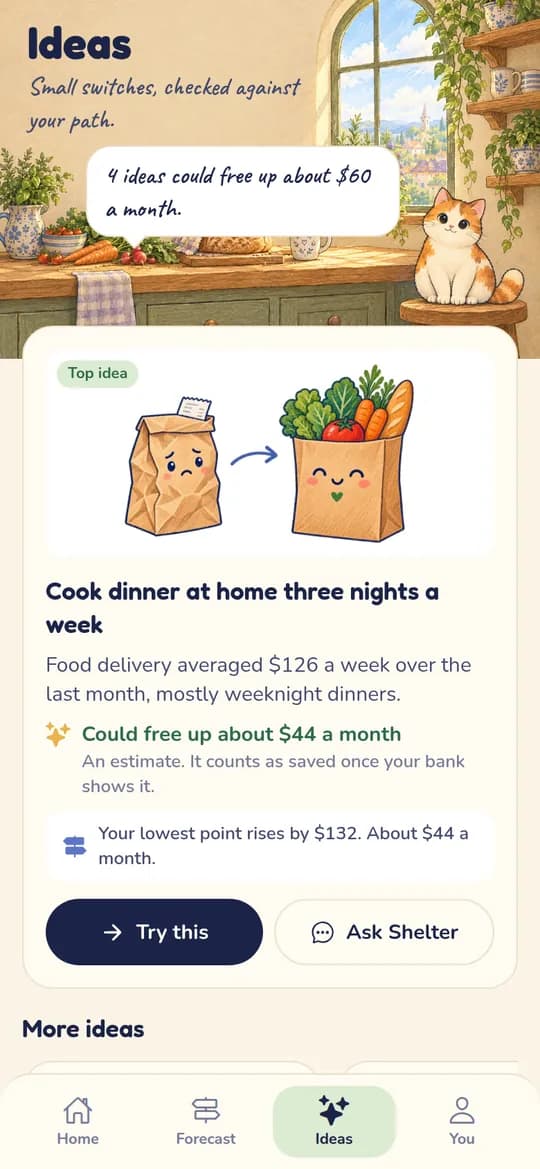
Shelter does this by connecting to your bank through Plaid and analyzing your real transaction history to predict what is coming. There is no manual entry or spreadsheet maintenance. You just see where your money is headed and whether any bills are at risk. You can explore how this works on the features page, the bill tracker app page, or the best bill tracker app comparison.
Tips for Irregular Income
If you are a freelancer, gig worker, or anyone without a predictable paycheck, never missing a bill requires a slightly different approach.
Pay bills the day money arrives. When a client payment or gig payout hits your account, immediately pay whatever bills are due next. Do not wait. Money that sits in your checking account without a job tends to get spent.
Prioritize by consequence. If you have to choose which bills to pay first, pay the ones with the steepest penalties and credit reporting first: mortgage, auto loan, credit cards. Utilities and subscriptions are important, but a late utility payment typically has lighter consequences than a reported late credit card payment.
Build a one-month buffer over time. This is the ultimate solution for irregular income. Once you have a full month of expenses saved in a buffer account, you can pay this month's bills from last month's income. The timing pressure disappears entirely.
Use a forecast to see the gaps. When income is unpredictable, cash flow forecasting becomes even more valuable. It shows you exactly how far your current balance will stretch and when you need the next deposit to land to keep everything covered.
The Payoff of Not Missing Payments
Once you have systems in place and you string together several months of on-time payments, a few things happen. Late fees disappear from your bank statements, which means more of your money stays yours. Your credit score starts climbing, which reduces the interest you pay on everything. And the mental overhead of bill management drops dramatically.
You stop spending energy worrying about whether something got paid. You stop getting those anxiety-inducing "payment overdue" emails. You stop paying a tax on disorganization.
Building these systems takes an afternoon. The late fee savings alone pay for the effort many times over, and the credit score improvement pays dividends for years. If you are living paycheck to paycheck and the timing pressure feels especially acute, the paycheck-to-paycheck cash flow plan covers strategies designed specifically for tight margins.
The goal is not to become obsessive about bill management. The goal is to set up systems good enough that you can stop thinking about it entirely.

Take control of your cash flow
Shelter connects to your bank, forecasts your balance 30 days out, and alerts you before problems happen.