Living Paycheck to Paycheck? A Cash Flow Plan That Works
According to a 2025 survey by Bankrate, 59% of American adults live paycheck to paycheck. That number has barely moved in years. It includes people earning $30,000 a year and people earning $100,000 a year. It includes single parents, dual-income households, recent graduates, and mid-career professionals.
If you are part of that 59%, you already know what it feels like. The low-balance anxiety on the Thursday before payday. The mental math every time you swipe your card. The creeping dread when an unexpected expense appears and there is nowhere to absorb it.
The standard advice is to "make a budget." But if you have tried budgeting and it did not stick, you are not alone -- and you are not the problem. The problem might be the tool.
Why Paycheck-to-Paycheck Is a Timing Problem
Here is something that gets overlooked in most financial advice: living paycheck to paycheck is often a cash flow timing problem, not purely an income problem. Yes, some people genuinely do not earn enough to cover basic needs. But many people living paycheck to paycheck have enough income over the course of a month -- just not at the right times.
Consider this scenario. Your rent is $1,500, due on the 1st. Your car payment is $400, due on the 3rd. Your car insurance is $180, due on the 5th. That is $2,080 in the first five days of the month. If you get paid biweekly and your paycheck is $2,200, you have burned through almost an entire paycheck before the month even gets started.
The second half of the month might be perfectly manageable. But that first-week crunch creates a cascade: you put groceries on a credit card, which creates a balance that costs you interest, which makes next month tighter, which reinforces the cycle.
This is not a spending problem. It is a timing problem. And timing problems need a different kind of solution than a category-based budget.
The Cash Flow Gap
The cash flow gap is the period between when money goes out and when it comes back in. When you live paycheck to paycheck, your cash flow gap is razor-thin. There is almost no buffer between outflows and inflows.
In a healthy financial situation, you have enough savings to absorb the gap. Your bills get paid regardless of when your paycheck lands because there is money in the account from previous cycles. But when savings are thin or nonexistent, the gap is exposed. Every mismatch between bill timing and income timing becomes a potential crisis.
Understanding your cash flow gap is the first step toward closing it. Not by earning more (though that helps), but by seeing exactly when the gap opens and making small adjustments to close it.
A Practical 4-Step Cash Flow Plan
This plan does not require you to track every dollar, categorize every purchase, or give up anything you enjoy. It focuses on the one thing that matters most when you are living paycheck to paycheck: making sure money is in the right place at the right time.
Step 1: Map Your Income Dates
Write down every date you receive income over the next two months. If you are paid biweekly, that is four dates. If you freelance or do gig work, estimate based on your recent deposit history. The goal is to know exactly when money arrives.
Step 2: Map Your Fixed Expense Dates
List every recurring bill and its due date. Rent, utilities, car payment, insurance, subscriptions, minimum debt payments. Be thorough. Check your bank statement for the last three months and look for charges you might have forgotten about, like that annual cloud storage fee or the quarterly pest control service.
Now lay income and expenses side by side on a calendar. You will likely see the problem immediately: a cluster of expenses that falls right before (or right after) payday, creating a gap.
Step 3: Shift What You Can
This is the most actionable step, and it is one most people do not realize is available to them. Many billers will let you change your due date. Call your car insurance company, your utility provider, your credit card issuer, and ask to move your due date.
The goal is to spread your fixed expenses more evenly across the month so they align better with your income. If you get paid on the 1st and 15th, try to split your bills roughly evenly between those two periods instead of having 80% due in the first week.
Even shifting one or two bills by a week can meaningfully reduce the cash flow crunch.
Step 4: Build a One-Week Buffer
You do not need a three-month emergency fund to break the paycheck-to-paycheck cycle. That is the end goal, not the starting point. The immediate goal is a one-week buffer: enough money to cover one week of essential expenses, sitting in your account as a cushion.
For most people, a one-week buffer is somewhere between $300 and $800. That might take a few months to build. But once it is there, it fundamentally changes your relationship with the cash flow gap. Bills that land two days before payday stop being emergencies. You stop paying overdraft fees. The cycle begins to break.
For a detailed approach to building that buffer, see our guide on how to build an emergency fund.
Why Traditional Budgets Fail for This Group
If you have tried budgeting apps and abandoned them, it is worth understanding why they did not work. It is not a character flaw.
Budgets assume a monthly cadence. You set a monthly limit for groceries, entertainment, transportation. But if you are paid biweekly, your financial life does not operate on a monthly cycle. It operates on a 14-day cycle. A monthly budget does not account for the three-paycheck months that occasionally create breathing room, or the five-week months that create extra strain.
Budgets focus on categories, not timing. Knowing you spent $600 on groceries last month does not help if the problem is that $400 of that hit during the same week as your rent. The category was fine. The timing was not.
Budgets require maintenance. When you are stressed about money, the last thing you want to do is spend 30 minutes categorizing transactions and feeling bad about the ones that went over budget. The administrative overhead of budgeting is a real barrier, and it falls hardest on the people who are already stretched thin.
Budgets create guilt. Going "over budget" in a category feels like failure, even when the overage was unavoidable (car repair, medical copay, a kid's school supplies). Cash flow planning does not judge your spending. It just shows you what is coming and whether you can handle it.
A cash flow plan sidesteps all of these problems. It does not care about categories. It cares about timing. It does not require you to log every purchase. It just needs to know what is coming in and what is going out, and when.
Seeing the Crunch Before It Hits
The most powerful part of a cash flow approach is early warning. When you can see that your balance will be dangerously low next Thursday, you have days to respond. You can pick up an extra shift. You can delay a non-essential purchase. You can move $50 from savings. You can call a biller and ask for a few days' grace.
None of that is possible when you are checking your balance after the fact and discovering the problem after it has already caused an overdraft fee or a declined payment.
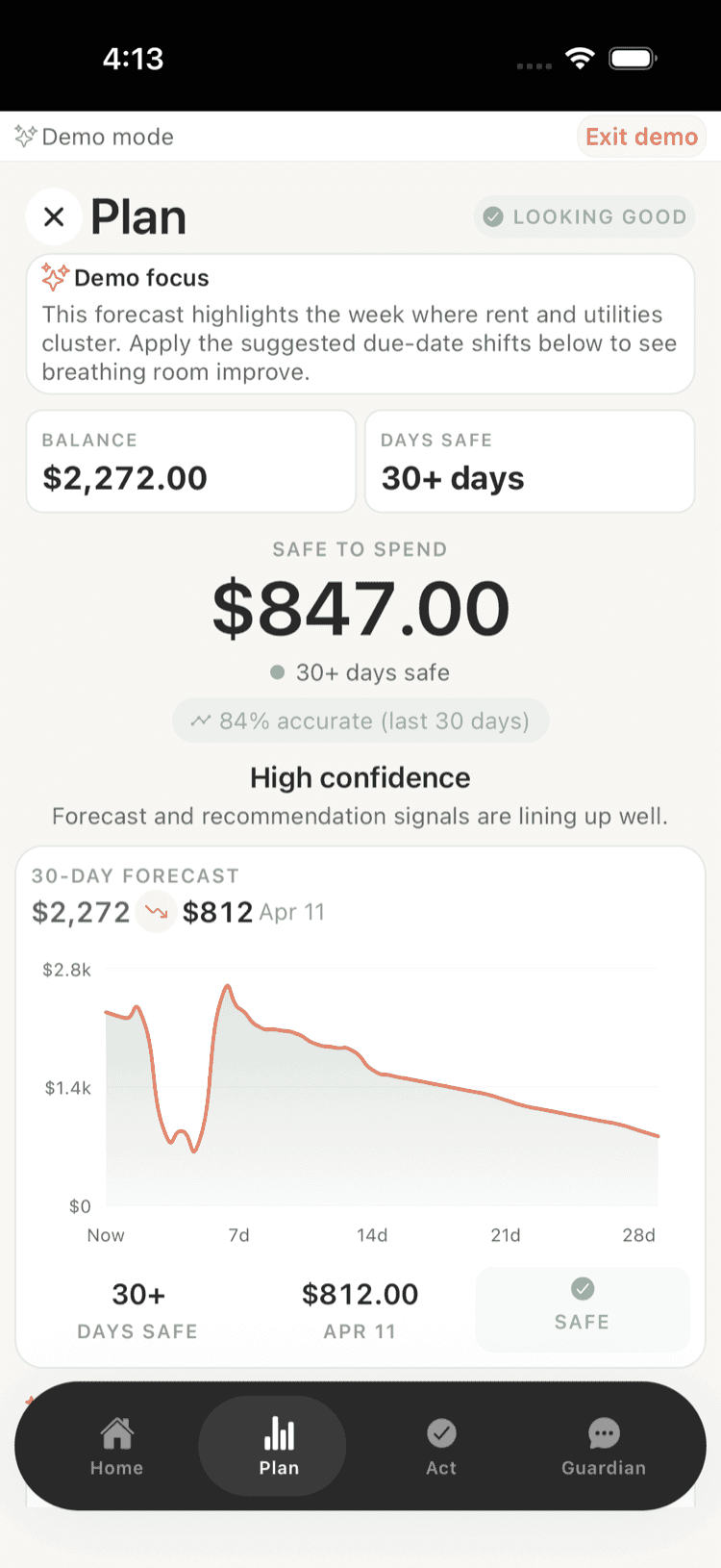
Shelter automates this kind of early warning. It connects to your bank account, identifies your recurring income and expenses, and projects your balance 30 days ahead. When it detects that your balance is heading toward a low point, it flags it. The goal is to give you the time to act before a timing problem becomes a financial one.
If you want to understand the forecasting concept in more depth, cash flow forecasting explained covers how the 30-day projection works and what it catches.
Small Wins Compound
Breaking the paycheck-to-paycheck cycle does not happen in a single dramatic moment. It happens through a series of small wins. You move a bill date and gain three days of breathing room. You build a $200 buffer and stop worrying about one particular recurring charge. You see a cash crunch coming and avoid it for the first time.
Each of these wins is small on its own. But they compound. The buffer grows. The timing improves. The anxiety decreases. You stop spending mental energy on daily balance checks and start thinking about slightly bigger things, like whether you can put an extra $50 toward a credit card this month.
The 59% number does not have to be permanent for you. The cycle is breakable. It just requires a different tool than the one most people have been told to use.
If overdraft fees are part of the cycle you are trying to escape, our guide on how to avoid overdraft fees outlines six concrete strategies, including several that work even with a tight budget. And if you have heard the advice to "just stop budgeting," why budgets do not work explores the structural reasons behind that advice.
Take control of your cash flow
Shelter connects to your bank, forecasts your balance 30 days out, and alerts you before problems happen.