Why Budgets Do Not Work and What to Do Instead
If you have ever sat down on a Sunday evening, opened a spreadsheet, and carefully allocated every dollar of your income into categories -- groceries, gas, dining out, entertainment, clothing, miscellaneous -- only to abandon the whole thing by the second week of the month, you are in excellent company. Research from multiple financial studies suggests that roughly 80% of budgets fail within the first two months. Not because the people making them are bad with money. Because the system itself is fighting against how most people actually live.
So why do budgets fail so reliably, and what can you do instead?
The Willpower Problem
Traditional budgeting is essentially a willpower exercise. You set a limit -- say $400 a month on groceries -- and then you have to remember that limit, track your spending against it in real time, and make purchasing decisions based on how much runway you have left in that category.
This works great for the first few days, when motivation is high and the numbers are fresh in your head. But willpower is a depletable resource. By the middle of the month, you are making a hundred small decisions a day, and "should I buy this $6 coffee" becomes one decision too many. You buy the coffee. Then you feel guilty. Then you stop checking the spreadsheet because the guilt makes it unpleasant. Then the budget quietly dies.
This is not a character flaw. It is a well-documented phenomenon in behavioral psychology called decision fatigue. The more decisions you have to make in a day, the worse each subsequent decision becomes. Budgets add dozens of micro-decisions on top of an already decision-heavy day, and eventually something gives.
The Friction Problem
Even if you have superhuman willpower, budgets impose a significant amount of friction on your daily life. You need to record every transaction, categorize it correctly, and reconcile your records against your bank statements. Miss a few days and you are playing catch-up, trying to remember what that $23.47 charge from last Thursday was.
Some people genuinely enjoy this level of tracking. They find it satisfying, even meditative. If that is you, more power to you -- budgeting might actually work. But for the majority of people, the overhead of maintaining a budget feels like a part-time job. And unlike a part-time job, it does not pay you anything. It just tells you what you already spent.
The friction compounds over time. A budget that takes 20 minutes a week to maintain in January takes 40 minutes by March, because you are fixing categorization errors, adjusting limits that turned out to be unrealistic, and dealing with the accumulation of small discrepancies.
The Guilt Cycle
Here is where budgets do real psychological damage. When you overspend in a category -- and you will, because life is unpredictable -- the budget frames it as a failure. You went over your dining budget by $60. That is bad. You should feel bad.
This guilt creates a toxic cycle. You overspend, feel guilty, avoid looking at the budget, spend more because you have no visibility, feel worse, and eventually give up entirely. The tool that was supposed to help you take control of your money ends up making you feel less in control than you did before you started.
Restriction-based systems have this problem across every domain, not just personal finance. Strict diets fail for the same reason strict budgets fail. When the system is built on deprivation and willpower, any slip feels like a moral failure rather than a normal part of life.
What Actually Works
If budgets are the wrong tool, what is the right one? The answer comes down to three principles: awareness, automation, and cash flow visibility.
Awareness Over Tracking
You do not need to know that you spent $14.23 at Whole Foods on Tuesday. You need to know whether your overall spending patterns are sustainable. There is a huge difference between tracking every dollar and understanding where your money goes at a high level.
The anti-budget method is one approach that leans into this distinction. Instead of setting limits for every category, you save a fixed amount first and spend the rest without guilt. It replaces granular tracking with a single, meaningful number: did I save what I planned to save this month?
Another lightweight framework is the 50/30/20 rule, which divides your income into just three broad buckets -- needs, wants, and savings. It gives you a gut-check without the overhead of tracking 15 different spending categories.
Automation Over Willpower
Anything you can automate, you should. Set up automatic transfers to savings on payday. Put bills on autopay. The fewer financial decisions you have to make manually, the less likely any of them will go wrong.
Automation removes willpower from the equation entirely. You are not deciding whether to save this month -- the money moves before you have a chance to spend it. This is not a new idea, but it is remarkable how many people still rely on manually transferring money to savings each month and then wonder why it does not happen consistently.
Cash Flow Visibility Over Category Limits
Instead of asking "am I staying within my budget?" ask "will I have enough money when my next bills hit?" That question is more useful and more actionable.
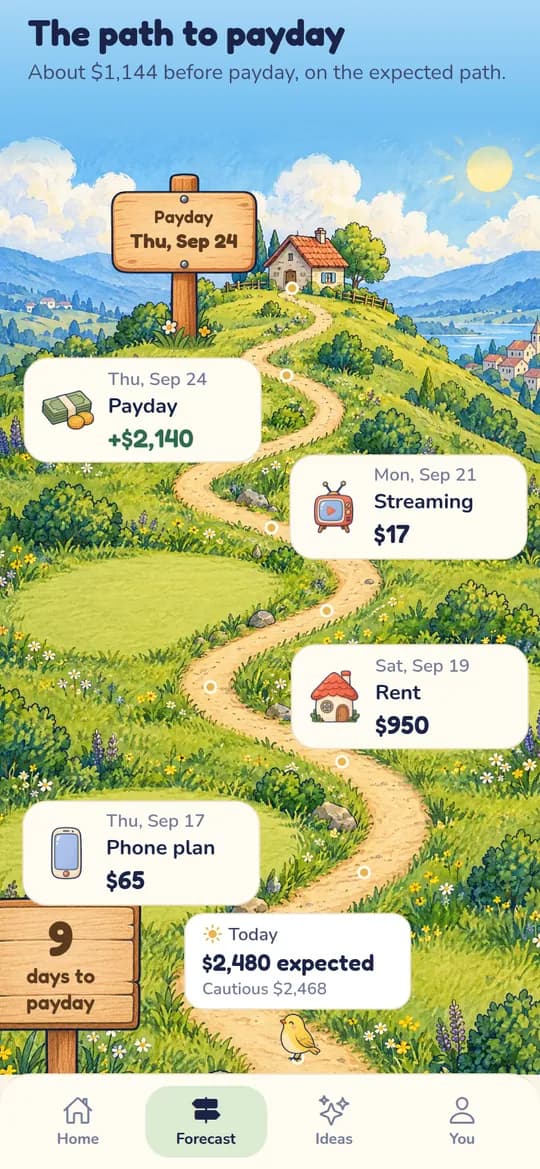
Cash flow forecasting gives you a forward-looking view of your finances. It shows you your projected balance for the next 30 days based on your actual income and spending patterns. When you can see a shortfall coming five days before it happens, you can do something about it. No spreadsheet or spending category required.
This is the approach Shelter is built around. It connects to your bank accounts, learns your income and spending patterns, and shows you exactly where your balance is headed. No manual entry, no categorization, no guilt. Just visibility into what is coming next.
The Shift From Tracking to Understanding
The fundamental problem with traditional budgeting is that it focuses on the wrong unit of analysis. It tracks individual transactions and spending categories, when what actually matters is cash flow -- the overall movement of money in and out of your accounts over time.
When you understand your cash flow, you do not need to agonize over whether that dinner out was "in the budget." You already know whether your spending patterns are sustainable, because you can see what your balance will look like in two weeks. If it looks fine, enjoy the dinner. If it looks tight, maybe cook at home this week.
This is a fundamentally more relaxed and more effective way to manage money. You trade the anxiety of constant monitoring for the confidence of knowing what is ahead. You stop tracking every penny and start understanding patterns.
Why This Matters
The personal finance industry has spent decades telling people that the solution to their money problems is better budgeting. Stick to the plan. Track every dollar. Stay disciplined. And for decades, most people have tried and failed, and then blamed themselves for the failure.
But maybe the failure is not yours. Maybe the tool is just not very good. A hammer is a great tool, but it is a terrible screwdriver. Budgets are great for organizations with accounting departments and predictable revenue streams. They are not great for individual humans with messy, unpredictable lives.
The good news is that you do not need a budget to manage money well. You need awareness of your patterns, automation for the important stuff, and visibility into what is coming next. Those three things, together, do more for your financial health than any spreadsheet ever will.
If you are ready to try a different approach, Shelter gives you the visibility piece. Connect your bank, see your 30-day forecast, and stop wondering whether you will have enough. No budget required.
Take control of your cash flow
Shelter connects to your bank, forecasts your balance 30 days out, and alerts you before problems happen.