The anti-budget is exactly what it sounds like: a way to manage your money that is the opposite of traditional budgeting. There are no spending categories. No spreadsheets. No tracking every latte and tank of gas. Instead, you do one thing first -- save a set amount -- and then spend the rest however you want, guilt-free.
The idea was popularized by financial writer Paula Pant, and it has gained traction because it strips away the parts of budgeting that cause most people to quit. If you have tried and failed to stick with a detailed budget (and statistically, most people have), the anti-budget might be the alternative that actually sticks.
How the Anti-Budget Works
The core principle is simple: pay yourself first, spend the rest freely. That is it. There are no percentages to hit for dining out, no grocery limits to agonize over, no end-of-month reckoning where you discover you went $80 over in the "entertainment" category.
Here is the logic. A traditional budget tries to control your spending by placing limits on outgoing money. The anti-budget controls your saving by placing a floor under it. As long as your savings target is met, everything else is discretionary.
Think of it this way. A budget says "you can only spend $200 on dining out this month." The anti-budget says "save $500 this month, and what you do with the rest is your business." Both approaches aim for the same outcome -- having enough money saved -- but one requires constant monitoring and the other does not.
Setting It Up in Three Steps
The anti-budget is refreshingly easy to implement. You can have it running in less than an hour.
Step 1: Determine Your Savings Target
Start by figuring out how much you want to save each month. If you are not sure, a good starting point is 20% of your take-home pay. That aligns with the savings portion of the 50/30/20 framework, and it gives you a meaningful cushion for building an emergency fund, paying down debt, or investing.
If 20% feels aggressive, start with 10%. Even 5% is better than nothing. The exact number matters less than the consistency. You can always increase it later once you see how your spending naturally adjusts.
Your savings target should include all non-spending financial goals: emergency fund contributions, retirement savings, extra debt payments, and any sinking funds for large future expenses like a vacation or car repair.
Step 2: Automate the Transfer
This is the step that makes the whole system work. Set up an automatic transfer from your checking account to your savings account (or investment account, or wherever your savings are going) on payday. Not the day after payday. Not "when I get around to it." On payday.
The timing matters because it removes the decision from the equation. The money is gone before you have a chance to spend it. You never see it sitting in your checking account, tempting you with its availability. It simply moves, automatically, like a bill payment.
If you get paid biweekly and your savings target is $500 per month, set up a $250 automatic transfer on each payday. If you get paid monthly, set up a single transfer for the full amount.
Step 3: Spend the Rest Without Guilt
This is the part that makes the anti-budget psychologically sustainable. Once your savings have been moved, whatever is left in your checking account is yours to spend. All of it. On anything. Without tracking, without guilt, without a spreadsheet.
Want to spend $150 on a nice dinner? Go for it. Feel like buying a new pair of shoes? Your call. The money is there, your savings target has already been met, and there is no budget police waiting to flag you for overspending in the "personal care" category.
This guilt-free spending is not reckless. It is mathematically sound. You have already secured your savings. The rest is genuinely available. Spending it is not a failure -- it is the system working as intended.
Who the Anti-Budget Works Best For
The anti-budget is ideal for people who meet a few criteria:
You have stable income. The anti-budget works best when you know roughly how much money will land in your account each month. With consistent income, you can set a fixed savings target and trust that the remaining amount will cover your expenses.
You dislike tracking. If the idea of logging into a budgeting app every day to categorize transactions fills you with dread, the anti-budget removes that chore entirely.
Your spending is roughly consistent. If you naturally spend about the same amount each month -- give or take a couple hundred dollars -- the anti-budget does not need guardrails. Your spending self-regulates within the available balance.
You are motivated by simplicity. Some people thrive with detailed systems. Others need the simplest possible approach or they will not follow through. The anti-budget is as simple as personal finance gets.
The Limitations
No system is perfect, and the anti-budget has real limitations worth understanding before you commit.
It does not catch timing problems. The anti-budget tells you how much you can spend in total, but it does not tell you whether three big bills landing on the same day will temporarily overdraw your account. You could have plenty of money for the month overall and still run into trouble on a specific Tuesday when rent, insurance, and your car payment all hit at once.
It requires a baseline of financial stability. If you are living paycheck to paycheck with zero margin, the anti-budget is hard to implement because there may not be enough left over after savings to cover basic expenses comfortably. In that case, you might need a more structured approach until your income or expenses shift.
It does not help with overspending in specific areas. If you have a particular spending category that tends to get out of control -- say, online shopping or subscription creep -- the anti-budget will not flag it. You might save your target amount every month while still wasting $200 on subscriptions you do not use.
It ignores irregular expenses. Annual insurance premiums, car registration, holiday gifts -- these lumpy expenses can blow up an otherwise solid month. The anti-budget does not account for them unless you build sinking funds into your savings target.
Pairing the Anti-Budget With Cash Flow Awareness
The limitations above are real, but they are also solvable. The key is combining the simplicity of the anti-budget with some form of cash flow visibility.
You do not need to go back to tracking every dollar. You just need a way to see what is coming. Knowing that your account will dip low next Thursday because three bills hit at once is useful information that the anti-budget alone cannot provide.
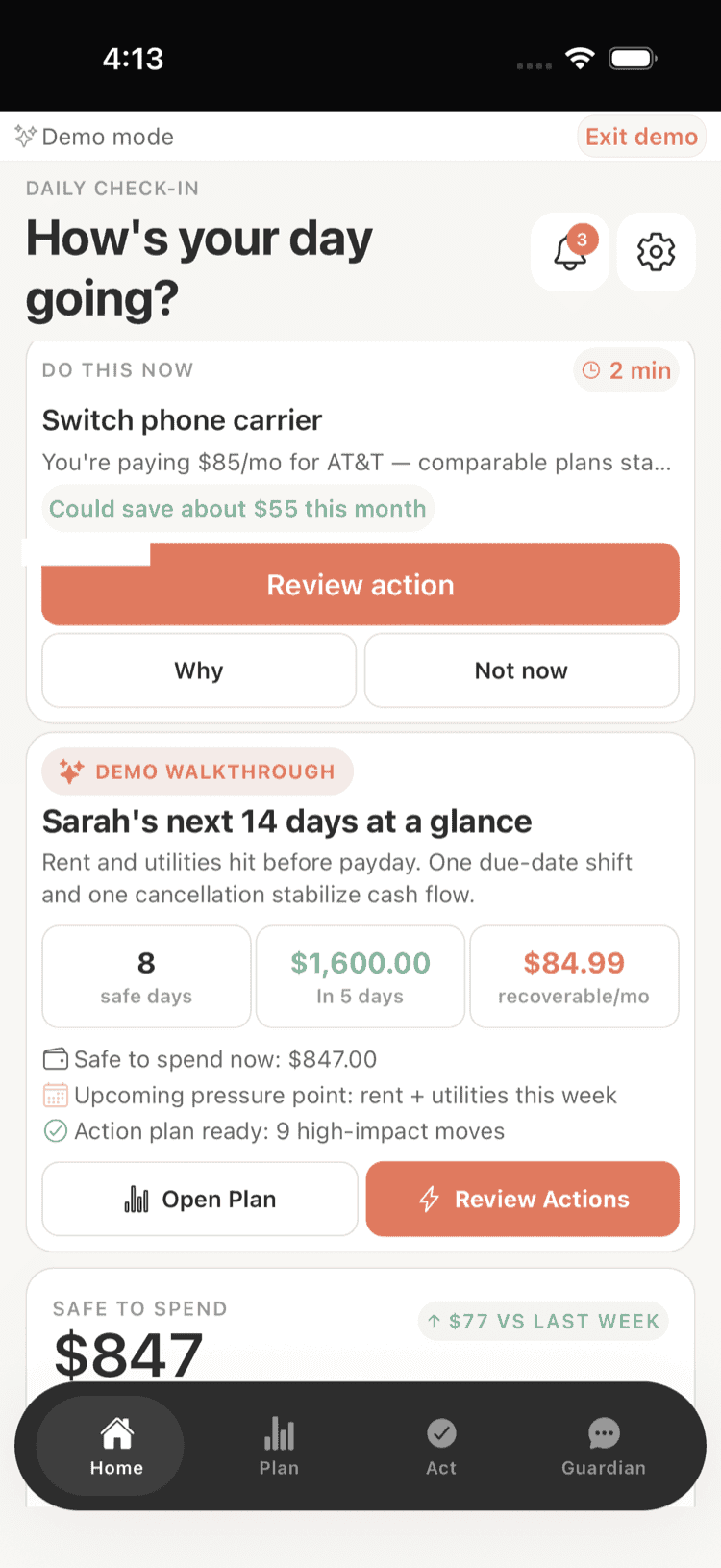
This is where tools that connect to your bank and show your projected balance become valuable. Shelter does this by analyzing your transaction history and mapping out the next 30 days of income and expenses. It does not ask you to categorize anything. It just shows you the trajectory of your balance, so you can pair the anti-budget's simplicity with the confidence of knowing what is ahead.
The combination is powerful: automate your savings, spend freely, and keep one eye on the forecast to avoid timing-related surprises.
Making It Stick
If you decide to try the anti-budget, give it at least three months before evaluating whether it works for you. The first month might feel uncomfortable because you are used to the structure (or at least the idea) of a budget. By the third month, the automatic transfers feel normal and spending without tracking feels like freedom rather than recklessness.
One practical tip: keep a small buffer in your checking account -- maybe $500 or $1,000 beyond what you need for monthly spending. This buffer absorbs the timing fluctuations that the anti-budget does not account for and prevents you from accidentally overdrawing when bills cluster together.
If you want to learn more about managing money without a traditional budget, our guide on how to manage money without a budget covers several complementary strategies that work alongside the anti-budget approach. And if you are curious about automating your savings more aggressively, automating your savings goes deeper on how to set up the transfers and accounts that make the whole system run on autopilot.
The anti-budget is not for everyone. But for people who have bounced off traditional budgeting more than once, it offers something rare in personal finance: a system that is actually easy enough to follow through on.
Take control of your cash flow
Shelter connects to your bank, forecasts your balance 30 days out, and alerts you before problems happen.