If tracking every dollar across a dozen spending categories sounds exhausting, you are not wrong. Traditional budgeting asks a lot of you, and for most people, the effort is not sustainable. But that does not mean you need to fly completely blind with your finances. The 50/30/20 rule sits in the sweet spot between meticulous tracking and no plan at all.
The concept was introduced by Senator Elizabeth Warren and her daughter Amelia Warren Tyagi in their 2005 book All Your Worth: The Ultimate Lifetime Money Plan. Two decades later, it remains one of the most widely recommended frameworks in personal finance, and for good reason -- it is simple enough to remember, flexible enough to adapt, and effective enough to actually use.
What the 50/30/20 Rule Is
The rule divides your after-tax income into three buckets:
50% for needs. These are expenses you cannot avoid: rent or mortgage, utilities, groceries, insurance, minimum debt payments, transportation to work, and healthcare. If you would face serious consequences for not paying it, it is a need.
30% for wants. Everything that makes life enjoyable but is not strictly necessary: dining out, entertainment, hobbies, subscriptions, vacations, new clothes beyond the basics, gym memberships, and that fancy coffee drink you look forward to every morning.
20% for savings and debt repayment. Emergency fund contributions, retirement savings, investments, and any debt payments above the minimum. This is the money building your future financial security.
That is it. Three categories. No need to track whether the $12 you spent at Target was "household supplies" or "personal care." You just need to know whether your overall spending falls roughly into these proportions.
How to Calculate Your Numbers
Start with your monthly take-home pay -- the amount that actually hits your bank account after taxes, health insurance deductions, and any pre-tax retirement contributions. If your paycheck deposits vary, average the last three months.
Say your take-home pay is $5,000 per month. Your targets would be:
- Needs: $2,500 (50%)
- Wants: $1,500 (30%)
- Savings/debt: $1,000 (20%)
Now look at your actual spending. Pull up two or three months of bank statements and sort your expenses into these three buckets. Do not worry about being precise -- close enough counts here. The goal is to see whether you are roughly in range or dramatically off in one area.
If your needs are eating up 65% of your income, that tells you something important even if your exact grocery spending is not perfectly categorized. If your savings are at 5% instead of 20%, that tells you something too. The 50/30/20 rule is a diagnostic tool as much as it is a spending plan.
Adjustments for Real Life
The standard 50/30/20 split works well for people with moderate incomes in average cost-of-living areas. But real life is messy, and the numbers often need adjusting.
High Cost-of-Living Areas
If you live in San Francisco, New York, Boston, or any other city where rent alone might consume 40% of your income, hitting a 50% needs target may be impossible without roommates or a long commute. In expensive markets, a 60/20/20 or even 70/15/15 split might be more realistic.
The important thing is not hitting the exact percentages. It is understanding the trade-offs you are making. If your needs consume 65% of your income, that means your wants and savings are getting squeezed. Knowing that helps you make intentional decisions about where to live, what to drive, and how aggressively to pursue higher income.
Lower Income
When you are earning less, needs naturally take up a larger share. Someone making $30,000 a year might need 70% or more just for essentials. In that situation, rigid adherence to 50/30/20 is not helpful -- it just makes you feel bad about a structural problem.
If you are in this situation, focus on two things: covering your needs and saving whatever you can, even if it is $50 a month. The percentages are targets to grow toward, not judgments on where you are now.
High Income
On the other end of the spectrum, if you earn well above average, spending 30% of your income on wants might be far more than you need to be happy. High earners often benefit from flipping the ratio -- something like 50/20/30, where 30% goes to savings and investments while wants stay at 20%. The math of compound interest rewards this heavily over time.
Variable Income
Freelancers and gig workers face a unique challenge because their income changes month to month. One approach is to base your 50/30/20 split on your lowest typical month. In good months, the extra goes to savings. In lean months, you are already living within the baseline.
Common Mistakes
The 50/30/20 rule is simple, but there are a few ways people trip over it.
Misclassifying Wants as Needs
This is the biggest one. Your basic phone plan is a need. The $80 unlimited plan with hotspot and international calling is partly a want. A reliable car to get to work is a need. A brand-new SUV with heated seats is partly a want. Groceries are a need. The organic artisanal cheese and $7 kombucha are partly wants.
Be honest with yourself during the classification. It does not mean you cannot buy the nice cheese. It means the nice cheese comes out of your wants budget, not your needs budget.
Ignoring Debt Payments
If you are carrying credit card debt, student loans, or other consumer debt, the minimum payments count as needs (because you are contractually obligated to make them). But any extra payments toward paying off that debt come from the 20% savings and debt category. This is important because it means aggressive debt payoff and retirement savings compete for the same bucket. You might need to prioritize one over the other for a while, and that is a reasonable choice to make consciously.
For a detailed look at debt payoff strategies, our guide on why budgets do not work covers how to think about money management more broadly, including debt.
Treating It as a Rigid System
The 50/30/20 rule is a guideline, not a law. Some months you will be at 55/25/20 because your car needed new tires. Other months you will be at 45/25/30 because nothing broke and you got a bonus. The value is in the general direction, not in hitting the exact numbers every single month.
If you treat it as a rigid system, it becomes just another budget -- complete with the guilt and failure cycle that makes budgets unsustainable for most people.
Using It as a Gut-Check
The most practical way to use the 50/30/20 rule is not as a monthly tracking exercise. It is as a periodic gut-check. Once a quarter, pull up your spending and see how the broad categories are trending. Are your needs creeping up because of subscription inflation? Are you actually saving 20%, or has that slipped to 10%?
This quarterly review takes maybe 30 minutes and gives you more useful information than weekly budget tracking. You see the big picture. You notice trends. And you can make one or two adjustments that move the needle without overhauling your entire financial life.
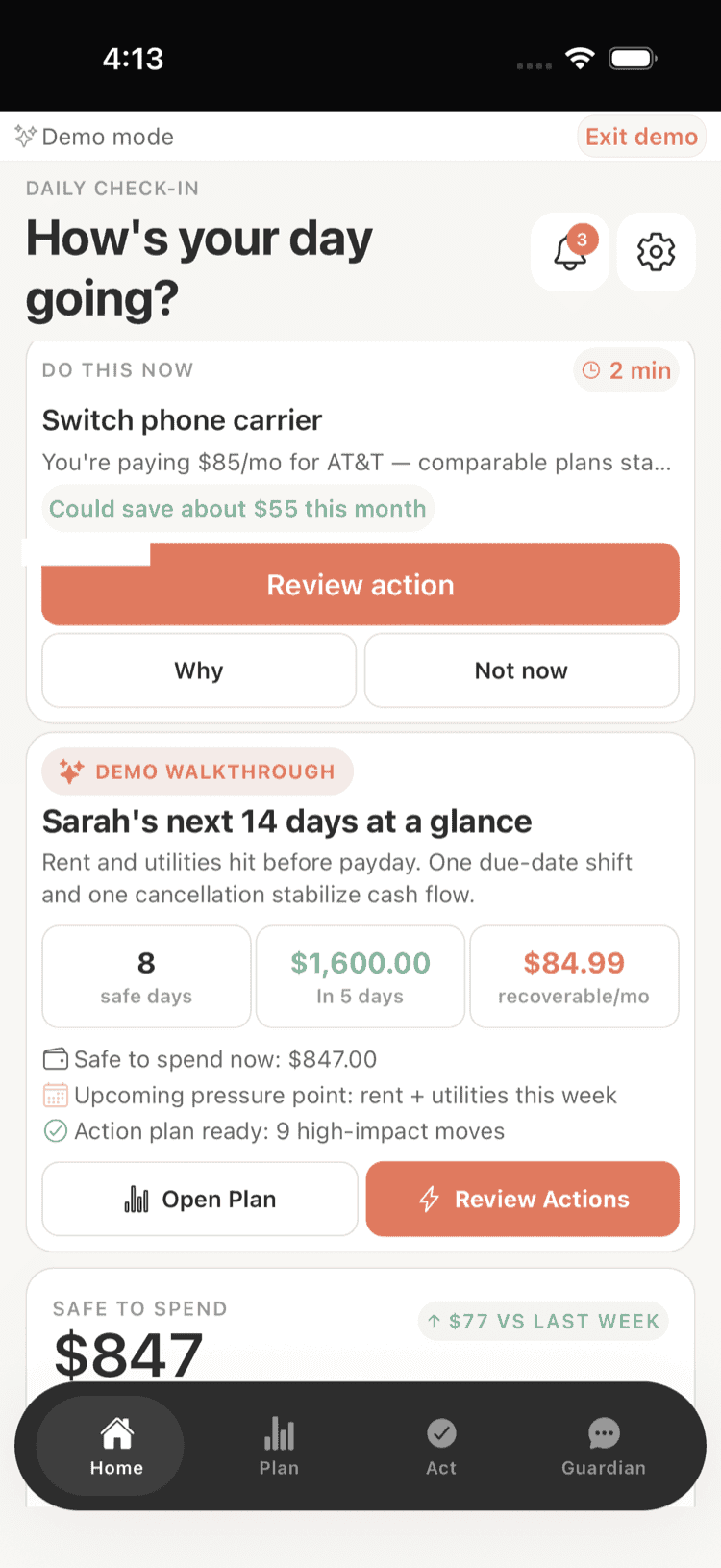
Shelter can make this even easier. Because it connects to your bank accounts and categorizes your spending automatically, you can see at a glance whether your money is flowing in roughly the right proportions. No manual tracking required -- just a quick look at the dashboard to confirm you are still on track.
Where the 50/30/20 Rule Fits
The 50/30/20 rule is not a complete financial plan. It does not tell you which debt to pay off first, how much to invest, or what to do when an unexpected expense hits. What it does is give you a simple framework for thinking about your money that is dramatically better than no framework at all.
It pairs well with other approaches. Use the 50/30/20 rule for overall allocation, the anti-budget method for day-to-day spending, and cash flow forecasting for timing. Together, these tools give you a complete picture of your finances without the overhead of traditional budgeting.
If you want to go further into managing your money without a detailed budget, our guide on how to manage money without a budget covers additional strategies that complement the 50/30/20 framework.
The beauty of the 50/30/20 rule is that it meets you where you are. Whether you use it as a strict allocation system or a loose quarterly check-in, it gives you enough structure to make progress without enough rigidity to burn you out. And sometimes, that is exactly the right amount of financial planning.
Take control of your cash flow
Shelter connects to your bank, forecasts your balance 30 days out, and alerts you before problems happen.