Here is a confession that would make most personal finance writers uncomfortable: you do not need a budget. Not a detailed one, anyway. Not the kind where you allocate $347 to groceries and $120 to gas and $45 to coffee shops and then feel terrible when reality does not match the plan.
Millions of people manage their money well without tracking every dollar. They are not winging it -- they have systems. But their systems look nothing like a traditional line-item budget. If you have tried budgeting, hated it, and assumed the only alternative was financial chaos, this guide is for you.
The Case Against Detailed Budgets
Before getting into what works, it is worth understanding why budgets fail for most people. The short version: they require too much willpower, create too much friction, and generate guilt when you inevitably deviate from the plan. The long version involves behavioral psychology, decision fatigue, and the fact that life is fundamentally unpredictable -- but the result is the same. Most people quit within two months.
The deeper issue is that budgets solve the wrong problem. They answer the question "where did my money go?" But the question that actually matters is "will I have enough money for what is coming?" Those are very different questions, and they require very different tools.
Here are five strategies that answer the right question without requiring a budget.
Strategy 1: Automate Your Savings First
This is the single most impactful thing you can do for your finances, budget or no budget. Set up an automatic transfer from your checking account to your savings or investment account on payday. Not at the end of the month. Not when you "have some left over." On the day your paycheck lands.
The amount matters less than the consistency. Start with whatever you can sustain -- 10% of your take-home pay is a solid starting point. If that feels too aggressive, start at 5%. The key is making it automatic so it happens without any effort or decision-making on your part.
This is the foundation of the anti-budget method: save first, spend the rest. It works because it eliminates the hardest part of saving -- the decision to actually move the money. Automation handles the discipline. You handle the living.
Once the transfer is in place, what remains in your checking account is genuinely yours to spend. You do not need to track it. You do not need to categorize it. The important money has already been moved to safety.
Strategy 2: Use Cash Flow Forecasting
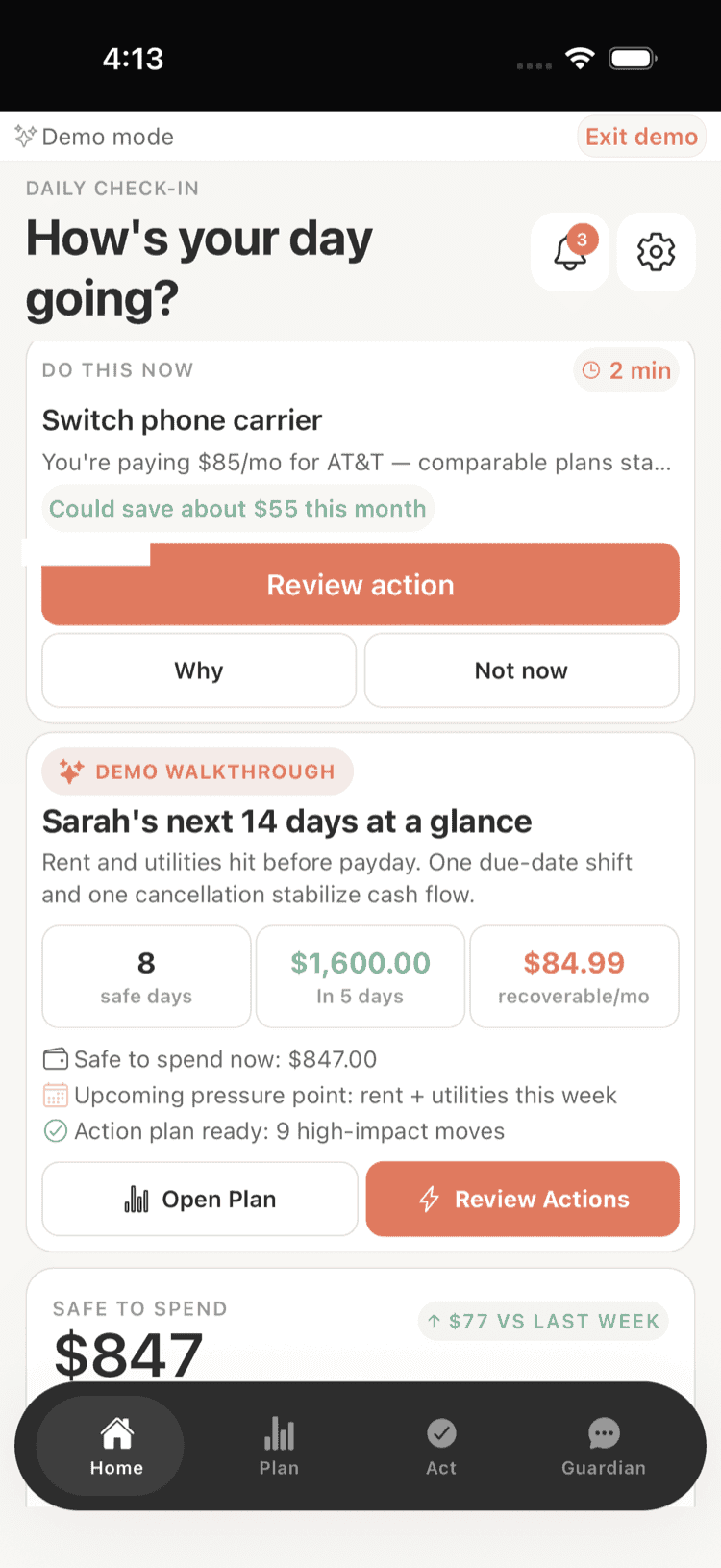
This is the budget replacement that most people do not know about. Instead of tracking what you spent last month, cash flow forecasting projects what will happen to your bank balance over the next 30 days based on your income patterns and upcoming expenses.
The difference is like the distinction between looking in the rearview mirror and looking through the windshield. Both are important, but if you had to pick one while driving, you would pick the windshield.
A cash flow forecast shows you things a budget never could. It shows that your balance will dip to $200 next Thursday because three bills land on the same day. It shows that you are fine overall for the month, but week two is going to be tight. It shows that the annual insurance premium you forgot about is going to hit in 11 days.
For a deep dive into how this works, our guide on cash flow forecasting explained covers the mechanics in detail. The short version is that you can do it manually with a spreadsheet or automatically with a tool that connects to your bank and builds the forecast from your real transaction history.
Shelter takes the automatic approach. It connects to your accounts through Plaid, identifies your recurring income and expenses, and maps out the next 30 days. No manual entry, no categorization. Just a clear picture of where your money is headed.
Strategy 3: Set Spending Guardrails
You do not need limits on every category. You need guardrails on the one or two areas where you tend to lose control. For some people that is online shopping. For others it is dining out, or subscriptions, or impulse purchases during late-night browsing.
The guardrail approach is targeted. Instead of monitoring 15 spending categories, you identify the two or three that cause problems and put a specific system in place for just those areas. Here are some examples:
The 24-hour rule for purchases over $50. If you want something that costs more than $50, wait 24 hours before buying it. Most impulse purchases lose their appeal after a day of cooling off.
A dedicated "fun money" account. Transfer a fixed amount to a separate checking account or prepaid card each month. That is your discretionary spending. When it is gone, it is gone -- but you do not need to track anything within it.
Subscription caps. Decide on a maximum number of active subscriptions (say, five) and enforce a one-in-one-out rule. Want to add a new streaming service? Cancel an existing one first.
These guardrails target specific behaviors without requiring you to monitor everything. They are fences, not cages.
Strategy 4: Do Quarterly Check-Ins
You do not need to review your finances every week. Once a quarter is enough to catch trends before they become problems.
A quarterly check-in takes about 30 minutes. Pull up your bank statements for the past three months and answer three questions:
-
Is my savings rate holding? Check that the automatic transfers have been running and that you have not dipped into savings for non-emergencies.
-
Has my spending shifted? Look at the big categories -- housing, transportation, food, and subscriptions. You are not tracking to the dollar; you are looking for meaningful shifts. Did food spending jump 30%? Did a new subscription appear that you forgot about?
-
Am I on track for big upcoming expenses? Think ahead to the next quarter. Any annual premiums due? Car registration? Holiday spending? If something big is coming, adjust your savings transfers now to absorb the impact.
This is where the 50/30/20 rule is most useful -- not as a monthly budget, but as a quarterly benchmark. If your needs have crept from 50% to 60% of your income, that is a signal worth investigating. But you do not need to catch it in real time.
Strategy 5: Use Alerts for Anomalies
Most banks let you set up alerts for things like low balances, large transactions, and recurring charges. These alerts act as an early warning system, catching problems without requiring you to actively monitor anything.
Set up alerts for:
- Balance drops below a threshold. Pick a number that represents your personal "danger zone" -- maybe $500 or $1,000. If your balance hits that level, you need to pay attention.
- Transactions above a certain amount. A notification for any charge over $100 helps you catch fraudulent activity and unexpected large expenses.
- New recurring charges. This catches zombie subscriptions at birth, before they have a chance to accumulate for months unnoticed.
Beyond basic bank alerts, tools like Shelter can take this further by analyzing your transaction patterns and flagging anomalies automatically. A charge that seems unusual based on your history -- an unexpectedly large bill, a new recurring payment you did not set up -- gets surfaced without you having to go looking for it.
How Technology Enables Budget-Free Living
The reason budget-free money management works better today than it would have 20 years ago comes down to technology. When all your financial information lived on paper statements that arrived once a month, you needed a manual tracking system to stay on top of things. Budgets were the best available tool.
Today, your bank accounts, credit cards, and bills are all digital. Real-time transaction data is available through secure banking APIs like Plaid. Machine learning can identify patterns in your spending history and project them forward. Alerts and notifications can reach you instantly on your phone.
This changes the game fundamentally. You no longer need to track transactions because the data is already being tracked. You do not need to manually project your balance because algorithms can do it automatically. You do not need to scan your statements for anomalies because pattern-detection systems can surface them for you.
The role of the human in this system shifts from data entry clerk to decision maker. Instead of spending your time recording and categorizing, you spend it deciding. And the decisions are easier because the information is better.
Putting It All Together
Here is what budget-free money management looks like in practice:
- Automate savings on payday. This ensures you are building wealth regardless of what happens with your spending.
- Use cash flow forecasting to see the next 30 days. This catches timing problems before they become overdraft fees.
- Set guardrails on your one or two problem areas. Targeted interventions beat blanket restrictions.
- Check in quarterly to make sure the big picture is on track. Thirty minutes, four times a year.
- Rely on alerts to surface anomalies and problems between check-ins.
No spreadsheet. No daily tracking. No guilt. Just a system that works with your life instead of against it.
The best financial system is the one you actually follow. If budgeting works for you, great -- keep doing it. But if it does not, you are not stuck choosing between a budget and chaos. There is a whole middle ground of tools and strategies that provide structure without suffocation. And increasingly, technology like Shelter is making that middle ground easier to occupy than ever. If you are specifically looking for a hands-off alternative to category budgeting, the YNAB alternative page lays out the difference.
Take control of your cash flow
Shelter connects to your bank, forecasts your balance 30 days out, and alerts you before problems happen.