Cash Flow

Cash Flow Forecasting Explained: See Your Balance 30 Days Out

5 min read

Most personal finance advice starts with the same suggestion: make a budget. But budgets tell you what you should spend. They do not tell you what is actually going to happen to your bank account next Tuesday, or whether three bills landing on the same day will leave you short before your next paycheck arrives.

That is the problem cash flow forecasting solves. Instead of categorizing past spending into neat little buckets, it looks forward. It answers the question that actually keeps people up at night: will I have enough money when I need it?

What Is Cash Flow Forecasting?

Cash flow forecasting is the practice of projecting your future account balance based on expected income and upcoming expenses. Businesses have used it for decades to avoid running out of operating capital. The same principle applies to your personal finances, just at a smaller scale.

At its core, a cash flow forecast takes three inputs:

  1. Your current balance -- what you have right now.
  2. Expected income -- paychecks, freelance payments, refunds, side hustle deposits.
  3. Expected expenses -- bills, subscriptions, loan payments, and recurring spending patterns.

Layer those together on a timeline and you get a projected balance for every day over the next few weeks. That projection is your cash flow forecast.

Why Cash Flow Matters More Than a Budget

Budgets are backward-looking by nature. You set a category limit at the beginning of the month, then check at the end to see how you did. The feedback loop is slow, and by the time you realize you overspent on dining out, the damage is done.

Cash flow forecasting flips this around. It is inherently forward-looking. Instead of asking "did I stay within my grocery budget last month?" it asks "will my balance dip below zero before Friday?"

That distinction matters because most financial stress is not caused by overspending in aggregate. It is caused by timing. Your rent, car payment, and insurance premium all hit in the same week. Your paycheck deposits two days after a cluster of automatic withdrawals. The math works out over a full month, but the timing does not.

A budget cannot catch timing problems. A cash flow forecast can.

How 30-Day Forecasting Works in Practice

A useful personal cash flow forecast looks ahead roughly 30 days. That window is long enough to see upcoming problems but short enough that the predictions stay accurate.

Here is how it works in practice. The system looks at your transaction history to identify recurring patterns: when your paycheck lands, when your rent gets drafted, when your streaming subscriptions renew. It maps those patterns onto the next 30 days, adjusting your projected balance day by day.

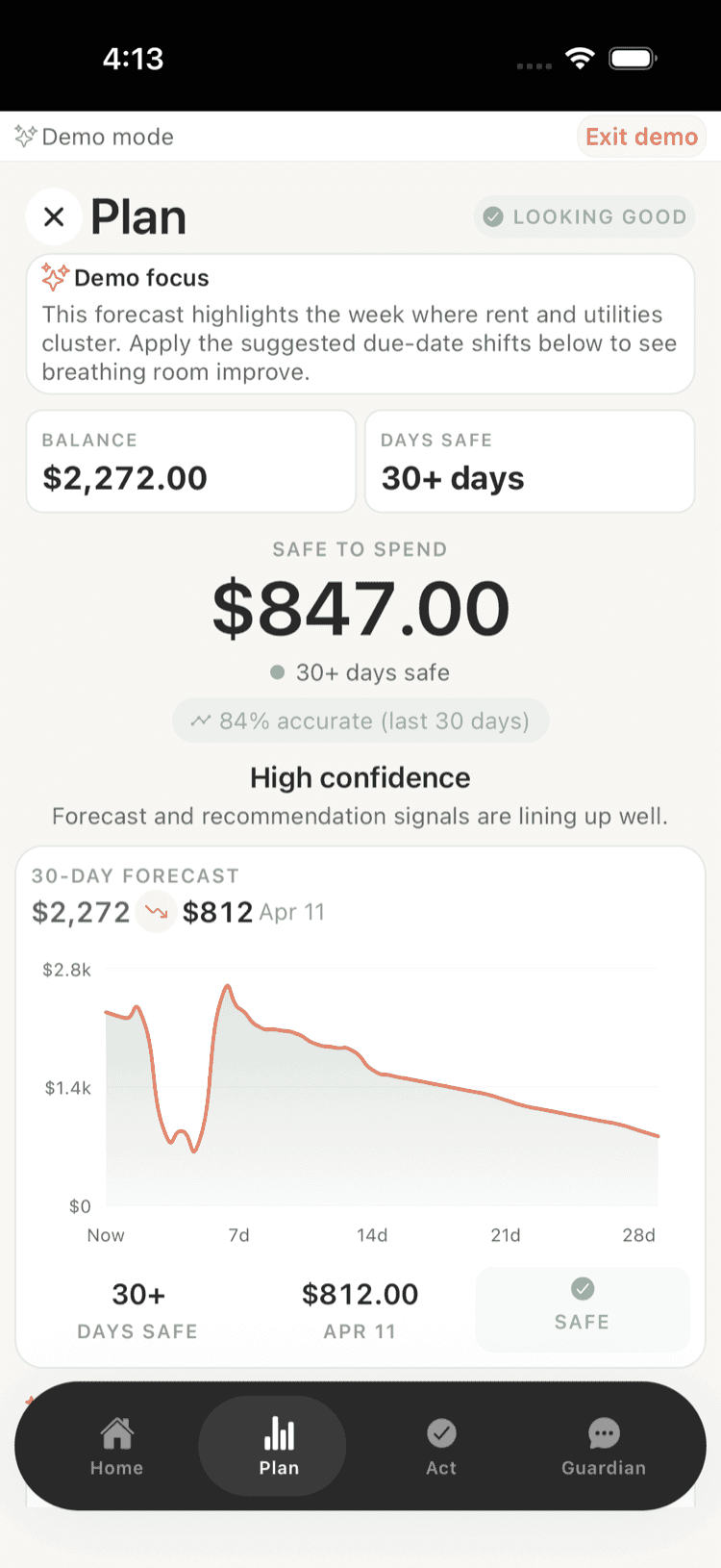
The result is a curve. Some days your balance rises (payday). Other days it drops (bill due dates). The valuable insight is not any single point on that curve -- it is the overall shape. You can see exactly when your balance will be at its lowest, and whether that low point is dangerously close to zero.

Shelter does this automatically by connecting to your bank through Plaid and analyzing your real transaction history. There is no manual entry. The forecast updates as new transactions come in, so you always have a current picture of where your money is headed. You can explore how this looks on the features page.

Common Scenarios a Forecast Catches

The real value of cash flow forecasting shows up in specific, concrete situations that happen to nearly everyone.

Bills Stacking Up on the Same Day

Plenty of people have three or four automatic payments scheduled around the first of the month. Rent, a car payment, insurance, a gym membership. Individually, each one is manageable. Together, they can temporarily drain your account. A 30-day forecast shows this pile-up days in advance, giving you time to shift a payment date or transfer money from savings.

Irregular Income

Freelancers, gig workers, and anyone with variable income know the anxiety of not knowing when the next payment will arrive. A cash flow forecast that tracks your deposit patterns can project when income is likely to land and flag weeks where expenses will outpace what is coming in. If this describes your situation, the paycheck-to-paycheck cash flow plan goes deeper on strategies that help.

Forgotten Subscriptions and Annual Charges

That annual software renewal you forgot about. The streaming service you signed up for during a free trial. These charges show up on your forecast before they show up on your bank statement, because the system has seen them before and knows they are coming back.

The Post-Holiday Recovery

January and February are notoriously tight months for household finances. Holiday spending is done, but the credit card bills are just arriving. A forecast built from your actual spending patterns can show you exactly how long the recovery period will last and when you will be back to normal.

The Difference Between Forecasting and Guessing

Everyone does some version of cash flow forecasting in their head. You check your balance, think about what bills are coming, and make a rough mental estimate of whether you are okay. The problem with mental math is that it misses things. You forget about the insurance premium that only hits quarterly. You underestimate how much those small daily purchases add up to. You do not account for the three-day hold on a deposit.

Automated forecasting removes the guesswork. It uses your actual transaction data, not your best guess, and it accounts for every recurring charge it has ever seen in your history. The difference between a mental estimate and a data-driven forecast is the difference between "I think I will be fine" and "I can see that my balance will be $347 on the 14th."

If you want to understand how to do this manually before trying an automated approach, our guide on how to predict your bank balance walks through the spreadsheet method step by step.

Who Benefits Most from Cash Flow Forecasting?

Cash flow forecasting is useful for anyone, but it is especially valuable for a few groups:

  • People living paycheck to paycheck. When there is no margin for error, knowing your balance five days out is not a luxury -- it is a necessity.
  • Freelancers and gig workers. Variable income makes traditional budgeting nearly impossible. Forecasting adapts to irregular deposits.
  • Couples managing shared finances. When two people spend from the same account, surprises multiply. A shared forecast keeps both partners informed.
  • Anyone who has ever been hit with an overdraft fee. If you have paid $35 because your balance dipped $5 below zero the day before payday, a forecast would have saved you that fee and the frustration that came with it.

Moving from Reactive to Proactive

The biggest shift that cash flow forecasting creates is psychological. Instead of checking your bank app with a knot in your stomach, wondering what charges have posted overnight, you check your forecast already knowing what to expect. The anxiety of the unknown is replaced with clarity.

You stop reacting to your finances and start anticipating them. That is a fundamentally different relationship with money, and it does not require a complicated budget, an accounting degree, or hours of spreadsheet work. It just requires visibility into what is coming next.

Shelter was built around this idea: that seeing your financial future clearly is more useful than tracking your financial past. If you are tired of being surprised by your own bank account, try the demo and see what 30 days of visibility looks like.

Take control of your cash flow

Shelter connects to your bank, forecasts your balance 30 days out, and alerts you before problems happen.

Related articles