Think about the last time you checked your bank balance. Were you looking because you had a plan, or because you were nervous? For most people, checking their balance is a reactive habit. Something feels off. A bill is coming. Payday seems far away. So you open the app, look at the number, and either feel relieved or anxious.
But what if you already knew what that number was going to be -- not just today, but next Thursday, or the Tuesday after that? Predicting your bank balance is not fortune-telling. It is straightforward math, and learning how to do it changes the way you relate to your money.
Why Most People Check Their Balance Reactively
Banking apps are designed to show you where you stand right now. Your current balance. Your recent transactions. Maybe a pie chart of last month's spending. All of it looks backward.
This creates a reactive cycle. You spend, then check. You get paid, then relax. You see a low number, then worry. At no point does your banking app tell you what is coming next. It is like driving a car by only looking in the rearview mirror.
The result is that financial surprises feel inevitable. A subscription renewal you forgot about. Two bills landing on the same day. A paycheck that deposits a day later than expected because of a holiday. None of these are unpredictable -- they follow patterns. But without a forward-looking view, every one of them feels like it came out of nowhere.
The Manual Prediction Method
You do not need special software to predict your bank balance. A spreadsheet works. Here is the basic approach:
Step 1: Start With Your Current Balance
Open your bank app and note your available balance. Not your total balance -- your available balance, after any pending transactions.
Step 2: List Your Expected Income
Write down every deposit you expect over the next two to four weeks. Paychecks are the obvious one, but also include tax refunds, side hustle payments, reimbursements from work, or money a friend owes you. For each one, note the expected date and amount.
Step 3: List Your Expected Expenses
This is the harder part. Start with the obvious recurring charges:
- Rent or mortgage
- Car payment
- Insurance premiums
- Utility bills
- Subscriptions (streaming, gym, software, etc.)
- Loan payments
- Credit card minimum payments
Then estimate your variable spending. Look at the last few months and average your grocery, gas, and dining spending per week. It will not be exact, but a rough estimate is far better than nothing.
Step 4: Map It on a Timeline
Create a row for each day over the next 30 days. Start with your current balance. For each day, add any expected income and subtract any expected expenses. The running total is your predicted balance for that day.
Step 5: Look for Danger Zones
Scan the timeline for days where your predicted balance drops uncomfortably low. These are your danger zones -- the days when an unexpected charge could push you into overdraft territory. If you see one coming, you have time to act: delay a discretionary purchase, move money from savings, or shift a bill payment date.
The Limitations of Manual Tracking
The spreadsheet method works. People have managed their finances this way for years. But it has real limitations that are worth acknowledging.
It is time-consuming. Building and maintaining a cash flow spreadsheet takes 30 to 60 minutes per week if you are being thorough. Most people start with good intentions and stop updating it within a month.
It misses things. Annual charges, quarterly bills, and irregular expenses are easy to forget. You might perfectly track your weekly spending but get blindsided by a $120 annual subscription renewal because it was not on your radar.
It does not update in real time. If you spend $80 at the grocery store on Wednesday, your spreadsheet does not know about it until you manually enter it. By then, your predictions for the rest of the week are off.
It requires discipline. Every transaction needs to be entered. Every new subscription needs to be added. Every changed bill amount needs to be updated. The system is only as good as the data you put into it, and humans are not great at consistent data entry over long periods.
How Automation Changes the Game
The core concept of predicting your bank balance is sound. The problem is execution. Doing it manually is tedious enough that most people quit.
This is where automation makes a meaningful difference. When an app connects directly to your bank account and reads your actual transactions, several things change at once.
First, there is no manual entry. Your transactions flow in automatically, so your predictions are always based on current data. Second, pattern recognition gets better over time. Instead of you trying to remember every recurring charge, the system identifies them from your history. That annual subscription you forgot about? It shows up in the forecast because the system saw it last year.
Third, the predictions update continuously. When your paycheck lands a day early, the forecast adjusts. When you make an unplanned purchase, the projected balances for the rest of the month shift accordingly.
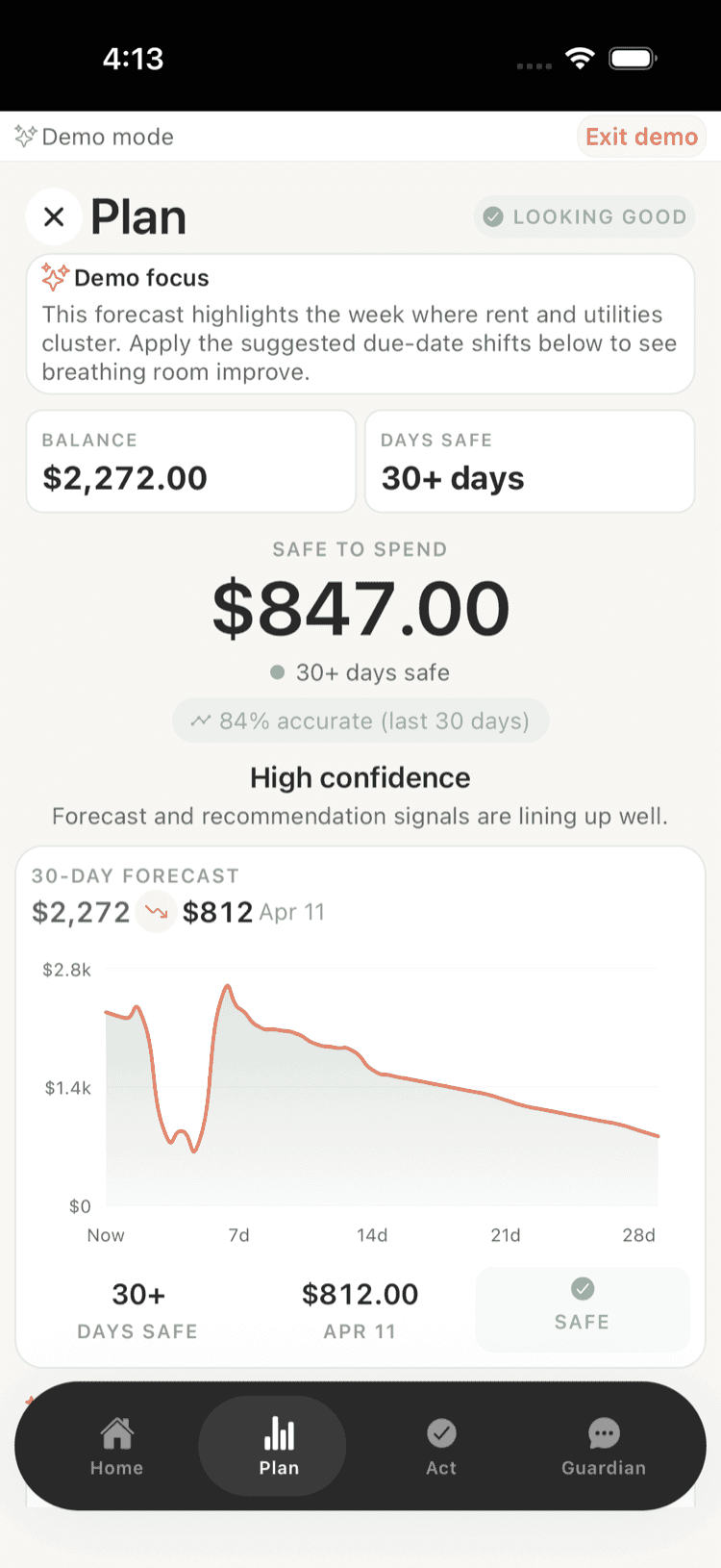
Shelter was built specifically around this idea. It connects to your bank via Plaid, reads your transaction history, and generates a 30-day forecast of your balance automatically. No spreadsheets, no manual entry, no forgetting to update. You can see exactly what this looks like in the interactive demo.
For a deeper explanation of how the forecasting engine works, read our guide on cash flow forecasting explained.
What Prediction Enables
Knowing your future balance is not just about avoiding problems. It enables better decisions across the board.
Timing large purchases. Want to buy new tires for your car? Your balance forecast tells you the best week to do it -- the window after payday but before your rent is due, when your account has the most room.
Negotiating bill due dates. If your forecast shows a consistent crunch around the 1st of the month, you can call your insurance company or utility provider and ask to move your due date to the 15th. Most companies will accommodate this, and the result is a smoother cash flow curve.
Building savings intentionally. Instead of transferring whatever is "left over" at the end of the month (which is often nothing), you can look at your forecast and identify the specific days when your balance is highest. That is when a transfer to savings will have the least impact on your daily finances.
Reducing financial anxiety. This one is less tangible but arguably the most important. Financial stress is often driven by uncertainty. You do not know if that autopay is going to cause a problem. You do not know if you can afford dinner out this weekend. Prediction replaces uncertainty with information, and that changes how you feel about money even when the numbers themselves do not change.
The Compounding Effect of Visibility
Here is something that is easy to overlook: the value of predicting your bank balance compounds over time. The first week, you catch a potential overdraft. The second week, you time a purchase better. By the second month, you start noticing patterns you never saw before -- like the fact that your spending spikes every other Wednesday, or that your electric bill is $40 higher in summer.
This kind of awareness does not come from budgeting. Budgets tell you about categories. Cash flow prediction tells you about timing and trajectory. Over months, that awareness quietly reshapes your financial habits without requiring willpower or restriction.
Getting Started
If you want to start predicting your bank balance today, the spreadsheet method outlined above is a perfectly valid first step. Give it two weeks and see if the visibility changes how you think about upcoming expenses.
If you find the concept valuable but the manual work unsustainable, that is exactly the gap Shelter fills. It automates the entire process -- connecting to your bank, identifying recurring patterns, and projecting your balance forward. The result is the same insight you would get from a perfectly maintained spreadsheet, without the maintenance.
Either way, the core idea is simple: stop only looking at where your money has been. Start looking at where it is going. The difference between those two perspectives is the difference between reacting to your finances and actually managing them.
If overdraft fees have been a recurring problem, our guide on how to avoid overdraft fees covers six specific strategies that work alongside balance prediction.
Take control of your cash flow
Shelter connects to your bank, forecasts your balance 30 days out, and alerts you before problems happen.