Every piece of financial advice eventually gets around to telling you to build an emergency fund. Three to six months of expenses, they say, as if that is something you can just decide to do on a Tuesday. When you are living paycheck to paycheck, the gap between "I should have an emergency fund" and "I have the money to build one" can feel impossibly wide.
But here is the thing the advice-givers often skip: you do not need three to six months of expenses to benefit from an emergency fund. You need enough to absorb the small shocks that derail people financially. A $500 emergency fund covers a car repair, an urgent dentist visit, or an appliance replacement. A $1,000 fund covers most of the genuine emergencies that blow up a monthly budget.
The goal is not perfection. It is a buffer between you and the kind of surprise expense that currently sends you to a credit card, a payday lender, or a frantic call to a family member.
Why Emergency Funds Matter More Than Almost Anything Else
Before talking about how to build one, it is worth understanding why this particular savings goal deserves priority over almost everything else.
Unexpected expenses are not really unexpected. They are inevitable. Something will break. Someone will get sick. A bill you forgot about will surface. The Federal Reserve's Survey of Household Economics found that nearly 40% of Americans could not cover a $400 emergency expense without borrowing or selling something.
Without a buffer, these events do not just cause inconvenience -- they create cascading financial damage. You put the expense on a credit card. Now you have a balance accruing interest. The higher credit card payment means you are shorter on cash next month. That shortage means another expense goes on the card. The cycle accelerates.
An emergency fund breaks that cycle. It turns a potential crisis into a manageable event. The car breaks down, you pay for the repair, and life continues without a spiral.
Start With $500, Not $5,000
The traditional advice to save three to six months of expenses is fine as a long-term goal. As a starting target, it is paralyzing. If your monthly expenses are $3,000, saving even three months means putting away $9,000. For someone on a tight budget, that number feels like a different planet.
So forget it for now. Your first target is $500. That is enough to cover the most common financial emergencies and keep you from reaching for high-interest debt. Once you hit $500, your next target is $1,000. After that, you can think about bigger goals, but honestly, having $1,000 set aside puts you in better shape than a significant portion of the population.
Realistic Strategies for Tight Budgets
Micro-Savings
Small amounts, moved consistently, add up faster than you think. Setting aside $5 per day puts you at $500 in about three months. Even $2 per day gets you to $500 in eight months. The amounts feel insignificant in the moment, but they are not.
The key is automation. Set up a recurring transfer from checking to savings -- daily, weekly, or per-paycheck. Make the amount small enough that you genuinely will not notice it. If $5 per transfer sounds like too much, start with $2. The habit matters more than the amount.
For a deeper look at how to set this up, the guide on automating your savings covers the mechanics of timing transfers to align with your income.
Found Money
"Found money" is any income that is outside your regular paycheck: tax refunds, cash gifts, rebates, cashback rewards, selling things you no longer need, side gig income, reimbursements. The temptation is to absorb this money into your regular spending, but directing it to your emergency fund accelerates your progress dramatically.
A $300 tax refund plus two months of $5 daily transfers gets you to $500 in about two months instead of three. Found money does not require any change to your regular spending. It is purely additive.
The Subscription Audit
Canceling subscriptions you do not use is the closest thing to free money that exists. The average person carries two to three subscriptions they have not used in the last month. At $10 to $15 each, that is $20 to $45 per month that can go straight to your emergency fund without any change to your daily life.
Go through your bank statement and look for recurring charges. Cancel anything you have not used recently. If you want a structured approach, the paycheck-to-paycheck cash flow plan includes subscription review as one of its core strategies.
The 1% Increase
If you can spare anything at all, try increasing your savings by 1% of your paycheck every month. On a $2,000 biweekly paycheck, that is $20 the first month, $40 the second month, $60 the third month. The gradual increase gives your spending habits time to adjust. By month six, you are saving $120 per paycheck without ever having made a dramatic cut.
Redirect One Expense
Identify one regular expense you can reduce or eliminate, and redirect that exact amount to savings. This could be switching to a cheaper phone plan, bringing lunch twice a week instead of buying it, canceling a gym membership you do not use, or switching from a paid streaming service to a free one temporarily.
The key word is "redirect." Do not just save the money abstractly -- move the specific dollar amount into your emergency fund. If you cancel a $15 subscription, set up a $15 automatic transfer. The one-to-one swap makes the progress tangible.
Where to Keep Your Emergency Fund
Your emergency fund needs to be two things: accessible and separate. Accessible means you can get the money within a day or two when you need it. Separate means it is not sitting in your checking account where it will get absorbed into regular spending.
A high-yield savings account at an online bank is the most common choice. They typically offer higher interest rates than traditional banks, have no minimum balance requirements, and allow transfers back to your checking account within one to two business days.
Do not put your emergency fund in a certificate of deposit, an investment account, or anything with withdrawal penalties. The whole point is that you can get to it quickly when something goes wrong.
Some people worry about the temptation of having the money in an accessible savings account. If that is a concern, choosing a bank that is different from your primary checking account adds just enough friction to prevent impulse transfers while still keeping the money reachable when you genuinely need it.
When to Use Your Emergency Fund (and When Not To)
An emergency fund is for unplanned, necessary expenses. Car repairs. Medical bills. Emergency home repairs. Job loss (to cover essentials while you find new income).
It is not for planned expenses you forgot to save for, like holiday gifts or annual insurance premiums. It is not for sales, deals, or opportunities. It is not for things you want but do not need.
The distinction matters because every time you dip into your emergency fund for a non-emergency, you erode the buffer that protects you from real ones. A useful test: would you be willing to put this expense on a credit card at 25% interest if you had no emergency fund? If the answer is no, it is probably not an emergency.
When you do use your emergency fund, start rebuilding it immediately. Even small contributions add up. The goal is to always be moving back toward your target number.
Tracking Your Progress
Building an emergency fund on a tight budget requires patience, and patience is easier when you can see your progress. Watching the balance grow -- even slowly -- provides motivation that abstract goals cannot.
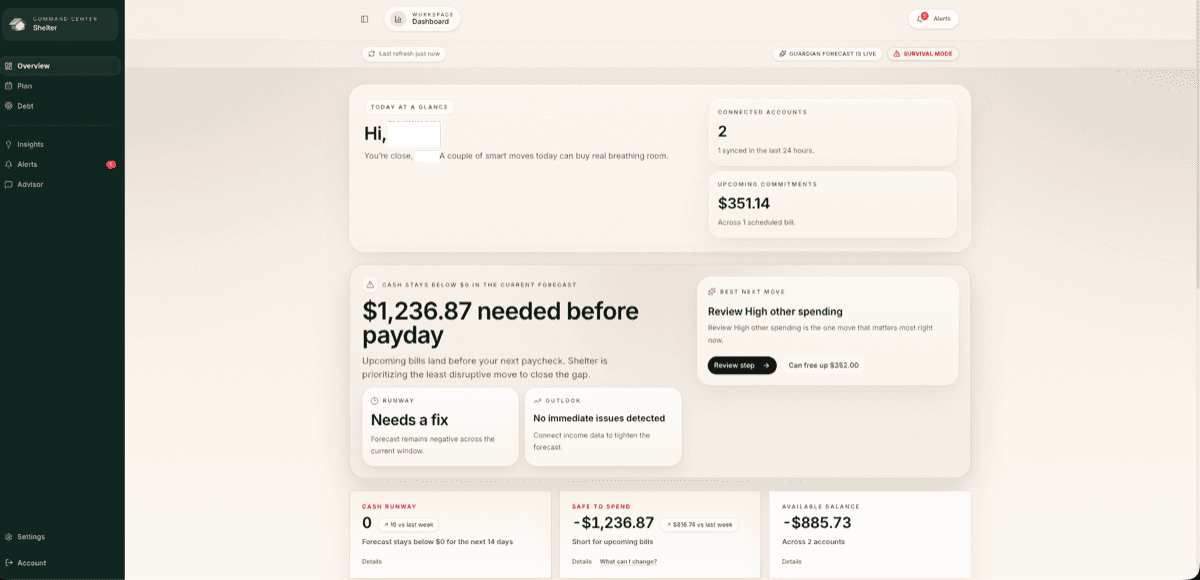
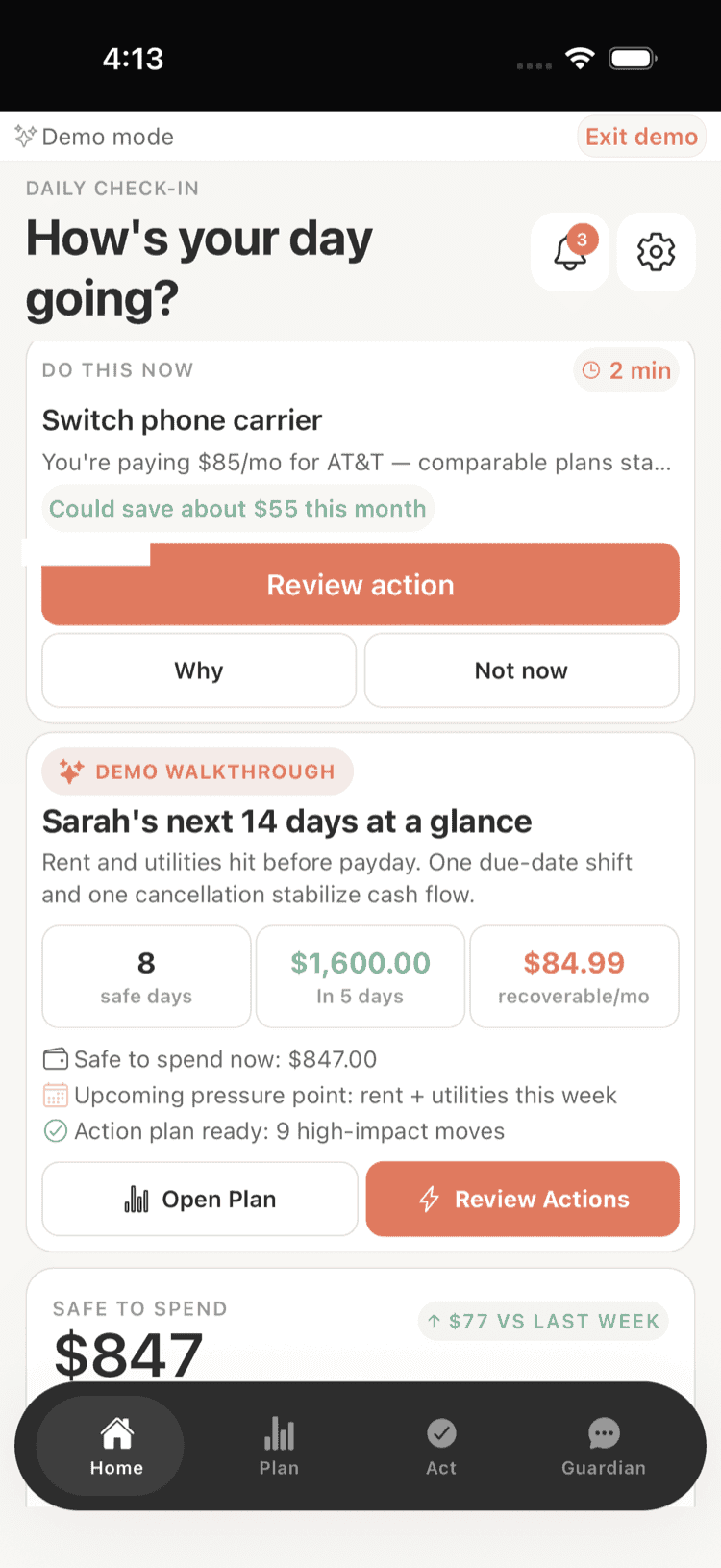
You can try Shelter's demo to see how connecting your bank accounts gives you a real-time view of all your balances, including savings. Seeing your emergency fund balance alongside your checking account and your cash flow forecast puts the whole picture in one place. You can see not just what you have saved, but how your day-to-day cash flow supports continued saving.
What Happens After $1,000
Once you have $1,000 in your emergency fund, something shifts psychologically. You have a cushion. You are no longer one flat tire away from a financial crisis. That security changes how you experience every financial decision.
From here, the next steps depend on your situation. If you have high-interest debt, many financial advisors recommend directing extra money toward paying it down, since the interest you are paying likely exceeds the interest you are earning on savings. If you are debt-free or carrying only low-interest debt, continue building toward one month of expenses, then two, then three.
But do not rush past the milestone. Having $1,000 saved when you started with nothing is a significant achievement. It means you built a habit, stuck with it, and created a financial buffer that most people do not have. The same discipline that got you to $1,000 will get you to $5,000 and beyond, one small transfer at a time.
For more practical strategies to keep your savings growing, read saving money tips that actually work.
Take control of your cash flow
Shelter connects to your bank, forecasts your balance 30 days out, and alerts you before problems happen.