Here is a scenario that plays out in millions of households every month. You earn enough to cover all your bills. The math works. But three major payments land on the 1st, two more hit on the 5th, and your paycheck does not deposit until the 7th. For those six days, your checking account is in freefall, and one unexpected charge could trigger an overdraft.
The problem is not how much money you make. The problem is timing. And the fix is surprisingly simple: a bill calendar.
What Is a Bill Calendar?
A bill calendar is exactly what it sounds like. It is a visual map of when every recurring bill is due, laid out alongside your pay dates. Nothing fancy. No special app required. The value is in seeing the overlap -- or lack of overlap -- between when money goes out and when it comes in.
Most people carry a vague mental model of their bills. Rent is due on the first. Car payment is around the middle of the month. Credit card is... sometime. That vague awareness is enough most months, until it is not. A bill calendar replaces guesswork with a clear picture.
Why Timing Matters More Than Amounts
Budgets focus on amounts. A bill calendar focuses on timing. Both matter, but timing is what actually causes the financial emergencies that knock people off track.
Consider two people who both earn $4,000 a month and spend $3,200 on bills and necessities. Person A has bills spread evenly across the month, with income arriving in two biweekly checks. Person B has 70% of their bills due in the first week of the month, with the same biweekly pay schedule.
Person A floats through the month without stress. Person B scrambles to make it through the first week, might overdraft, and then has excess cash sitting around for the last three weeks. Same income. Same expenses. Completely different experience.
A bill calendar makes Person B's problem visible and fixable.
How to Build Your Bill Calendar
Building a bill calendar takes about 30 minutes. Here is the process.
Step 1: List Every Recurring Bill
Go through your bank and credit card statements for the last three months. Write down every recurring charge, including the amount and the date it typically posts. Do not forget the ones that hit quarterly or annually -- insurance premiums, subscription renewals, annual memberships. Those surprise charges are often the ones that cause the most damage.
Your list should include things like:
- Rent or mortgage
- Car payment and insurance
- Utilities (electric, gas, water, internet, phone)
- Streaming services and subscriptions
- Gym membership
- Loan payments (student, personal)
- Credit card minimum payments
- Insurance premiums
- Any other automatic withdrawals
Step 2: Map Bills Against Pay Dates
Now take a calendar -- paper, digital, spreadsheet, whatever you prefer -- and mark your pay dates. If you are paid biweekly, mark every pay date for the next two months. If you are paid on the 1st and 15th, mark those.
Then add each bill to its due date. Color-code them if that helps: one color for bills, another for income.
Step 3: Identify the Gaps
Look at the calendar and find the clusters. Where do bills pile up? Are there stretches between a pay date and a bill cluster where your account will be at its lowest? Are there weeks where almost nothing is due and money just sits?
These gaps and clusters are the actionable insight. They show you exactly where the timing risk lives.
Step 4: Request Due Date Changes
Here is the part most people do not realize: you can change when many bills are due. Credit card companies, utilities, phone providers, and even some loan servicers will adjust your due date if you ask.
Call or go online and request a due date that aligns better with your pay schedule. If you get paid on the 1st and 15th, try to move half your bills to the first week and half to the third week. Spread the load so no single paycheck bears too much of the burden.
Not every biller will accommodate this, but enough will to make a meaningful difference. Rent is typically the hardest to move, so work around that fixed point and adjust everything else.
Step 5: Split Along Biweekly Lines
If you are paid biweekly, divide your bills into two groups, each roughly equal in total dollars. Assign each group to the paycheck that arrives closest to when those bills are due. This creates a rhythm: paycheck arrives, bills get paid from that paycheck, and the remainder is what you have for discretionary spending until the next check.
This approach eliminates the feast-and-famine cycle where one paycheck gets obliterated by bills and the other feels like a windfall.
A Sample Bill Calendar Layout
Here is what a simplified bill calendar might look like for someone paid on the 1st and 15th:
Paycheck 1 (1st of the month) covers:
- Rent: 1st ($1,200)
- Car insurance: 3rd ($140)
- Internet: 5th ($65)
- Streaming services: 5th-7th ($35)
Paycheck 2 (15th of the month) covers:
- Car payment: 15th ($350)
- Electric: 17th ($95)
- Phone: 18th ($85)
- Credit card: 20th ($200)
- Gym: 22nd ($40)
Each paycheck covers roughly the same total, and every bill falls within a few days of its funding source. No more scrambling at the start of the month.
Managing a Bill Calendar With Irregular Income
If you are a freelancer or gig worker without predictable pay dates, the bill calendar strategy needs a modification. Instead of mapping bills to specific paychecks, you need to think in terms of priority tiers.
Tier 1 bills are the ones with the most severe consequences for late payment: housing, car payment, insurance, loans. These get paid first, out of whatever money is currently available.
Tier 2 bills are important but have lighter penalties: utilities, phone, internet. These get paid next.
Tier 3 bills are subscriptions and discretionary recurring charges. These get paid last, and they are the first to be paused if cash is tight.
When income arrives, work through the tiers in order, paying whatever is due soonest within each tier. Over time, the goal is to build up a buffer that is large enough to cover Tier 1 bills even during a slow income week. The paycheck-to-paycheck cash flow plan gets into specific strategies for building that buffer with irregular income.
Pairing the Calendar With Cash Flow Forecasting
A bill calendar tells you when bills are due. Cash flow forecasting tells you what your balance will actually be on each of those dates. Together, they give you full visibility.
The calendar shows the schedule. The forecast shows whether the schedule is going to work. If your forecast shows your balance dipping to $12 the day before payday, you know you need to take action -- move money, delay a purchase, or tap your buffer.
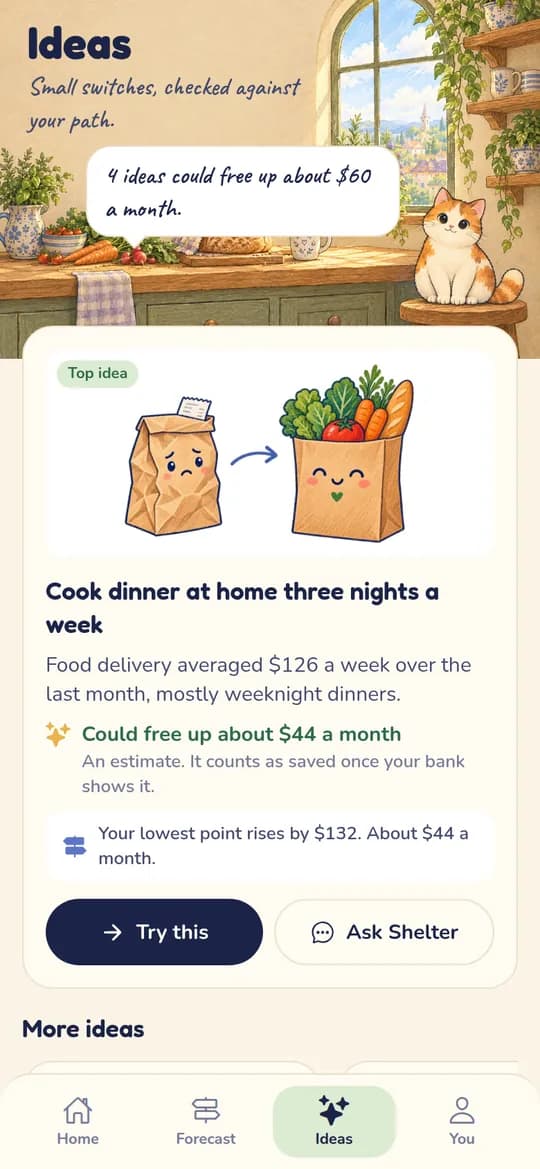
Shelter automates the forecasting side of this equation. It connects to your bank, identifies all your recurring payments, and projects your balance 30 days into the future. You can see exactly when each bill will hit and whether you will have enough to cover it. The bill calendar gives you the plan; the forecast tells you if the plan is going to hold. The bill tracker app page and best bill tracker app comparison are the best places to see how Shelter approaches this.
Maintaining Your Calendar
A bill calendar is not a one-time project. Review it once a month for about five minutes. Look for any new recurring charges that have appeared, any bills that have changed amounts, and any pay date shifts (holidays can move direct deposits).
Quarterly and annual charges deserve special attention. Set a reminder to check for these at the start of each quarter. The $200 annual software renewal or the $600 semi-annual insurance premium can wreck a week's budget if you are not expecting it.
The Bigger Picture
The bill calendar strategy is not about being obsessive with money. It is about removing the anxiety that comes from not knowing whether your bills and your income are going to line up this month. Once the calendar is set up and you have adjusted your due dates, the system runs itself.
You stop dreading the first of the month. You stop doing mental math in the grocery store aisle, trying to remember if your car payment already went through. You just know, because you designed a system that works with your pay schedule instead of against it.
That clarity is worth the 30 minutes it takes to set up. And for people who are serious about never missing a bill, the bill calendar is the foundation everything else builds on.

Take control of your cash flow
Shelter connects to your bank, forecasts your balance 30 days out, and alerts you before problems happen.