Late fees are not an accident. They are a business model. Banks, credit card companies, utilities, and landlords collectively earn more than $12 billion a year from late payment penalties in the United States alone. That is $12 billion transferred from people who were a day or two late to companies that designed the system to make lateness easy and forgiveness hard.
You do not have to keep contributing to that number. Late fees are almost entirely preventable, and the strategies to eliminate them are straightforward once you understand how the game works.
The Late Fee Industry by the Numbers
The scale of late fee revenue is staggering when you break it down.
Credit card late fees are the biggest category. Before recent regulatory changes, the average credit card late fee was $32, and issuers collected roughly $14.5 billion a year. New CFPB rules have capped most late fees at $8 for large issuers, but many companies are fighting the regulation in court, and smaller issuers remain exempt. The actual fee you pay depends on your specific card agreement.
Bank overdraft and insufficient funds fees add another layer. While technically different from late fees, they are often triggered by the same problem: a bill drafting from an account that does not have enough to cover it. The average overdraft fee is still around $26, and banks earned roughly $6 billion from them in recent years.
Rent late fees vary by lease but commonly run 5% to 10% of the monthly rent. On a $1,500 apartment, that is $75 to $150 for being a few days late. Some landlords charge a flat fee; others charge per day.
Utility late fees are usually smaller, in the $5 to $15 range, but they add up when you are paying them on electric, gas, water, and internet every month.
Add it all together and the average American household loses $150 to $300 per year to late fees. For lower-income households, the number is disproportionately higher because late fees hit hardest when cash is already tight.
Who Profits From Your Late Payments
It is worth understanding that late fees are not just penalties designed to encourage on-time payment. They are profit centers.
Credit card companies have historically earned a significant portion of their revenue from fees rather than interest. Late fees, in particular, have enormous margins because there is no cost of goods sold. When you pay a $35 late fee, nearly all of that is pure profit.
Banks have a similar relationship with overdraft fees. The cost to the bank when your account goes negative by $5 is essentially zero, but the fee they charge is $26 to $35. The return on that transaction is astronomical from the bank's perspective.
This is not a conspiracy. It is just business. But understanding the incentive structure helps explain why due dates, grace periods, and payment windows are designed the way they are. The system is optimized for revenue, not for your convenience.
Common Late Fee Traps
Late fees do not always come from forgetting to pay. Sometimes the system itself makes on-time payment harder than it needs to be.
Due dates that fall on weekends or holidays. If your bill is due on Saturday and you pay on Monday, some billers count that as late. Read your agreements to understand whether the posted due date or the next business day applies.
Processing time on payments. Paying online on the due date does not always mean the payment is credited that day. Some billers take 1 to 3 business days to process electronic payments. If you pay on the due date but it processes on the 3rd, you may be charged a late fee.
Minimum payment traps. For credit cards, paying less than the minimum counts as a missed payment, even if you sent money. If your minimum is $35 and you pay $30, you will likely be charged a late fee and may trigger a penalty APR.
Annual and quarterly bills. Monthly bills become habits. Annual or quarterly bills are easy to forget entirely. Your annual insurance renewal, domain registrations, professional memberships -- these are the charges that blindside people because they are not part of the monthly routine.
Autopay failures. Even autopay is not bulletproof. If your card on file expires, if you change bank accounts, or if the biller's system glitches, the automatic payment can fail silently. You do not find out until the late fee appears.
Six Strategies to Eliminate Late Fees
1. Set Up Autopay for Every Bill
This is the highest-impact, lowest-effort strategy. Enroll every recurring bill in autopay. For credit cards, set autopay to at least the minimum payment. For fixed bills like rent and car payments, set it to the full amount.
Yes, this requires having enough in your account when the payments draft. That is what the next strategies address. But autopay is the foundation because it removes the most common cause of late fees: simply forgetting.
2. Build a Bill Calendar
A bill calendar gives you a visual map of when every payment hits and how it aligns with your income. When you can see that four bills are due in the same three-day window, you can prepare for it instead of being surprised.
The calendar also makes it easy to spot the quarterly and annual charges that might otherwise sneak up on you. Block off 5 minutes at the start of each month to review the calendar and flag anything unusual coming up.
3. Know Your Grace Periods
Most billers have a grace period between the official due date and when a late fee is actually assessed. Credit cards typically give you 21 to 25 days after the statement closing date. Utilities often have a 5- to 10-day grace period. Some landlords have a 3- to 5-day grace window written into the lease.
Knowing your grace periods does not mean you should plan to pay late. But if you are a day or two past a due date and panicking, check whether you are still within the grace window before assuming a fee has been charged. This knowledge buys you breathing room in a pinch.
4. Call and Ask for Fee Reversals
This is the most underused strategy. When you are charged a late fee, pick up the phone and call the biller. Ask them to waive the fee. If you have a history of on-time payments and this is an occasional miss, most companies will reverse the charge.
Credit card companies are especially amenable to this. A polite call explaining that you set up autopay to prevent future occurrences goes a long way. Utility companies, internet providers, and even some landlords will waive fees as a courtesy, particularly for first-time offenses.
The key is to call promptly and be straightforward. "I missed the due date, I have set up autopay so it does not happen again, and I would appreciate it if you could waive the late fee." Success rates on these calls are surprisingly high -- some studies suggest 70% or more for first-time requests with major credit card issuers.
5. Maintain a Buffer Account
A small savings account holding $300 to $500 acts as a safety net for timing mismatches. When an autopay drafts before your paycheck lands, the buffer covers the gap. When an unexpected annual charge hits, the buffer absorbs the shock.
This is not an emergency fund. It is a timing fund. Its only job is to prevent the two-day gaps between bills and income that trigger overdrafts and late fees. Every dollar in that buffer has a massive return on investment when measured against the fees it prevents.
6. Get Cash Flow Visibility
The common thread in all late fee situations is a lack of visibility. You did not see the bill coming, did not realize your balance would be low, did not know that two automatic payments would draft on the same day.
Cash flow forecasting solves this by projecting your balance forward and showing you exactly when it will be at its lowest. When you can see a potential shortfall five days before it happens, you have time to prevent it.
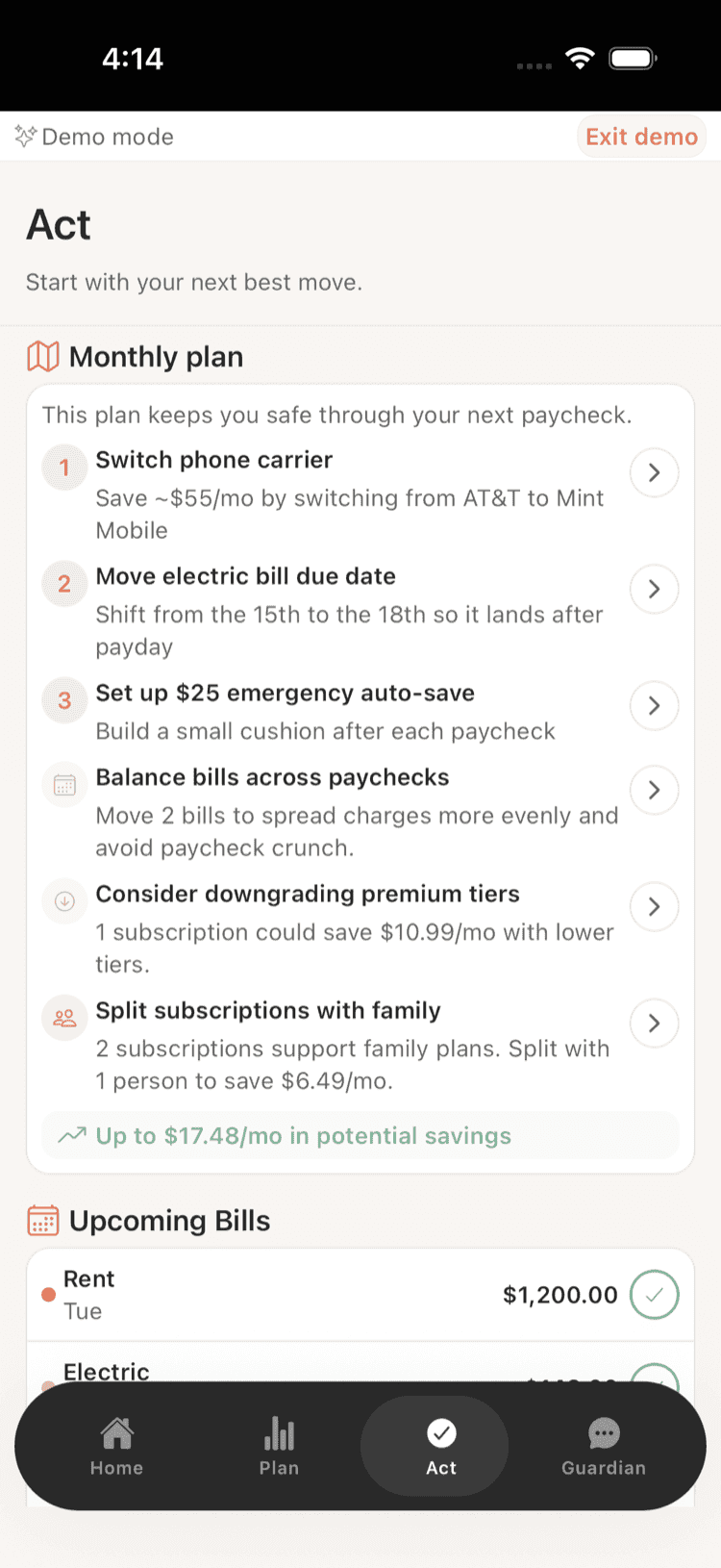
Shelter provides this visibility automatically. It connects to your bank, identifies all your recurring payments, and shows your projected balance for the next 30 days. When a bill is about to hit and your balance is going to be close, you see the warning in advance, not after the fee has already been charged. You can explore how this works on the features page.
What to Do If You Are Already Stuck in a Late Fee Cycle
If you are currently paying late fees every month because you are perpetually behind, the strategies above will help, but you may need to address the root cause first.
Sometimes the issue is that a past-due bill snowballed. You were late on one payment, the late fee ate into next month's budget, which made you late on another payment, and now you are running behind on everything. The way out is to pick the single smallest past-due bill, get it current, and then work your way up. Each bill you bring current removes one source of compounding fees.
If the issue is that your expenses genuinely exceed your income, late fees are a symptom rather than the disease. In that case, the first priority is reducing your monthly bills to create even a small margin. Canceling a few unused subscriptions or renegotiating a phone plan can free up enough to stop the late fee cycle.
Your Money, Not Theirs
Late fees persist because they are small enough that most people absorb them as a cost of life. A $25 fee here, a $35 fee there -- it barely registers against rent or a car payment. But $200 a year in late fees, invested instead at a reasonable return, would grow to over $6,000 in 20 years. That is real money, and it is leaving your account purely because of timing and forgetfulness.
The systems to prevent late fees are not complicated. Autopay, a bill calendar, a small buffer, and cash flow visibility. Set them up once, maintain them with minimal effort, and stop paying a fee that exists only because the system was designed to collect it.
You have better things to do with your money than hand it to a late fee department. And the companies charging those fees will be perfectly fine without your $35. Keep it. You earned it. They did not.
Take control of your cash flow
Shelter connects to your bank, forecasts your balance 30 days out, and alerts you before problems happen.