Every January, millions of people set financial resolutions. Save more. Spend less. Pay off debt. Build an emergency fund. The intentions are solid. The follow-through is not. By February, most financial resolutions have joined the gym memberships and journaling habits in the graveyard of good intentions.
The problem is not a lack of discipline. The problem is how the goals are structured. A vague resolution like "save more money" has no mechanism to sustain itself. It relies entirely on willpower, which is a depletable resource that runs out right around the time January's credit card bill arrives.
Goals that stick are built differently. They are specific, attached to systems, and designed to survive the inevitable moments when motivation dips.
Why Most Financial Resolutions Fail
Understanding the failure modes helps you avoid them.
They Are Too Vague
"Save more money" is not a goal. It is a wish. There is no number attached, no timeline, no way to measure progress, and no clear definition of success. When a goal is vague, your brain has no way to track whether you are making progress, so there is no sense of momentum and no satisfaction from improvement.
"Save $3,000 by December 31 by transferring $250 per month to a high-yield savings account" is a goal. It has a number, a deadline, a method, and 12 monthly checkpoints where you can see whether you are on track.
They Are Too Ambitious
"Pay off all my debt this year" sounds inspiring when you say it on January 1st while riding a wave of New Year's optimism. But if you have $22,000 in debt and earn $50,000, the math does not work unless you make extraordinary sacrifices that are unsustainable for 12 months.
Ambitious goals create early failure. When you miss the first monthly target, discouragement sets in. When you miss the second, you abandon the goal entirely. A modest goal that you actually achieve is infinitely more valuable than an ambitious one that makes you feel like a failure by March.
They Have No System
A goal without a system is a destination without a vehicle. "I want to save $5,000 this year" is the destination. "I have an automatic transfer of $420 moving from my checking account to my savings account on the 2nd of every month" is the vehicle.
Systems operate independently of motivation. They work when you are excited about your goals and they work when you are tired, stressed, and thinking about ordering takeout for the fifth time this week. The automatic transfer does not care how you feel. It just moves the money.
How to Set Financial Goals That Actually Work
The framework that works for financial goals has three components: specificity, a system, and accountability.
Make It Specific
Every financial goal should answer four questions:
- What exactly am I trying to achieve? A dollar amount, a debt balance, a savings target.
- By when? A specific date, not "someday" or "this year."
- How will I get there? The monthly or weekly action that moves you toward the goal.
- How will I know if I am on track? A checkpoint schedule -- monthly at minimum.
"Build a $2,000 emergency fund by June 30 by saving $340 per month" answers all four questions. There is nothing ambiguous about it.
Attach a System
For every goal, define the automatic behavior that makes progress inevitable.
If the goal is saving, set up an automatic transfer that runs the day after payday. The money moves before you have a chance to spend it. This is not a hack or a trick. It is acknowledging how human behavior works and designing around it.
If the goal is paying off debt, set up automatic payments above the minimum. Even an extra $50 per month above the minimum, automated so you do not have to think about it, makes meaningful progress over a year.
If the goal is reducing spending, automate the analysis. Use a tool that monitors your spending and alerts you when you are exceeding your targets, rather than relying on yourself to manually review your bank statements weekly. For more on automating your finances, the savings automation guide covers the full playbook.
Build In Accountability
Accountability can come from a partner, a friend, a financial app, or just a calendar reminder. The point is to create a regular touchpoint where you confront your progress honestly.
A monthly money check-in -- even just 15 minutes looking at your accounts and comparing reality to plan -- prevents the slow drift that kills goals. Without check-ins, three months can pass without you realizing you have been off track the entire time.
Five Goals Worth Setting
Not all financial goals are equally impactful. Here are five that make a real difference, listed in roughly the order they should be tackled.
Goal 1: Build a Specific Emergency Fund
Do not just "build an emergency fund." Pick a number. For most people, $1,000 is a transformative first milestone. It is enough to cover most single emergency expenses -- a car repair, a medical copay, a broken appliance -- without resorting to credit cards.
The system: Automatic monthly transfer of [total divided by months until deadline]. If your goal is $1,000 in six months, that is $167 per month.
Why it matters: An emergency fund is the single most important financial buffer you can have. It prevents the downward spiral where one unexpected expense turns into months of credit card debt. The emergency fund guide covers how to right-size yours.
Goal 2: Pay Off One Specific Debt
Do not try to pay off all your debt at once. Pick one debt -- ideally either the smallest balance (for motivational momentum) or the highest interest rate (for mathematical efficiency) -- and focus on it.
The system: Automatic payment above the minimum, targeted at that specific debt. Use the debt payoff strategy to choose your approach and calculate the monthly amount.
Why it matters: Eliminating a single debt completely is more psychologically powerful than partially reducing five debts. The freed-up minimum payment can then roll into the next debt, creating momentum.
Goal 3: Save a Specific Percentage of Income
Rather than saving a dollar amount, commit to a percentage. Start with whatever is realistic -- even 5% -- and plan to increase it by 1% each quarter. If you earn $4,000 per month after taxes, 5% is $200. By the fourth quarter, 8% is $320. By the end of the year, you have saved over $3,000 and built the habit of saving at a rate that felt manageable the entire time.
The system: Automatic transfer of the target percentage, adjusted quarterly.
Why it matters: Percentage-based saving scales with your income and creates a habit that persists even when your financial situation changes.
Goal 4: Conduct Quarterly Money Check-Ins
Set four dates on your calendar -- one per quarter -- for a 30-minute financial review. During each check-in, answer three questions:
- Am I on track for my annual financial goals?
- Has anything changed in my income, expenses, or life situation that requires adjusting my plan?
- Are there any subscriptions, services, or expenses I should cancel or renegotiate?
The system: Calendar events with reminders. Block the time. Treat it like a doctor's appointment -- non-negotiable.
Why it matters: Quarterly check-ins catch drift before it becomes a crisis. A goal that is slightly off track in March can be corrected in April. A goal that is wildly off track by December cannot.
Goal 5: Automate One More Thing
Look at your financial life and find one thing you are currently doing manually that could be automated. Maybe it is a bill you pay manually each month that could be on autopay. Maybe it is a savings transfer you do sporadically that could be automatic. Maybe it is a retirement contribution you have been meaning to increase.
The system: Spend 15 minutes setting up the automation. Then it runs forever.
Why it matters: Every manual financial task is a point of failure. Automating it removes the possibility of forgetting and frees up mental bandwidth for the decisions that actually require your attention. The compounding effect of automating one thing per year means that after a few years, your finances run themselves.
The Monthly Check-In Framework
If you set one or more of these goals, a simple monthly check-in keeps you on track. Here is a five-minute framework:
- Check your progress numbers. How much have you saved? How much debt have you paid off? Compare to your target.
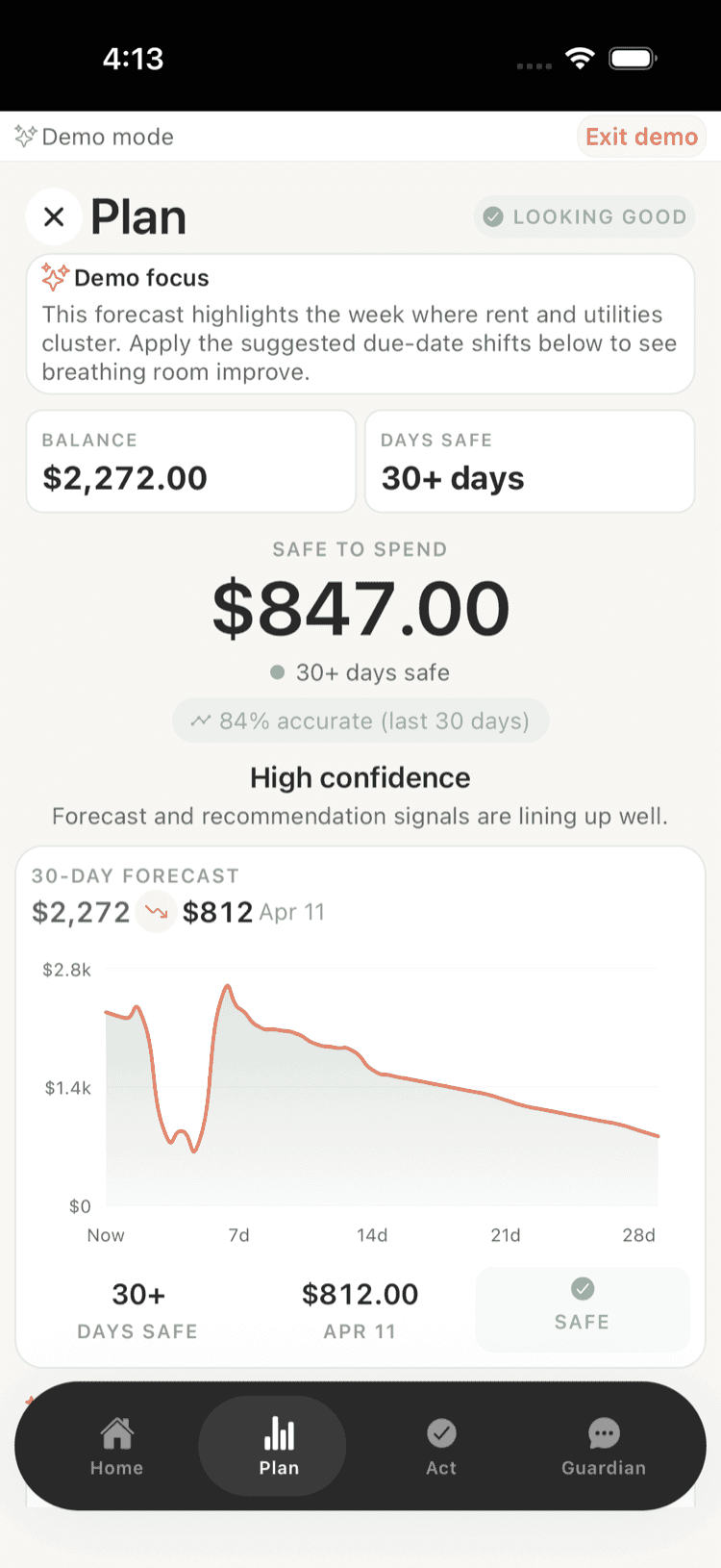
- Review your cash flow. Are your spending patterns consistent with your goals? Any unexpected expenses coming up? Shelter makes this step easy by showing your projected balance over the next 30 days, so you can see whether your plan is holding.
- Adjust if needed. If you are ahead of schedule, celebrate (quietly). If you are behind, diagnose why and make one small adjustment. Do not overhaul the plan. Tweak it.
- Confirm automations are running. Make sure your automatic transfers and payments are still active. Check for failed payments or expired cards.
This takes five to ten minutes. It is not a deep financial review. It is a pulse check. The quarterly check-ins are where you do the deeper analysis.
Systems Beat Willpower Every Time
The difference between people who keep their financial resolutions and people who do not is rarely about discipline or income. It is about systems. The people who succeed set up automatic transfers, automatic payments, and regular check-ins. The people who fail rely on remembering to save, choosing to make extra payments, and planning to review their accounts.
Your January self is motivated and optimistic. Your March self is tired and has other things to worry about. Build your goals for your March self, not your January self. Make the right behavior automatic, make progress visible, and make the check-ins short enough that you actually do them.
That is how you set financial goals you will actually keep. Not through willpower. Through design. For more on building financial habits that last, the financial wellness guide covers the broader picture of what sustainable financial health looks like. And if you want a tool that keeps your progress visible without requiring manual tracking, the features page shows how Shelter makes cash flow and spending patterns clear at a glance.
Take control of your cash flow
Shelter connects to your bank, forecasts your balance 30 days out, and alerts you before problems happen.