The average American spends over $900 on holiday gifts, food, decorations, and travel. For many families, the number is closer to $1,500 once you add in everything -- the office gift exchange, the teacher presents, the neighborhood party, the shipping costs, the wrapping paper you buy at the last minute because you forgot you used all of last year's.
And here is the part that hurts: roughly a third of holiday shoppers are still paying off last year's holiday spending when the current season starts. The cycle repeats because the approach repeats. Most people wing it, spend more than they intended, cover the difference with credit cards, and then spend the first quarter of the next year digging out.
A spending plan breaks this cycle. Not by making the holidays less enjoyable, but by making January less miserable.
Why "Winging It" Fails Every Year
There is a specific reason holiday spending spirals without a plan, and it is not a lack of willpower.
Holiday spending is death by a thousand cuts. No single purchase feels excessive. The $40 candle for your sister-in-law seems reasonable. The $25 bottle of wine for the holiday party is fine. The $15 Secret Santa gift is nothing. But those "nothing" purchases happen dozens of times over six weeks, and the total is shocking when you finally look at your credit card statement in January.
The other problem is scope creep. You start with a mental list of five people to buy for, and by mid-December you have added coworkers, neighbors, your mail carrier, your kid's sports coach, and three people you forgot about until they handed you a gift. Every addition is small, but the cumulative impact is significant.
Without a written plan with specific numbers, there is no mechanism to say "I have spent enough." The spending continues until the season is over, and the total is whatever it happens to be.
Creating a Holiday Spending Plan
A holiday spending plan does not need to be complicated. It needs to exist on paper (or a screen), have specific numbers, and be referenced as you spend. Here is how to build one.
Step 1: Set a Total Budget
Before you think about individual gifts, decide on a total number. How much can you spend on the holidays without going into debt or raiding your emergency fund?
Look at your financial picture for November and December. What are your expected expenses beyond holiday spending? What is your income? What is the maximum you can allocate to holiday spending without creating a cash flow problem in January?
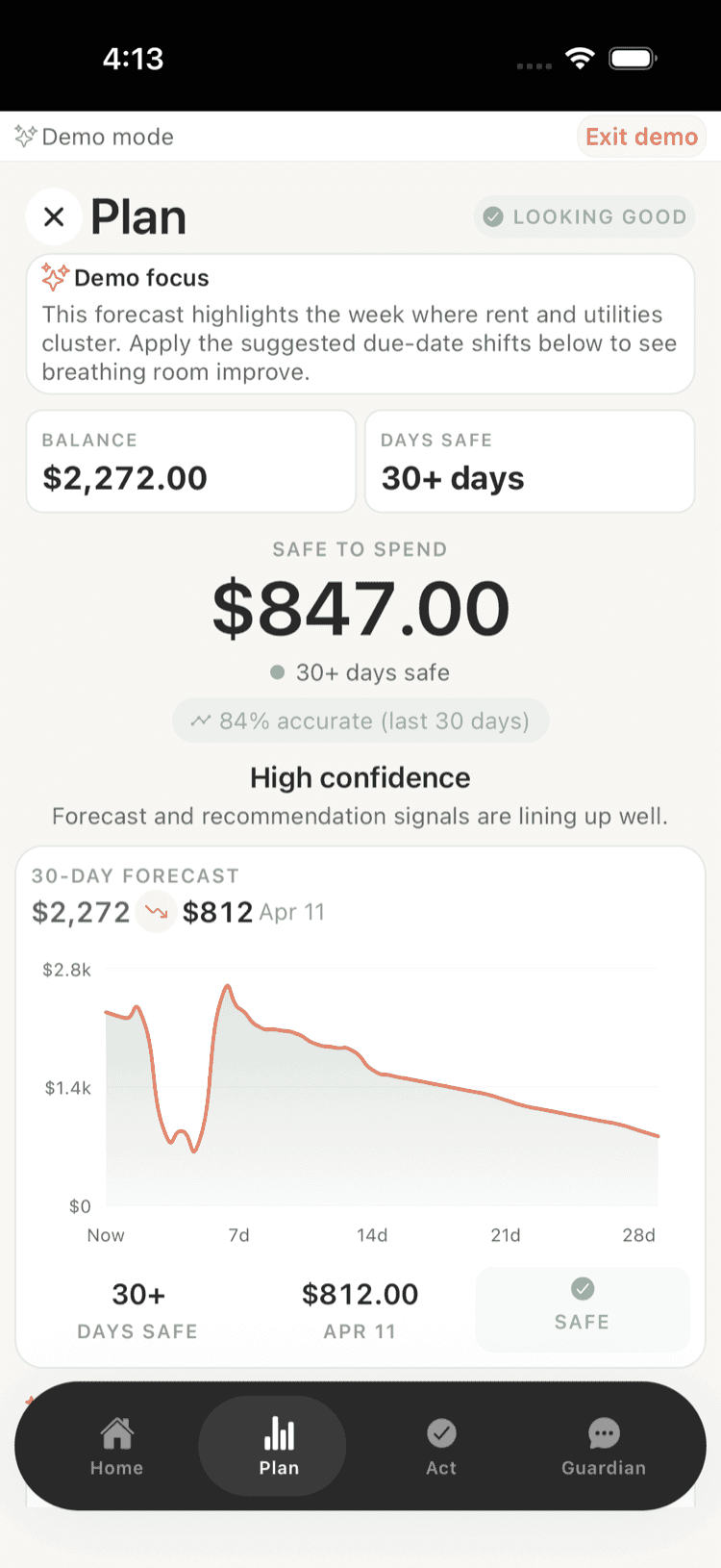
If you are not sure what your cash flow looks like over the coming weeks, this is exactly the kind of question a cash flow forecast answers. Seeing your projected balance through January -- including all your regular bills, the holiday spending, and any other year-end expenses -- tells you exactly how much room you have.
Be honest with yourself. A $500 budget that you actually stick to is infinitely better than a $1,200 budget that you blow past and then cover with credit cards.
Step 2: List Everyone
Write down every person you plan to buy a gift for. Then add every holiday expense category you can think of:
- Gift recipients (family, friends, coworkers, kids' friends, teachers)
- Holiday meals and entertaining
- Decorations
- Travel (gas, flights, hotels)
- Holiday outfits
- Charitable donations
- Shipping and wrapping
- The random expenses you always forget
This list is usually longer than people expect, which is exactly why writing it down matters.
Step 3: Set Per-Person and Per-Category Limits
Divide your total budget across the list. Be specific. "$50 for Mom, $50 for Dad, $30 for each sibling, $15 for each coworker" is a plan. "I'll probably spend about the same as last year" is not.
For non-gift categories, estimate based on past years. If you hosted Thanksgiving last year and spent $180 on food, plan for a similar amount this year. If you are flying home for the holidays, look up airfare now and build it into the plan.
When the per-person amounts do not add up to your total budget, adjust. This is the negotiation phase. Maybe some people get a smaller gift this year. Maybe you suggest a family gift exchange instead of buying for every sibling and their kids individually. Maybe you skip the expensive decorations and reuse what you have.
Step 4: Track as You Go
A plan only works if you reference it. As you make purchases, record them against the plan. A simple note on your phone works. A spreadsheet works. The method does not matter. What matters is that you can see at any point during the season how much you have spent versus how much you planned.
When you are standing in a store trying to decide whether to buy the $60 version or the $35 version of a gift, checking your plan gives you the answer. If you are under budget, get the nicer one. If you are at your limit, get the practical one. Without the plan, the $60 version always wins because there is no constraint.
The Sinking Fund Approach
The most effective way to fund holiday spending is to not fund it from November and December income at all. Instead, save for it throughout the year using a sinking fund.
Here is how it works. Take your expected holiday budget -- say $900 -- and divide it by 12. That is $75 per month. Set up an automatic transfer of $75 per month into a dedicated savings account starting in January. By November, you have $825 saved (you probably start spending in November, not December, so ten months of saving is a reasonable estimate). The holiday money is there, already saved, separate from your regular accounts.
This approach has several advantages. It removes the December cash crunch entirely. It means holiday spending does not compete with your regular bills for the same pool of money. And it changes the psychology of holiday shopping from "how am I going to pay for this?" to "I already have the money set aside."
If you missed the chance to save all year, start now for next year. Even saving $50 a month for 10 months gives you $500 before next holiday season. It will not cover everything, but it will dramatically reduce the January credit card bill.
The Cash-Only Challenge
If credit card debt from holiday spending is a recurring problem, consider a cash-only approach. Withdraw your total gift budget in cash and use it exclusively for holiday purchases.
Cash creates a physical constraint that credit cards do not. When the cash is gone, you are done. There is no "I'll just put this one thing on the card" rationalization. The limit is tangible and real.
This is admittedly less convenient than swiping a card. You miss out on credit card rewards points. And some purchases (especially online) require a card. But if the alternative is $1,200 in credit card debt that you pay interest on for the next six months, the inconvenience is worth it.
A hybrid approach works too: use cash for in-store shopping and a prepaid debit card loaded with a specific amount for online purchases.
Meaningful Alternatives to Expensive Gifts
The pressure to spend comes partly from social expectations, but those expectations are often more imagined than real. Most people do not measure the quality of a holiday by the price tags on the gifts.
Some alternatives that genuinely resonate:
Experiences over things. Concert tickets, a cooking class, a day trip, a movie night with homemade popcorn. Experiences tend to be remembered longer and valued more than physical gifts of equivalent cost.
Homemade gifts. A batch of cookies, a photo book, a handwritten letter, a coupon book for babysitting or lawn care. These are not "cheap" alternatives. They are personal ones that show thought rather than spending.
Charitable gifts. Donate to a cause in someone's name. This works especially well for the people on your list who already have everything they need.
Group gift exchanges. Instead of buying individual gifts for every family member, suggest a Secret Santa or White Elephant exchange. Everyone buys one gift, everyone gets one gift, and the total cost drops by 80%.
Reduced expectations with honest communication. A simple "Hey, let's keep gifts small this year -- under $25" message to family and friends is almost always met with relief, not disappointment. Most people feel the same pressure you do and are grateful when someone gives permission to scale back.
Avoiding the January Hangover
The goal of a holiday spending plan is not just to survive December. It is to start January in a strong position instead of a hole.
If you follow the plan, January looks like any other month. No unexpected credit card bills. No emergency fund depletion. No "I cannot believe I spent that much" regret. Just a regular month where your cash flow is predictable and your accounts are where you expected them to be.
Shelter can help you see this clearly by projecting your cash flow through the holiday season and into January. When you can see that your plan keeps your balance healthy through both the spending period and the recovery period, you shop with confidence instead of anxiety. You can explore this on the demo.
The holidays should be about the people, not about the financial stress of paying for it. A spending plan is what makes that possible. Build it once, reference it as you shop, and enjoy a January that does not start with regret.
Take control of your cash flow
Shelter connects to your bank, forecasts your balance 30 days out, and alerts you before problems happen.