The average federal tax refund in the United States is around $3,100. For many households, that is the single largest lump sum they receive all year. What happens to that money in the first 48 hours after it hits your account often determines whether it makes a lasting difference or evaporates into a vague memory of "I think I bought some stuff."
Tax refund season is a genuine financial opportunity. Not because the money is free -- it is not; it is money you overpaid to the government throughout the year -- but because a lump sum is uniquely useful. It can accomplish things that are nearly impossible to do with regular paychecks, like wiping out a stubborn debt balance or kickstarting a savings cushion.
Here is how to make the most of it.
The Temptation to Splurge
There is nothing inherently wrong with spending your refund on something you want. The problem is when the entire refund disappears into a weekend of retail therapy and you have nothing to show for it a month later.
The psychology of a lump sum works against you. Your checking account suddenly has an extra $3,000 in it, and everything feels affordable. That jacket you have been eyeing. The upgraded phone. A weekend trip. Each individual purchase feels reasonable against the backdrop of a windfall. But lump sums deplete fast when there is no plan, and the regret that follows is worse than the pleasure of the purchases.
The solution is not to deny yourself entirely. It is to have a plan before the money arrives.
Smart Refund Strategy 1: Shore Up Your Emergency Fund
If you do not have at least $1,000 in an emergency fund, this is the single best use of any portion of your refund. An emergency fund is what stands between you and credit card debt the next time your car breaks down or you get an unexpected medical bill.
The ideal emergency fund covers three to six months of essential expenses. That is a big number, and you do not have to hit it all at once. But if your emergency fund is currently at zero, using $1,000 of your refund to start one is a decision that will pay dividends for the rest of the year.
Put it in a high-yield savings account where it is accessible but not sitting in your checking account where it will get spent. If you want a deeper guide on getting this set up, the emergency fund guide covers the full strategy.
Smart Refund Strategy 2: Attack High-Interest Debt
If you are carrying credit card debt, your tax refund is one of the most efficient weapons against it. Credit card interest rates are brutal -- 20% to 29% for most cards. Every dollar of credit card debt you pay off saves you that interest rate in future charges.
A $3,000 refund applied to a credit card balance at 24% APR saves you roughly $720 in interest over the next year, assuming you do not add new charges. That is a guaranteed 24% return on your money. No investment can match that.
If you have multiple debts, the math says to pay off the highest interest rate first. The psychology says to pay off the smallest balance first for the motivational boost of eliminating a debt entirely. Either approach works. The important thing is that the money goes toward debt rather than generating more interest for the credit card company. The debt payoff guide walks through both approaches in detail.
Smart Refund Strategy 3: Fund Your Sinking Funds
Sinking funds are savings accounts earmarked for predictable future expenses: holiday gifts, car repairs, annual insurance premiums, back-to-school shopping. They prevent these expenses from becoming emergencies.
Your tax refund is a perfect opportunity to pre-fund the sinking funds for the rest of the year. If you know you will spend $800 on holiday gifts, $500 on car maintenance, and $400 on back-to-school expenses, that is $1,700 in future spending you can set aside now. When those expenses arrive later in the year, the money is already there. No scrambling. No credit card debt.
This strategy is especially valuable because it smooths out the financial bumps that cause the most stress. The predictable expenses that people fail to plan for are often more damaging to monthly cash flow than the truly unexpected ones.
Smart Refund Strategy 4: Invest for the Future
If your emergency fund is solid and you do not have high-interest debt, investing your refund is the move with the highest long-term payoff.
Options include:
Max out your IRA contribution. The annual contribution limit for an IRA is $7,000 (or $8,000 if you are 50 or older). If you have not maxed out this year's contribution, your refund can get you closer. The tax advantages of an IRA -- either the upfront deduction of a traditional IRA or the tax-free growth of a Roth IRA -- amplify the value of every dollar you contribute.
Contribute to a taxable brokerage account. If your retirement accounts are already funded, a simple index fund in a taxable brokerage account is a straightforward way to put money to work. Low-cost index funds tracking the total stock market have historically averaged around 10% annual returns over the long term.
Fund a 529 plan. If you have children and want to save for their education, 529 contributions grow tax-free when used for qualified education expenses. Some states also offer a state income tax deduction for contributions.
The common thread is putting the money somewhere that grows, rather than somewhere it gets spent.
Smart Refund Strategy 5: The Split Approach
For most people, the best strategy is not picking a single option. It is splitting the refund across multiple priorities.
Here is an example allocation for a $3,000 refund:
- $500 for something you actually want (guilt-free)
- $1,000 to the emergency fund
- $1,000 toward credit card debt
- $500 to sinking funds for upcoming expenses
This approach satisfies the immediate desire to enjoy the money, addresses the most urgent financial needs, and invests in future stability. You get to treat yourself without blowing the whole thing, and you make meaningful progress on the financial goals that matter most.
Adjust the percentages to fit your situation. If you have no debt, shift that allocation to investing. If your emergency fund is already healthy, put more toward sinking funds or investments. The principle is the same: plan the allocation before the money arrives, and give yourself permission to spend a portion without guilt.
Adjusting Your Withholding
Here is an unpopular but mathematically correct opinion: getting a large tax refund is not a good thing.
A refund means you gave the government an interest-free loan all year. That $3,100 average refund translates to roughly $258 per month that was withheld from your paychecks above what you actually owed. If that money had stayed in your paycheck instead, you would have had an extra $258 a month to put toward savings, debt, or investments throughout the year.
The counterargument is that many people would not save the extra $258 per month and would instead spend it. For them, the forced savings of overwithholding is a net positive, even though it is technically inefficient. This is a fair point. If you know you would spend the extra cash, the refund might actually work better for you as a forced lump sum.
But if you have the discipline to redirect the money automatically -- say, into a savings account or investment -- adjusting your W-4 to reduce your withholding and increase your take-home pay is the smarter financial move. You keep control of your money all year instead of waiting for the government to return it.
You can use the IRS Withholding Estimator to figure out the right amount, or talk to your payroll department about adjusting your W-4.
Tax Planning for Next Year
While you are thinking about taxes, spend 30 minutes on next year's tax position:
Maximize tax-advantaged accounts. If you are not maxing out your 401(k) match, that is literally free money you are leaving on the table. Increase your contribution to at least the employer match.
Track deductible expenses. If you are near the threshold where itemizing makes sense, start a system for tracking charitable donations, medical expenses, and other deductible items now. A folder in your email or a note on your phone is enough.
Review your withholding. As mentioned above, get your withholding close to what you will actually owe. This gives you more money throughout the year and avoids the annual cycle of overpaying and then waiting for a refund.
Set up a tax sinking fund. If you are self-employed or have income that does not have taxes withheld, set aside 25% to 30% of that income in a dedicated savings account for quarterly estimated tax payments. This prevents the April surprise of owing thousands you did not plan for.
Make the Refund Count
Your tax refund is not a bonus. It is not a gift. It is your money, returned to you after you overpaid throughout the year. Treating it as a windfall leads to windfall behavior -- splurge and forget. Treating it as a strategic tool leads to real financial progress.
Pick your allocation before the deposit hits. Automate as much as possible. And give yourself a reasonable portion to enjoy without guilt. That combination of discipline and self-compassion is what makes a refund strategy that actually works.
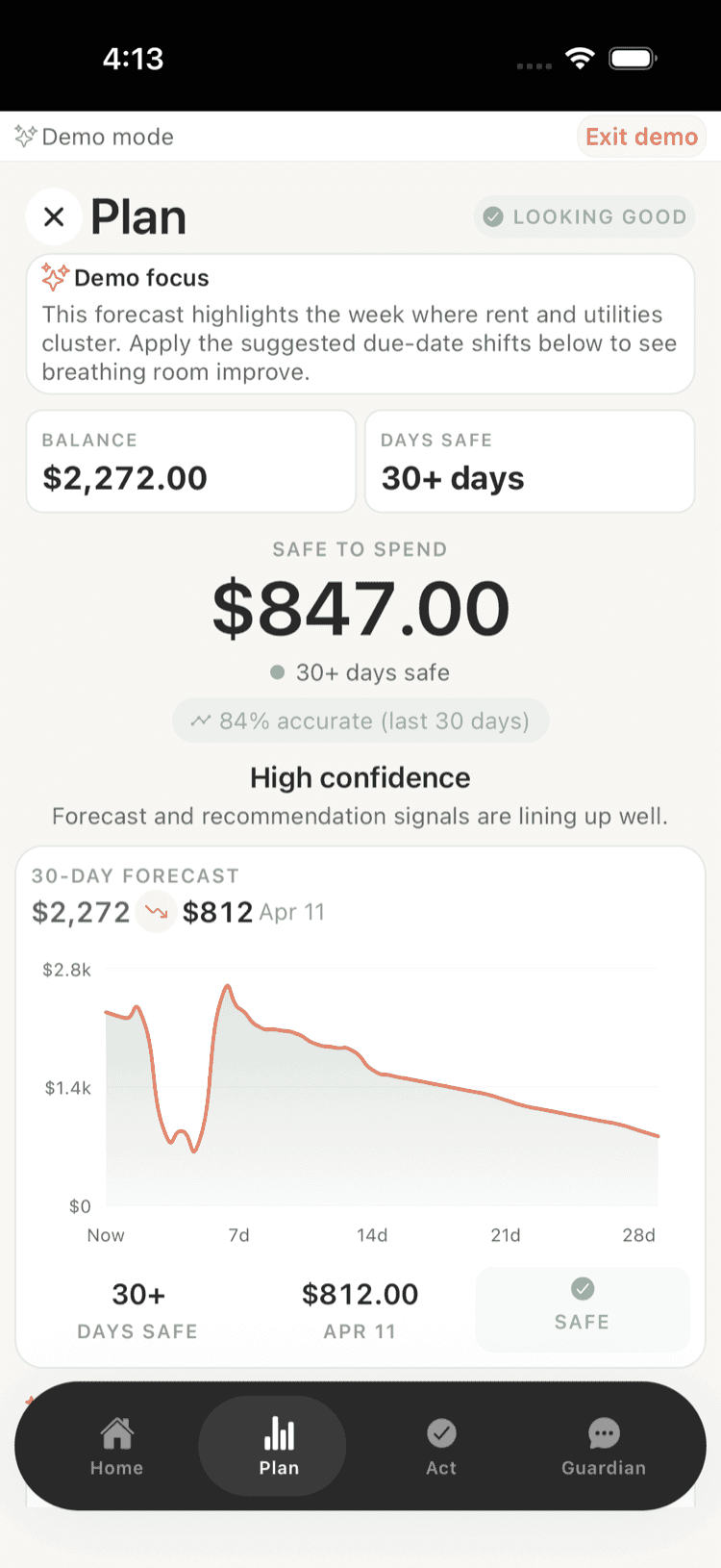
If you want help seeing how a lump sum payment affects your overall cash flow picture, Shelter can show you how your projected balance changes when you move money toward debt, savings, or investments. It is a useful way to pressure-test your allocation plan against your real financial obligations over the coming weeks. Check out the features page to learn more about how cash flow forecasting works.
Take control of your cash flow
Shelter connects to your bank, forecasts your balance 30 days out, and alerts you before problems happen.