Credit card debt is one of those things that starts small and grows quietly. You put a few unexpected expenses on the card, make the minimum payments, and one day you look at the statement and realize you are paying more in interest each month than you are putting toward the actual balance.
If that sounds familiar, you are not alone. The average American household with credit card debt carries about $7,000 in balances. But here is the thing: credit card debt is solvable. It does not require a windfall or a dramatic lifestyle change. It requires a clear plan and the patience to follow it.
Here is how to build that plan, step by step.
Step 1: Face the Full Picture
Before you can fix the problem, you need to know exactly what you are dealing with. Pull up every credit card statement and write down four things for each card:
- Current balance
- Interest rate (APR)
- Minimum monthly payment
- Due date
This is not the fun part, but it is the most important part. A lot of people avoid looking at their total debt because the number feels overwhelming. But a number you can see is a number you can plan around. A number you are avoiding just keeps growing.
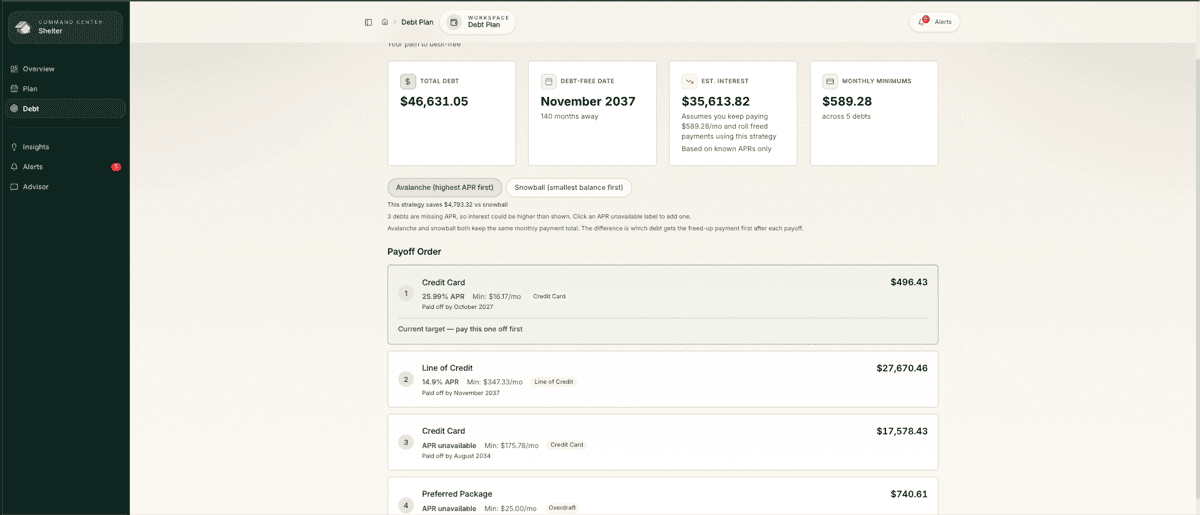
If you want to skip the manual spreadsheet, you can connect your accounts through Shelter's demo to see all your balances in one place. The point is to get everything visible in one view.
Step 2: Stop the Bleeding
This sounds obvious, but it matters: stop adding new charges to the cards you are trying to pay off. If you keep charging while you are paying down, you are running on a treadmill.
This does not mean cutting up every card or canceling accounts (closing old cards can hurt your credit score). It means shifting your daily spending to a debit card or cash while you work through the payoff plan. If you need a credit card for specific recurring bills, pick one card and route everything else through your bank account.
Step 3: Choose Your Payoff Method
You have two main options, and both work:
The avalanche method targets the card with the highest interest rate first. You pay minimums on all other cards and throw every extra dollar at the most expensive one. This saves the most money on interest over time.
The snowball method targets the card with the smallest balance first. You knock out quick wins to build momentum, then roll those freed-up payments into the next card.
We go deep on the pros and cons of each approach in debt snowball vs. avalanche. The short version: if you are analytical and patient, go avalanche. If you need quick wins to stay motivated, go snowball. Either way, pick one and commit.
Step 4: Find Extra Money in Your Budget
The minimum payment on a credit card is designed to keep you in debt for as long as possible. A $5,000 balance at 20% APR with a $100 minimum payment takes over 9 years to pay off, and you will pay more than $4,000 in interest alone.
Every extra dollar you can throw at your debt shortens that timeline dramatically. Here is where to look:
Cancel subscriptions you have forgotten about. Most people have at least one or two recurring charges they do not use anymore. That $15/month streaming service and the $10/month app subscription add up to $300/year you could redirect to your credit card. See our guide on zombie subscriptions for how to find the ones hiding in your statements.
Redirect windfalls. Tax refunds, bonuses, birthday money, rebates. It is tempting to treat these as "fun money," but a $1,500 tax refund thrown at a credit card balance saves you hundreds in future interest charges. That is a better return than almost any investment.
Negotiate bills. Call your internet provider, your insurance company, and your cell phone carrier. Ask if there is a lower rate or a promotion you qualify for. Fifteen minutes on the phone can free up $30 to $50 per month.
Sell things you do not need. Go through your closet, garage, or storage unit. Most people have a few hundred dollars worth of stuff they forgot they owned.
Step 5: Consider a Balance Transfer
If you have decent credit (usually 670 or above), a balance transfer card can give you 12 to 21 months at 0% APR. This means every dollar you pay goes directly toward the principal instead of interest.
A few things to watch for:
- Transfer fees are typically 3% to 5% of the balance. On $5,000, that is $150 to $250. Still worth it if you are currently paying 20%+ APR, but factor it in.
- The promotional period ends. If you do not pay off the full transferred balance before the 0% period expires, the remaining balance starts accruing interest at the card's regular rate, which is often 20% or higher.
- Do not use the new card for purchases. Many balance transfer cards apply the 0% rate only to the transferred balance, not new charges.
Balance transfers work best when you have a realistic plan to pay off the balance within the promotional window. If you are transferring $5,000 and the promotional period is 15 months, you need to pay about $335 per month to clear it.
Step 6: Call Your Credit Card Company
This one surprises people, but it works more often than you would think. Call your credit card issuer and ask for a lower interest rate. If you have been a customer for a while and have a reasonable payment history, they may drop your rate by a few percentage points.
A script that works: "I have been a customer for X years and I would like to request a lower interest rate on my account. I have been making my payments on time and I am working on paying down my balance."
The worst they can say is no. If they say yes, even a 2% to 3% reduction saves you real money over the life of your payoff plan.
Step 7: Automate Your Payments
Once you have your plan, automate it. Set up automatic payments for the minimum on every card, plus an automatic extra payment on whichever card you are targeting first. This removes willpower from the equation.
The biggest enemy of a debt payoff plan is not math. It is the moment when you are tired, it is Friday, and you think "I will just pay extra next month." Automation takes that decision off your plate.
Step 8: Track Your Progress
Paying off debt is a long game, and you need to be able to see that it is working. Check your balances weekly. Watch the numbers go down. Notice when you cross a milestone, like getting a balance below $3,000 for the first time, or paying off an entire card.
Shelter shows your cash flow 30 days out, which makes it easier to see how your debt payments fit into the bigger picture. When you can see that you will have $400 left over after bills next week, deciding to send $300 to your credit card feels a lot less scary than guessing.
For a look at how cash flow forecasting works in practice, check out cash flow forecasting explained.
Step 9: Handle Setbacks Without Spiraling
Your car will break down. A medical bill will show up. Something will go wrong that tempts you to put charges back on the card you are trying to pay off.
When this happens, do not throw out the whole plan. Adjust. Maybe you pay only the minimums for one month while you deal with the emergency. Maybe you slow down your extra payments for a few weeks. That is fine. The important thing is to keep the plan alive and get back to it as soon as you can.
A setback is not failure. Quitting is failure.
The Timeline Is Shorter Than You Think
Here is something that might surprise you: most people with $5,000 to $10,000 in credit card debt can be debt-free in 18 to 36 months with a focused plan. That sounds like a long time right now, but those months are going to pass regardless. You can arrive at month 36 with the same debt, more debt, or no debt. The plan is what makes the difference.
Start by getting honest about your numbers. Pick a method. Find some extra dollars. And start.
Take control of your cash flow
Shelter connects to your bank, forecasts your balance 30 days out, and alerts you before problems happen.