Student loan debt has a way of following you around like background noise. You graduated, you got a job, and now a chunk of your paycheck disappears every month toward a balance that barely seems to move. If that is your situation, you are dealing with the same thing roughly 43 million other Americans are navigating.
The good news is that student loans come with more repayment options than almost any other type of debt. The challenge is that having too many options can feel just as paralyzing as having none. Let us walk through what actually works and how to figure out the right path for your specific situation.
Understanding Your Federal Repayment Options
If you have federal student loans, you have access to several repayment plans. Each one treats your payments differently, and the right one depends on your income, your balance, and how quickly you want to be done.
Standard Repayment Plan
This is the default. Fixed monthly payments over 10 years. It is the fastest way to pay off your loans and costs the least in total interest, but the monthly payments are the highest. If you can comfortably afford the standard payment, this is the most straightforward option.
Graduated Repayment Plan
Payments start low and increase every two years over a 10-year period. The idea is that your income will grow over time. This works well if you are early in your career and expect significant raises, but you will pay more total interest than the standard plan because you are paying less toward the principal in the early years.
Income-Driven Repayment Plans
These plans cap your monthly payment at a percentage of your discretionary income. There are several versions:
- SAVE (Saving on a Valuable Education): Payments are 5% of discretionary income for undergraduate loans, 10% for graduate loans. Interest that your payment does not cover is not added to your balance. Remaining balance is forgiven after 20 or 25 years.
- PAYE (Pay As You Earn): Payments are 10% of discretionary income. Forgiveness after 20 years.
- IBR (Income-Based Repayment): Payments are 10% to 15% of discretionary income depending on when you borrowed. Forgiveness after 20 or 25 years.
- ICR (Income-Contingent Repayment): Payments are 20% of discretionary income or the amount you would pay on a fixed 12-year plan, whichever is less. Forgiveness after 25 years.
The income-driven plans are most useful when your student loan balance is high relative to your income. If you owe $80,000 but earn $45,000, the standard 10-year payment might eat 20% or more of your gross income. An income-driven plan brings that down to something manageable.
The tradeoff is time and total cost. You will be making payments for 20 to 25 years, and even with forgiveness at the end, you will likely pay more in total interest than you would on the standard plan, assuming you could have afforded it.
The Refinancing Question
Refinancing means taking out a new private loan to replace your existing student loans, ideally at a lower interest rate. This can save you a lot of money if your credit score and income have improved since you originally borrowed.
When Refinancing Makes Sense
- Your federal loans have interest rates above 6% to 7% and you can qualify for 4% to 5% with a private lender
- You have a stable income and do not expect to need income-driven repayment or forgiveness programs
- You are not pursuing Public Service Loan Forgiveness (PSLF)
- You have a solid emergency fund, since private loans have far fewer hardship protections
When Refinancing Is Risky
- You might need income-driven repayment in the future (refinancing federal loans into private loans permanently removes this option)
- You work in the public sector and could qualify for PSLF after 10 years of payments
- You do not have a stable income or emergency savings to fall back on
This is an irreversible decision for federal loans. Once you refinance into a private loan, there is no going back to federal protections. Make sure you are confident before you sign.
Accelerated Payoff Strategies
If you want to be done with your loans faster than the standard timeline, here are the approaches that move the needle:
Make Extra Payments Toward Principal
Even small extra payments add up. An extra $100 per month on a $30,000 loan at 5.5% cuts roughly 3 years off your repayment and saves about $3,500 in interest. The key is to specify that extra payments should go toward principal, not toward next month's payment. Most loan servicers apply extra payments to future payments by default, which does not help you.
Biweekly Payments
Instead of one monthly payment, split it in half and pay every two weeks. Since there are 26 biweekly periods in a year, you end up making the equivalent of 13 monthly payments instead of 12. That one extra payment per year can shave a year or more off your loan.
Target One Loan at a Time
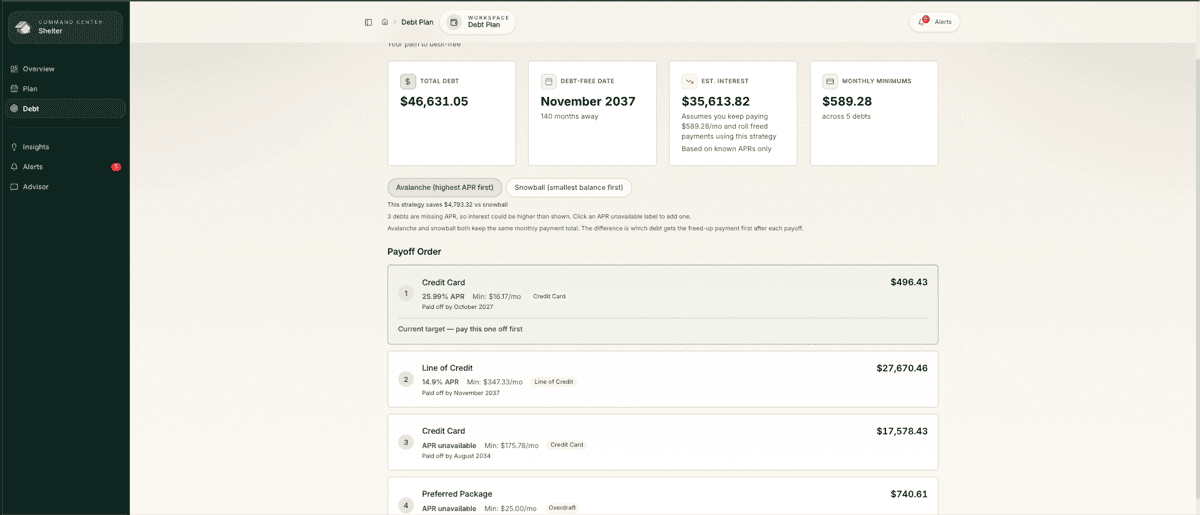
If you have multiple student loans, paying the minimums on all of them and directing extra money toward one specific loan gets results faster than spreading extra payments across all of them. This is the same logic behind the debt payoff plan approach: concentrate your firepower for maximum impact.
Forgiveness Programs Worth Knowing About
Public Service Loan Forgiveness (PSLF)
If you work full-time for a qualifying employer (government agencies, nonprofits, certain other organizations) and make 120 qualifying payments under an income-driven plan, your remaining balance is forgiven tax-free. That is 10 years of payments.
PSLF has a complicated history, but the program is better administered now than it was a few years ago. If you work in public service, it is worth investigating. Make sure you submit your Employment Certification Form annually so there are no surprises at the end.
Income-Driven Repayment Forgiveness
After 20 or 25 years of payments on an income-driven plan, your remaining balance is forgiven. Unlike PSLF, this forgiveness has historically been treated as taxable income, though recent legislation has changed the tax treatment through 2025. Check current tax rules before relying on this as part of your strategy.
How to Decide Your Path
There is no universal right answer here. Your best strategy depends on the intersection of several factors:
If your balance is low relative to your income (say, you owe $25,000 and earn $60,000), the standard plan or an accelerated payoff strategy makes the most sense. You can be debt-free in under 10 years and pay the least total interest.
If your balance is high relative to your income (you owe $100,000 and earn $50,000), income-driven repayment gives you breathing room. Pair it with PSLF if you qualify, or plan for the 20 to 25 year forgiveness timeline.
If your interest rates are high and your credit is good, refinancing can save thousands. Just make sure you are not giving up forgiveness options that would have saved you more.
If you are juggling student loans alongside other debt, the priority question gets more nuanced. Credit card debt at 22% APR should almost always be tackled before making extra payments on a 5% student loan. Understanding how all your debts interact with your monthly cash flow is critical. Tools like Shelter that forecast your cash flow 30 days out can help you see exactly how much room you have for extra payments without putting yourself in a bind.
For a broader look at how to predict and plan around your income and expenses, check out how to predict your bank balance.
Managing Student Loans Alongside Everything Else
The biggest mistake people make with student loans is treating them in isolation. Your student loan strategy needs to fit inside your overall financial picture. That means considering:
- Emergency fund: Having three to six months of expenses saved prevents you from taking on new debt when something unexpected happens. If you do not have this yet, building it is arguably more important than making extra loan payments.
- Retirement contributions: If your employer matches retirement contributions, contribute enough to get the full match before making extra loan payments. That match is a guaranteed 50% to 100% return, which beats any loan interest rate.
- Other high-interest debt: Pay off credit cards and other high-interest debt before accelerating student loan payments. The math is clear on this one.
Once those basics are covered, every extra dollar that goes toward your student loans is a smart move. And with Shelter's cash flow forecasting, you can see exactly where those extra dollars will come from each month without having to guess.
The Long View
Student loan repayment is a marathon, not a sprint. Whichever strategy you choose, the most important thing is to have a plan, revisit it periodically, and adjust as your life changes. A raise, a job change, a move to a lower cost-of-living area -- all of these create opportunities to accelerate your payoff or restructure your approach.
The debt will end. The question is whether you get there with a plan or by just grinding through minimum payments for decades. Choose the plan.
Take control of your cash flow
Shelter connects to your bank, forecasts your balance 30 days out, and alerts you before problems happen.