TL;DR
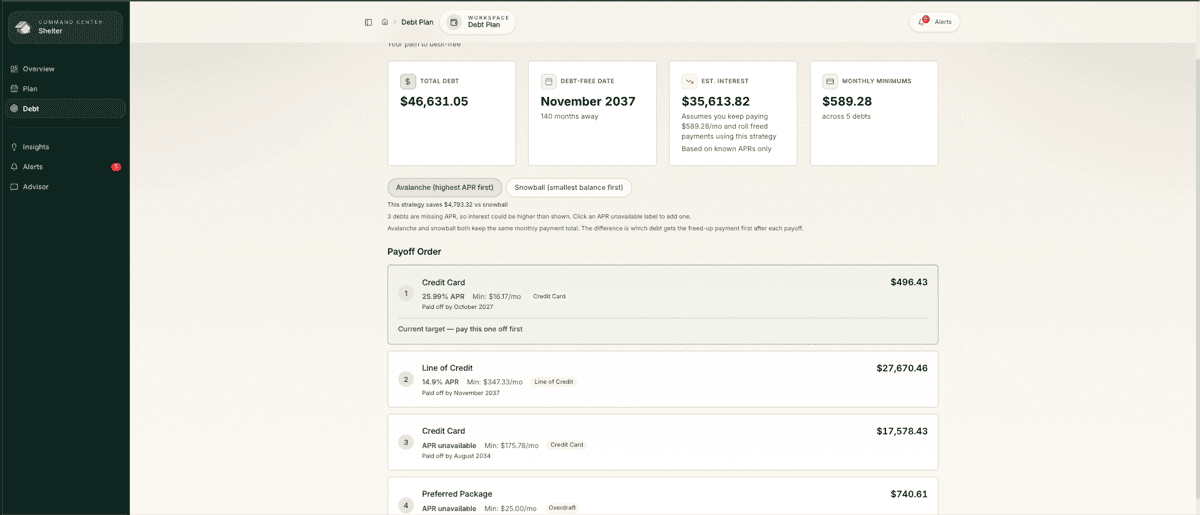
The debt avalanche (highest interest first) saves more money. The debt snowball (smallest balance first) keeps more people motivated to finish. Research shows snowball users are more likely to eliminate all debt because quick wins sustain momentum. A hybrid — one quick win then switch to avalanche — often works best.
If you have ever Googled "best way to pay off debt," you have probably run into the snowball vs. avalanche debate. Both methods have devoted followings, and both can get you to debt-free. But they work in fundamentally different ways, and the right choice depends less on math and more on how your brain handles money.
Let us break down each method, run actual numbers, and figure out which one fits the way you actually live.
How the Debt Snowball Works
The debt snowball method, popularized by Dave Ramsey, is dead simple: list your debts from smallest balance to largest balance, ignore interest rates entirely, and throw every extra dollar at the smallest debt first. Once that one is gone, you roll its payment into the next smallest debt. Repeat until you are debt-free.
The idea is momentum. Paying off that first small balance gives you a quick win. That psychological boost keeps you going when the larger debts feel overwhelming.
Here is how it looks in practice. Say you have three debts:
- Credit card A: $800 balance, 22% APR, $25 minimum
- Credit card B: $3,500 balance, 18% APR, $70 minimum
- Car loan: $8,000 balance, 6% APR, $200 minimum
With the snowball, you attack credit card A first. You pay the minimums on everything else and put every spare dollar toward that $800 balance. Once it is gone (probably in a few months), you take that freed-up payment and add it to the $70 minimum on credit card B. When credit card B is done, all of that combined payment goes toward the car loan.
How the Debt Avalanche Works
The avalanche method takes the opposite approach: list your debts from highest interest rate to lowest, and attack the most expensive debt first. You still pay minimums on everything, but your extra payments go toward the debt that is costing you the most in interest each month.
Using the same example, the avalanche would target credit card A first (22% APR), then credit card B (18% APR), then the car loan (6% APR). In this specific case, the order happens to match the snowball order, but that is not always true.
Let us change the example to show where the methods diverge:
- Medical bill: $1,200 balance, 0% APR, $50 minimum
- Credit card: $4,000 balance, 24% APR, $80 minimum
- Personal loan: $6,500 balance, 11% APR, $150 minimum
The snowball says: pay off the medical bill first, then the credit card, then the personal loan.
The avalanche says: attack the credit card first (24% APR), then the personal loan (11% APR), then the medical bill last (0% APR).
Running the Numbers
Let us use that second example and assume you have an extra $300 per month to put toward debt, on top of all your minimums. Total monthly debt payment: $580.
With the avalanche method:
- Total interest paid: approximately $1,740
- Debt-free in: about 23 months
With the snowball method:
- Total interest paid: approximately $2,180
- Debt-free in: about 24 months
The avalanche saves you roughly $440 and gets you out a month sooner. That is real money. But the snowball gives you a win in month three when that medical bill disappears, while the avalanche has you grinding away at a $4,000 credit card balance for over a year before you eliminate your first debt entirely.
The gap between the two methods varies wildly depending on your specific debts. When your balances and interest rates are close together, the difference is negligible. When you have a huge low-interest debt alongside small high-interest debts, the avalanche can save thousands.
The Psychology Factor
Here is where things get interesting. A 2016 study published in the Journal of Consumer Research found that people who focused on paying off small accounts first were more likely to eliminate their overall debt. Not because the math was better, but because the early wins kept them engaged.
Debt payoff is not a two-week project. It takes months or years, and the biggest risk is not choosing the wrong method. It is quitting halfway through. If you have ever started a budget and abandoned it by March, you already know this feeling.
The snowball works because it gives your brain something to celebrate. Zeroing out an account feels tangible. You can close the account, delete the app, and feel lighter. That feeling compounds.
The avalanche works because every dollar you throw at high-interest debt stops the bleeding faster. You might not get the quick win, but you also are not watching your money evaporate into interest charges.
The Hybrid Approach
You do not have to pick one or the other. Many people find that a hybrid method works best:
Start with one quick win, then switch to avalanche. If you have a small debt you can knock out in a month or two, pay that off first for the confidence boost. Then reorganize the rest by interest rate and go avalanche from there.
Group similar debts. If you have three credit cards all between 19% and 22% APR, the interest rate difference barely matters. Pay them off smallest to largest within that group, then move to the next interest rate tier.
Revisit every few months. As you pay down balances, the interest charges shift. What made sense six months ago might not be optimal now. A tool like Shelter can help you track how your balances and cash flow are changing in real time, so you are not making decisions based on outdated mental math.
Which One Should You Choose?
Ask yourself three honest questions:
How much debt do you have? If your total debt is under $5,000, the math difference between snowball and avalanche is probably under $200. Pick whichever one keeps you motivated. If you are dealing with $30,000 or more, the avalanche could save you thousands, and that is worth the slower emotional payoff.
How do you handle long projects? If you are the kind of person who finishes what they start regardless of how it feels, the avalanche is your friend. If you need visible progress to stay on track, the snowball was designed for you.
How varied are your interest rates? If all your debts are in a similar interest rate range, it barely matters. If you have a mix of 0% medical bills and 25% credit cards, the avalanche has a clear mathematical advantage.
For a deeper dive into the nuts and bolts of actually executing your chosen strategy, check out how to make a debt payoff plan that sticks with you through the finish line.
What Really Matters
Both the snowball and the avalanche will get you out of debt. Neither is wrong. The one that fails is the one you abandon in month four because it did not fit the way you think about money.
If you are carrying credit card debt specifically, our guide to paying off credit card debt walks through the full playbook, including balance transfer strategies and how to find extra cash in your budget.
The most powerful thing you can do right now is just pick a method and start. Use Shelter to connect your accounts and see exactly where your money is going each month. When you can see your cash flow clearly, choosing where to direct extra payments stops being a guessing game.
Snowball vs. Avalanche: Side-by-Side Comparison
| Factor | Debt Snowball | Debt Avalanche |
|---|---|---|
| Order | Smallest balance first | Highest interest rate first |
| Math advantage | Slightly worse | Saves more on interest |
| Psychological advantage | Quick wins, momentum | Knowing you are optimizing |
| Best for | People who need motivation | People who stick to plans |
| Risk | Paying more interest | Quitting before first payoff |
| Popularized by | Dave Ramsey | Math-first finance community |
Whatever you choose, the math is on your side. Every extra dollar you put toward debt today is a dollar that stops generating interest charges tomorrow. Snowball or avalanche, the best strategy is the one you actually follow through on.
Take control of your cash flow
Shelter connects to your bank, forecasts your balance 30 days out, and alerts you before problems happen.