Financial wellness is one of those phrases that sounds like it was invented by a bank's marketing department. But underneath the buzzword is a genuinely useful idea: your relationship with money is not just about how much you have. It is about how you feel about what you have. It is about whether money is a source of constant stress or something you feel reasonably in control of.
Here is the truth that most personal finance content skips over: you do not need to be wealthy to have financial wellness. You do not need to be debt-free, own a home, or have a six-figure retirement account. Financial wellness is about feeling confident that you can cover your needs, handle small surprises, and make progress -- however slowly -- toward the things that matter to you.
That is a much more accessible goal than "get rich." And it starts with small steps.
What Financial Wellness Actually Means
Researchers at the Consumer Financial Protection Bureau define financial well-being along four dimensions:
- Control over day-to-day finances. You can pay your bills. You know what is coming in and going out. You are not constantly scrambling.
- Capacity to absorb a financial shock. If your car needs a $400 repair, it is stressful but not catastrophic.
- On track to meet financial goals. You are making some progress toward the things you want, even if it is slow.
- Freedom to make choices that let you enjoy life. You can occasionally say yes to something that is not strictly necessary without guilt spiraling.
Notice that none of these require a specific income level or net worth. A person earning $45,000 with a clear picture of their finances and a small emergency fund can have better financial wellness than someone earning $150,000 who is living paycheck to paycheck on a lifestyle they cannot sustain.
8 Small Steps That Make a Real Difference
1. Check Your Balance Every Day
This is the simplest, most powerful financial wellness habit. Just look at your bank balance once a day. Not to analyze. Not to judge. Just to see the number.
Daily balance checking does two things. First, it eliminates the anxiety of not knowing. The actual number, whatever it is, is almost always less stressful than the vague fear of what it might be. Second, it creates a passive awareness of your spending patterns. You start to notice things: that your balance drops sharply on Mondays, that it stays flatter when you pack lunch, that subscriptions are nibbling away at it throughout the month.
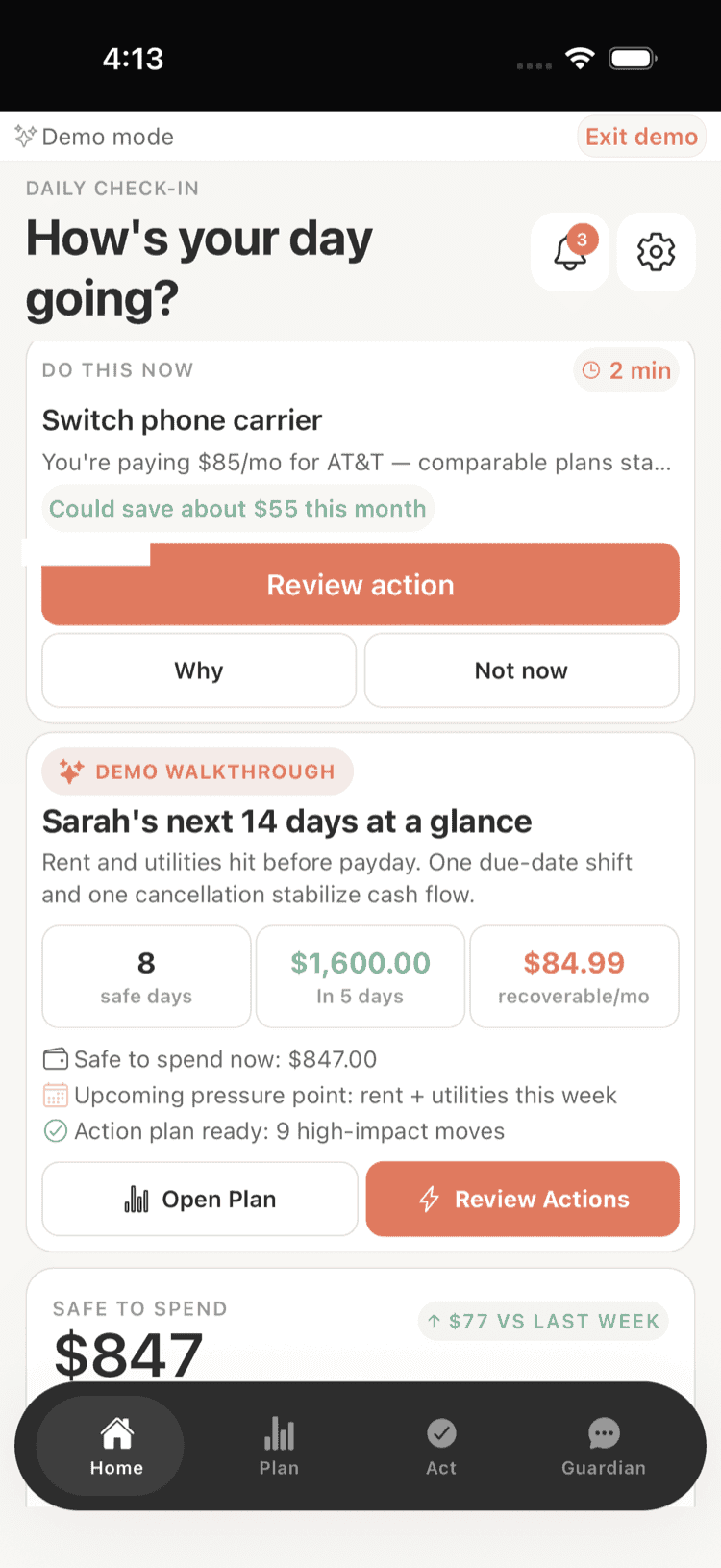
Shelter makes this even easier by not just showing your current balance but projecting it forward. You see today's number and tomorrow's number and next week's number, all based on your real transaction patterns. That forward view turns daily checking from a rearview mirror into a windshield.
2. Automate One Bill
If you are paying any of your recurring bills manually -- logging into a website each month, writing a check, remembering to transfer money -- pick one and automate it. Just one. The cognitive load of remembering bill due dates is a constant low-grade stressor that most people underestimate.
Start with the bill that causes the most anxiety, usually the one with the harshest late fees. Set up autopay and remove it from your mental to-do list. Next month, automate another one. Over time, your entire bill-paying process runs itself.
For more on this approach, read about how to automate your savings, which applies the same principle to building wealth instead of just paying bills.
3. Set Up One Savings Transfer
Open a savings account if you do not have one, and set up an automatic transfer for an amount so small it feels almost pointless. Five dollars a week. Ten dollars per paycheck. Whatever amount makes you think "that is nothing" is the right amount.
The goal is not to build a fortune. The goal is to establish the habit and the identity of someone who saves. Once the automation is running and you do not miss the money, you can increase it. But start with an amount that requires zero willpower and zero lifestyle change.
4. Review Your Subscriptions
The average American spends over $200 per month on subscriptions, and most people underestimate their total by 50% or more. Subscriptions are uniquely dangerous to financial wellness because they are invisible. You set them up once and then forget they exist, even as they quietly drain your account month after month.
Take 15 minutes to look through your bank statements for recurring charges. Cancel anything you have not used in the last 30 days. You can always re-subscribe later if you miss it. Most people never do. For a deeper dive into this process, the guide on how to do a subscription audit walks through it step by step.
5. Know Your "Safe Days"
Here is a concept that budgets do not give you: safe days. A safe day is a day when your balance is high enough, relative to your upcoming expenses, that spending a little extra will not cause problems downstream.
Most people either spend freely and hope for the best, or restrict themselves constantly and feel deprived. Neither approach is sustainable. Knowing your safe days lets you spend with confidence on days when the math works, and pull back on days when it does not.
This requires forward visibility -- knowing not just what your balance is today, but what it needs to be tomorrow, next Thursday, and next Friday when three bills hit. The features page shows how Shelter maps this out automatically, highlighting the days when your balance is comfortably above your upcoming obligations.
6. Create a One-Month Plan
Not a budget. A plan. The difference is that a budget tells you what categories to limit. A plan tells you what is going to happen.
Write down every expected expense for the next 30 days: rent, utilities, subscriptions, groceries, gas, that birthday gift you need to buy. Write down every expected income. Subtract one from the other. That is your plan.
A one-month plan is manageable enough to be accurate and short enough to actually follow. You are not committing to a year of discipline. You are just mapping the next four weeks. If you want a more detailed approach, read about how to stop money anxiety, which covers building a plan as one of seven strategies for reducing financial stress.
7. Talk to Someone About Money
Money is isolating. Most people do not talk about it, so everyone assumes they are the only one struggling. They are not.
Find one person you trust and have an honest conversation about money. It does not have to be about numbers. It can be about feelings: "I am stressed about money lately" is a perfectly good starting point. You will almost certainly find that they have their own worries, and the shared honesty creates a kind of relief that no app or spreadsheet can provide.
If you do not have someone in your life for that conversation, online communities focused on personal finance can fill the gap. Look for ones that emphasize support over showing off.
8. Forgive Past Mistakes
This one is less practical and more important than all the others. Everyone has made financial decisions they regret. The credit card you ran up in your twenties. The car loan with the terrible interest rate. The savings you raided for something that turned out not to matter.
Those decisions are done. They happened in a context -- a different life stage, different knowledge, different pressures. Carrying guilt about past financial decisions is like carrying a backpack full of rocks on a hike. It does not help you move forward. It just makes every step harder.
Forgiveness here is not about pretending the mistakes did not happen. It is about accepting that they happened, noting what you learned, and choosing to focus your energy on what you can control going forward.
The Compound Effect of Small Steps
None of these steps, individually, will transform your finances. Checking your balance will not pay off your debt. Canceling a streaming service will not fund your retirement. Automating a $10 transfer will not build an emergency fund overnight.
But small steps compound. Not just financially -- psychologically. Each small action reinforces the identity of someone who is paying attention to their money, who is making choices rather than drifting, who is building control one decision at a time.
After a week of checking your balance daily, you feel less anxious. After a month of automated savings, you feel proud. After canceling subscriptions you were not using, you feel lighter. After knowing your safe days, you feel confident spending on the days when you can.
That accumulation of small positive experiences is what financial wellness actually feels like. Not perfection. Not wealth. Just a steady, growing sense that you are pointed in the right direction.
Getting Started Today
Pick one step from the list above. Not the one that seems most impactful -- the one that seems easiest. Do that one thing today. Tomorrow, consider doing it again or adding a second step.
Financial wellness is not a destination you arrive at. It is a set of habits you build, and every habit starts with a single, almost-too-easy first step.
Shelter exists to make several of these steps easier -- daily balance visibility, forward forecasting, subscription detection -- but the most important tool is your own attention. Turn it toward your money, gently and consistently, and the wellness follows.
Take control of your cash flow
Shelter connects to your bank, forecasts your balance 30 days out, and alerts you before problems happen.