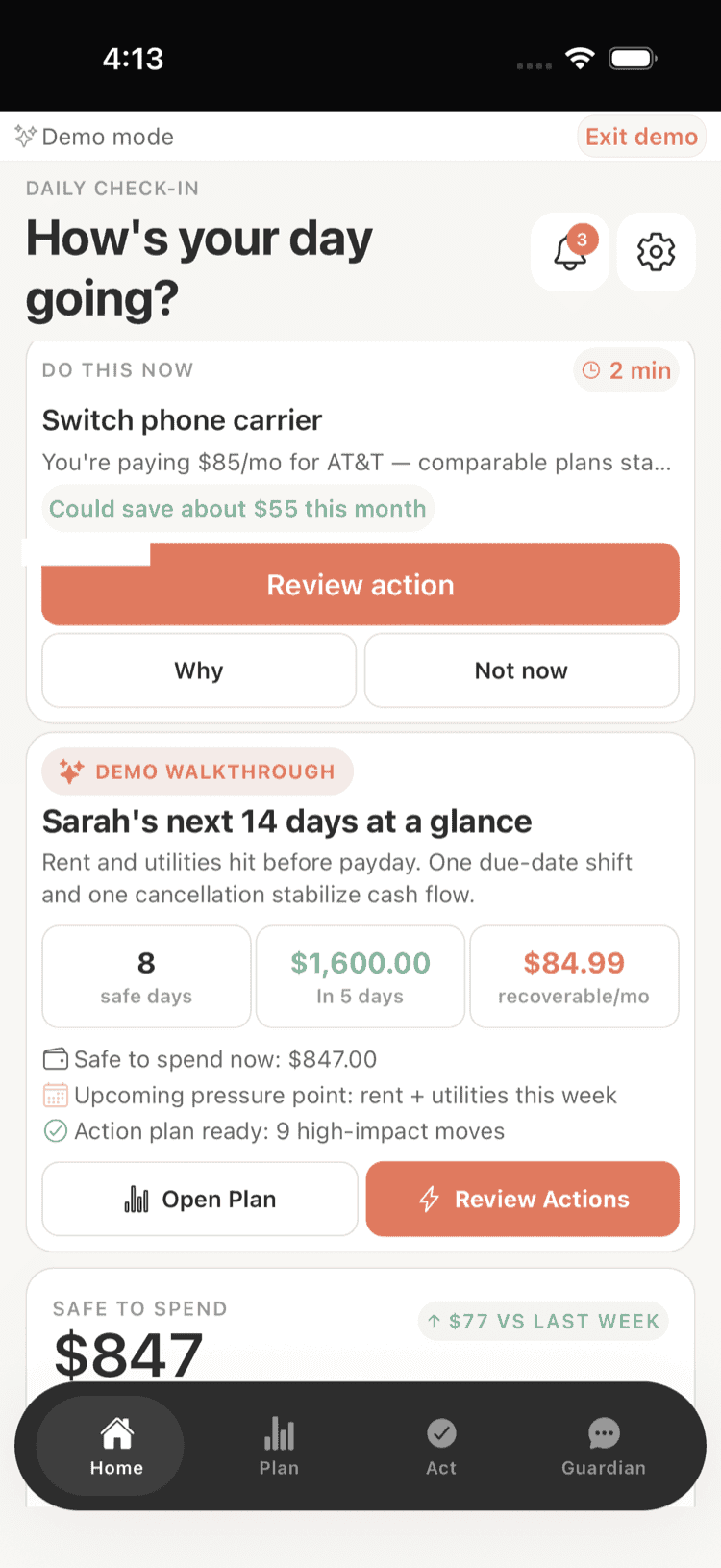
Managing money as a young professional or gig worker means staying ahead of cash flow gaps that trigger costly overdraft fees and subscription surprises. This guide shows you how to use read-only banking apps and automated tools to gain complete visibility into your finances without compromising security, helping you build sustainable financial habits that work with irregular income patterns.
Cash Flow Forecasting & Planning
Set up automated payroll deposit tracking
Connect your checking account to a read-only app that tracks when deposits hit and calculates your next expected payday based on historical patterns.
Create a rolling 30-day cash flow calendar
Map out known income dates against fixed bills to identify potential overdraft windows before they happen.
Build gig income averaging formulas
Use 90-day income averages to create conservative spending budgets that account for variable freelance or gig earnings.
Set up low balance alert thresholds
Configure bank alerts at $200, $100, and $50 to give yourself warning time before potential overdrafts occur.
Track seasonal income variations
Identify months where your income typically drops and build cash reserves during higher-earning periods.
Create bill-due buffer calculations
Calculate the minimum balance needed 3 days before major bills are due to avoid timing-related overdrafts.
Set up weekend spending freeze protocols
Establish rules for weekend spending when banks are closed and deposits may be delayed until Monday.
Build emergency expense cash flow models
Pre-calculate how unexpected expenses of $100, $300, and $500 would impact your next 2 weeks of cash flow.
Track employer direct deposit timing patterns
Document exact times your paychecks clear to optimize bill payment scheduling and avoid float periods.
Create side hustle income forecasting
Build conservative projections for freelance work, ride-sharing, or other variable income streams.
Set up bi-weekly budget splitting
Divide monthly expenses by 2.17 to create accurate bi-weekly spending targets that align with paycheck timing.
Monitor checking account float periods
Track how long different types of deposits take to become available for spending to avoid premature purchases.
Build rent-to-income safety calculations
Ensure housing costs don't exceed 30% of your lowest monthly income to maintain cash flow stability.
Create quarterly tax savings automation
Set aside 25-30% of gig income automatically to avoid cash flow disasters during tax season.
Track vendor payment timing patterns
Document when clients or platforms typically pay to improve cash flow predictability for irregular income.
Overdraft Prevention & Banking Safety
Enable read-only bank account monitoring
Use apps that connect securely without requiring login credentials to track balances without security risks.
Set up overdraft protection with savings accounts
Link a savings account to checking for automatic transfers that cost less than overdraft fees.
Configure real-time balance notifications
Get instant alerts when your balance drops below predetermined thresholds to prevent surprise overdrafts.
Calculate true available balance formulas
Subtract pending charges and scheduled payments from displayed balance to know your real spending power.
Track merchant hold patterns
Document how much gas stations, hotels, and restaurants typically hold beyond your actual purchase amount.
Set up bank fee monitoring alerts
Track overdraft, maintenance, and ATM fees to identify patterns and switch to fee-friendly accounts if needed.
Create spending cutoff time rules
Stop making purchases after 6 PM to avoid overnight processing that could cause overdrafts from delayed transactions.
Build automatic bill payment timing optimization
Schedule payments for 2-3 days after payday to ensure funds are available and avoid processing delays.
Monitor debit card vs. credit card processing differences
Understand how debit transactions clear immediately while credit cards offer float time for better cash flow management.
Set up account reconciliation routines
Check your account daily at the same time to catch unauthorized charges or processing errors before they cause overdrafts.
Create low-balance spending protocols
Establish rules for what purchases are allowed when your balance drops below $100 to avoid accidental overdrafts.
Track bank processing time variations
Document how long different types of transactions take to clear during weekdays vs. weekends and holidays.
Set up overdraft fee reimbursement requests
Create templates and tracking systems for requesting fee reversals from your bank when overdrafts occur.
Configure account linking verification checks
Regularly verify that overdraft protection accounts have sufficient funds and are properly connected.
Build weekend cash management strategies
Plan weekend spending around the fact that bank transfers and deposits may not process until Monday.
Subscription & Bill Tracking Automation
Set up subscription discovery scanning
Use apps that analyze your bank statements to identify all recurring charges, including forgotten subscriptions.
Create monthly subscription audit calendars
Schedule monthly reviews of all recurring charges to catch price increases and cancel unused services.
Build bill due date consolidation strategies
Contact service providers to align due dates with your payday schedule for better cash flow management.
Track subscription price change patterns
Monitor when services typically raise prices and cancel before increases take effect if the value isn't worth it.
Set up bill payment confirmation tracking
Create systems to verify that automated payments actually processed and were received by creditors.
Configure subscription category spending limits
Set maximum monthly amounts for entertainment, software, and service subscriptions to prevent spending creep.
Create free trial cancellation reminders
Set calendar alerts 2 days before free trials end to decide whether to keep services or cancel.
Build utility bill seasonal adjustment tracking
Monitor how heating and cooling costs fluctuate throughout the year to better predict monthly expenses.
Set up subscription sharing optimization
Coordinate with family or friends to share services like Netflix, Spotify Family, and cloud storage to reduce individual costs.
Track annual vs. monthly subscription savings
Calculate potential savings from paying annually instead of monthly for services you definitely plan to keep.
Create bill payment method optimization
Use credit cards with rewards for recurring bills, then pay off the balance immediately to earn points without interest.
Monitor subscription usage vs. cost ratios
Track actual usage of streaming services, gym memberships, and apps to identify subscriptions that aren't worth their cost.
Set up automatic subscription downgrade reminders
Schedule quarterly reviews to downgrade services you're not fully utilizing instead of canceling entirely.
Build subscription tax deduction tracking
Categorize business-related subscriptions for tax purposes if you're a freelancer or have side income.
Create subscription pause strategy documentation
Research which services allow temporary pauses instead of cancellation for times when money is tight.
Spending Analysis & Financial Health Scoring
Set up automated spending categorization
Use read-only apps that automatically sort transactions into categories like groceries, transportation, and entertainment for analysis.
Create spending velocity tracking
Monitor how quickly you spend money after payday to identify patterns that lead to end-of-month cash shortages.
Build weekend vs. weekday spending comparisons
Analyze spending patterns to identify if weekends or social activities are major budget drains.
Track impulse purchase trigger identification
Document emotional states, locations, and times when you make unplanned purchases to build awareness.
Set up merchant spending limit alerts
Configure notifications when you spend more than usual at specific stores or categories within a month.
Create cost-per-use calculations for purchases
Divide purchase price by expected uses to evaluate whether items like gym equipment or software are worth buying.
Build financial health score tracking
Monitor metrics like debt-to-income ratio, emergency fund weeks, and bill payment consistency to track progress.
Track cash vs. card spending differences
Compare spending behavior when using cash versus cards to identify which method helps you spend less.
Set up spending trend analysis alerts
Get notifications when your spending in any category increases by more than 20% compared to previous months.
Create income-to-expense ratio monitoring
Track the percentage of income going to different expense categories to identify areas for optimization.
Build purchase decision delay protocols
Implement 24-hour or 7-day waiting periods for non-essential purchases above certain dollar amounts.
Track location-based spending patterns
Identify which locations or routes lead to higher spending to avoid temptation zones when money is tight.
Set up peer spending comparison benchmarks
Compare your spending in key categories to age and income-appropriate benchmarks to identify optimization opportunities.
Create spending seasonality analysis
Track how your spending changes during holidays, back-to-school, or other seasonal periods to plan ahead.
Build purchase satisfaction tracking
Rate purchases 30 days after buying to identify spending patterns that bring lasting value versus regret.
Take Control of Your Finances
Shelter gives you a clear picture of your cash flow, tracks your bills and subscriptions, and helps you avoid overdraft fees -- all without the stress of traditional budgeting. Connect your accounts in minutes and let Shelter do the heavy lifting.
Download Shelter and start managing your money smarter today.
Take control of your cash flow
Shelter connects to your bank, forecasts your balance 30 days out, and alerts you before problems happen.