You check your bank balance and your chest tightens. You see a bill notification and your stomach drops. You lie awake running numbers in your head, trying to figure out if everything will work out this month. If any of this sounds familiar, you are dealing with money anxiety, and you are far from alone.
According to the American Psychological Association, money has been the top source of stress for Americans for over a decade. It outranks work, health, and relationships. The anxiety is not limited to people who are struggling financially. Plenty of people earning good incomes still feel a persistent unease about money that they cannot shake.
The good news is that money anxiety is not a permanent condition. It is a response to uncertainty, and there are concrete steps you can take to reduce it.
What Money Anxiety Actually Looks Like
Money anxiety is not just worrying about a specific bill. It is a chronic, low-level stress that colors your entire relationship with money. It shows up in different ways for different people:
- Avoiding looking at your bank account or opening mail from financial institutions
- Obsessively checking your balance multiple times a day without actually doing anything about it
- Feeling guilty about every purchase, even necessities
- Arguing with your partner about spending, even when the amounts are small
- Procrastinating on financial tasks like filing taxes, reviewing insurance, or setting up retirement contributions
- Physical symptoms like trouble sleeping, headaches, or stomach problems
The common thread is that money feels threatening rather than neutral. Every financial decision carries emotional weight that it probably should not.
Why Money Anxiety Happens
Understanding the root causes helps you address the right problem. Money anxiety usually stems from one or more of these sources.
Uncertainty. You do not know what is coming. You do not know if you will have enough. The unknown is inherently stressful, and most people have very little visibility into their financial future beyond the current week. If your financial stress is affecting more than just your mood, the article on financial stress affecting your health is worth reading.
Past experiences. Growing up in a household where money was scarce, or experiencing a financial crisis as an adult, can create lasting anxiety patterns. Your nervous system learned that money problems are dangerous, and it keeps sounding the alarm even when the danger has passed.
Shame. Our culture ties money to personal worth. Earning less than your peers, carrying debt, or not having savings can feel like a personal failure rather than a circumstance. That shame makes people avoid dealing with their finances, which makes the anxiety worse.
Comparison. Social media makes it easy to compare your financial situation to curated highlight reels. Everyone else seems to be traveling, buying houses, and living well. You do not see their credit card balances or the fact that they are also anxious.
7 Strategies That Actually Reduce Money Anxiety
1. Know Your Numbers
This sounds counterintuitive if checking your balance makes you anxious, but avoidance is the single biggest amplifier of money anxiety. The stories you tell yourself about your finances are almost always worse than reality. When you know exactly where you stand -- your income, your bills, your balances, your upcoming expenses -- the uncertainty shrinks dramatically.
You do not need to build a complex spreadsheet. Start with three numbers: what you have, what you owe this month, and what is coming in. That alone puts you ahead of most people. If you want to see this in action, Shelter's features page shows how connecting your bank account gives you a complete picture without any manual tracking.
2. Automate Your Bills
A huge portion of money anxiety comes from the mental load of remembering when bills are due and whether there is enough in the account to cover them. Automating your bills eliminates that entire category of worry. Set up autopay for everything you can -- rent, utilities, insurance, subscriptions.
The key is to also know when those autopayments will hit. Automation without visibility can create its own problems if multiple payments draft on the same day. That is where a cash flow forecast becomes valuable: you can see the timing of every upcoming payment and make sure the money is there when it needs to be.
3. Build a Small Buffer
You do not need three months of expenses in savings to feel less anxious. Even a small buffer of $200 to $500 in your checking account above what you need for bills creates breathing room. It means one unexpected charge will not set off a chain reaction of overdrafts and late fees.
Think of it as a shock absorber. It does not need to cover a job loss or a medical emergency. It just needs to cover the gap between when an expense hits and when your next paycheck arrives. For a practical plan to build that buffer, read how to build an emergency fund on a tight budget.
4. Stop Comparing Your Finances to Others
This is easier said than done, but it is critical. You do not know anyone else's full financial picture. The couple posting vacation photos might be drowning in credit card debt. The friend who just bought a house might have gotten help from their parents. The coworker with the new car might be leasing it at a rate they cannot really afford.
Your financial situation is yours. It has its own history, its own constraints, and its own trajectory. Comparing it to someone else's curated surface is like comparing your rough draft to someone else's final edit.
If social media is a trigger, unfollow or mute accounts that make you feel bad about your financial situation. This is not about denial. It is about protecting your mental health so you can actually focus on your own progress.
5. Talk About Money
Money is one of the last remaining taboos. People will discuss their health, their relationships, even their therapy -- but asking someone what they earn or how much debt they carry is still considered rude. This silence creates isolation, and isolation feeds anxiety.
You do not need to broadcast your net worth. But having even one person you can talk honestly with about money -- a partner, a friend, a family member, a financial advisor -- reduces the feeling that you are the only one struggling. You will almost certainly discover that they have their own financial worries too.
6. Get Professional Help When You Need It
If money anxiety is interfering with your daily life -- if you cannot sleep, if you are avoiding opening mail, if you are fighting with your partner constantly about finances -- it may be worth talking to a professional. That could mean a therapist who specializes in financial anxiety, or a fee-only financial planner who can help you make a plan.
There is no shame in getting help. You would see a doctor for a persistent physical symptom. Persistent financial anxiety deserves the same attention.
7. Use Tools That Give You Visibility
A lot of money anxiety boils down to not being able to see what is coming. You know bills are out there. You know subscriptions are draining your account. But you do not have a clear picture of when everything hits and what your balance will look like next week.
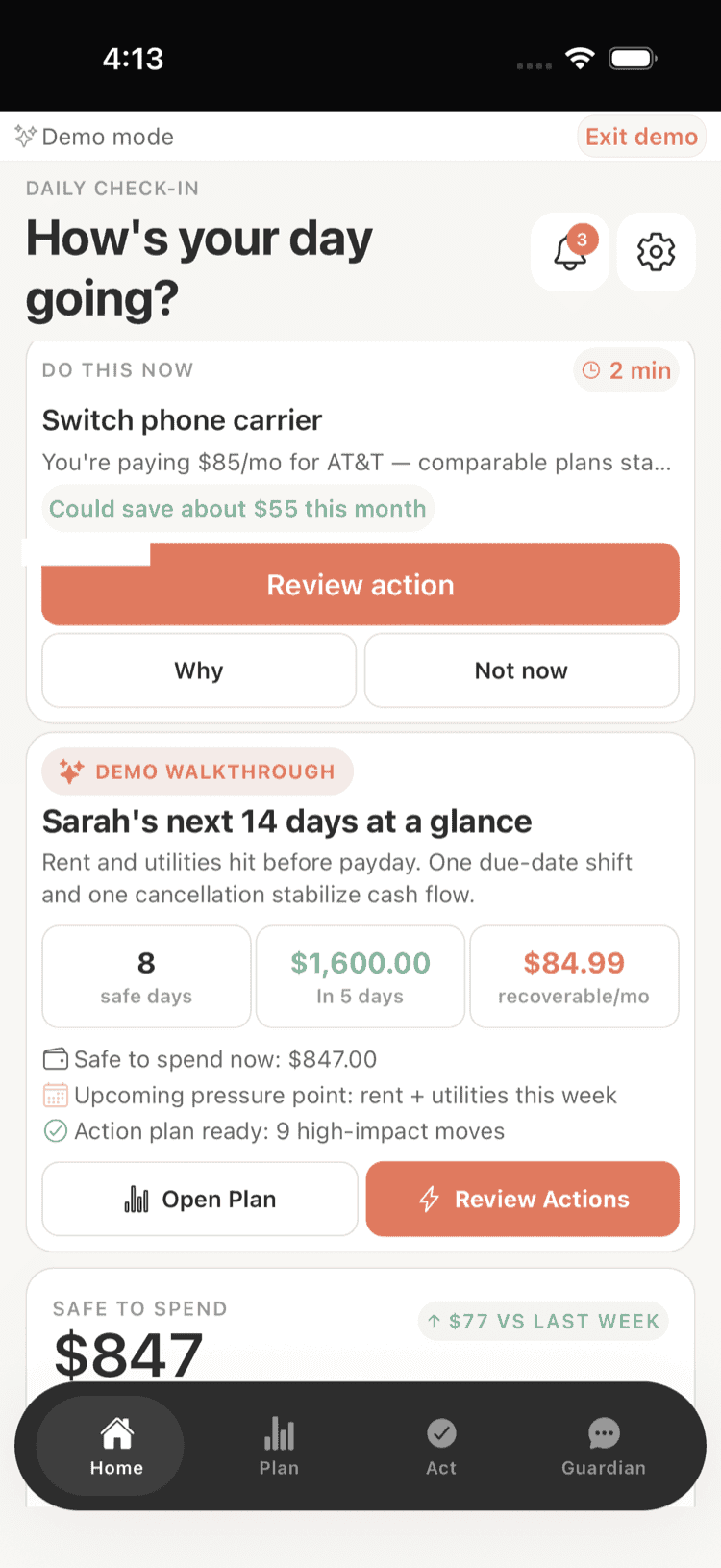
This is exactly the problem that Shelter was built to solve. By connecting to your bank through Plaid, it shows you your projected balance for the next 30 days. You can see every upcoming charge, spot potential shortfalls before they happen, and know your "safe" days when it is actually fine to spend a little. The features page walks through how this works in practice.
Visibility does not fix everything. But it replaces the vague dread of "I do not know if I will be okay" with the concrete clarity of "I can see exactly what is coming." That shift alone is often enough to break the anxiety cycle.
The Anxiety Cycle and How to Break It
Money anxiety tends to be self-reinforcing. You feel anxious, so you avoid looking at your finances. Because you avoid looking, you do not know where you stand. Because you do not know where you stand, you feel more anxious. The cycle feeds itself.
Breaking it requires doing the thing that feels hardest: looking. Not analyzing, not optimizing, not making a perfect plan. Just looking. Check your balance. Open that bill. See the number. More often than not, the number is less scary than the story you were telling yourself about it.
Start small. Commit to checking your balance once a day for a week. That is it. No judgment, no action required. Just look. Most people find that the simple act of looking, consistently, drains the anxiety faster than any budgeting strategy.
Progress, Not Perfection
Money anxiety does not disappear overnight. It is a pattern that took years to develop, and it takes time to unwind. The goal is not to never feel anxious about money again. The goal is to have fewer anxious moments, shorter anxious moments, and better tools for handling them when they arise.
Every time you check your balance instead of avoiding it, you weaken the anxiety cycle. Every time you automate a bill, you remove one source of worry. Every time you build your buffer by even $20, you create a little more breathing room.
Small steps, taken consistently, change your entire relationship with money. Not because your financial situation transforms overnight, but because your experience of it does.
Take control of your cash flow
Shelter connects to your bank, forecasts your balance 30 days out, and alerts you before problems happen.