You already know that money problems are stressful. But you might not realize just how far that stress reaches into the rest of your life. Financial stress does not stay neatly contained in the "money" compartment of your brain. It bleeds into your sleep, your relationships, your immune system, and your ability to function at work. It is not just a financial problem. It is a health problem.
And yet, most conversations about personal finance focus exclusively on the numbers. Balance your budget. Pay down debt. Save more. Nobody talks about the fact that the stress itself is causing measurable harm -- or that addressing the stress is just as important as addressing the balance sheet.
The Physical Toll of Money Stress
The research on this is extensive and consistent. Financial stress triggers the same physiological responses as any other chronic stressor. Your body does not distinguish between "there is a threat in the environment" and "I do not know how I am going to pay rent." It floods your system with cortisol and adrenaline either way.
Here is what the research shows:
Sleep disruption. A study published in Social Science and Medicine found that people with higher levels of financial stress were significantly more likely to experience insomnia and poor sleep quality. If you have ever lain awake running numbers in your head, you know this intuitively. The problem is that poor sleep then impairs your decision-making the next day, making it harder to deal with the financial issues causing the stress in the first place.
Cardiovascular effects. Chronic stress elevates blood pressure and increases inflammation. The American Heart Association has identified financial stress as a risk factor for heart disease. One study found that people reporting high financial stress had a 13-fold increase in the risk of heart attack.
Immune function. Cortisol, the primary stress hormone, suppresses immune function when it stays elevated for long periods. People under chronic financial stress get sick more often, take longer to recover, and are more susceptible to infections.
Chronic pain. Financial stress correlates with increased reports of headaches, back pain, and muscle tension. The mechanism is straightforward: stress creates physical tension, and sustained tension creates pain.
Weight changes. Stress eating is real, and so is stress-induced appetite loss. Financial pressure pushes people toward cheap, calorie-dense comfort foods. It also reduces the time and energy available for cooking healthy meals or exercising.
The Mental and Emotional Impact
Beyond the physical symptoms, financial stress takes a serious toll on mental health.
Anxiety and depression. The relationship between financial stress and mental health conditions is well-established. A meta-analysis in Clinical Psychology Review found that people in debt were three times more likely to have a mental health condition than those who were debt-free. This does not mean debt causes mental illness directly, but the chronic stress it creates is a significant contributing factor.
Cognitive impairment. This one is particularly cruel. Research from Princeton published in Science showed that financial scarcity actually reduces cognitive bandwidth. People dealing with financial pressure performed worse on tests of logic and impulse control -- not because they were less capable, but because their mental resources were consumed by financial worry. You are literally less able to think clearly about money when you are stressed about money.
Relationship strain. Money is consistently cited as one of the top causes of conflict in relationships. Financial stress makes people irritable, defensive, and less patient. Couples fight about spending. Parents feel guilty about what they cannot provide. The stress radiates outward into every relationship in your life.
Shame and isolation. Financial struggle carries a stigma that health problems and relationship problems do not. People hide their financial stress, which prevents them from getting support, which deepens the isolation and shame. It is a lonely kind of suffering.
The Stress-Avoidance Cycle
One of the most damaging patterns in financial stress is the avoidance cycle. It works like this:
- You feel stressed about money.
- Because it is stressful, you avoid dealing with it. You do not open the bills. You do not check your balance. You do not return the call from the collection agency.
- Because you are not dealing with it, things get worse. Late fees accumulate. Problems compound. Opportunities to intervene early are missed.
- Because things have gotten worse, the stress increases.
- Repeat.
This cycle is not a character flaw. It is a normal human response to a stressful stimulus. Avoidance feels like self-protection in the moment. The problem is that it trades short-term relief for long-term pain.
Breaking this cycle does not require solving all your financial problems at once. It requires breaking through the avoidance barrier, even in the smallest way. For a deeper look at strategies for the anxiety side of this, read about how to stop money anxiety.
Breaking the Cycle: Small Steps That Help
The instinct when you realize financial stress is affecting your health is to try to fix everything at once. Pay off all the debt. Build a six-month emergency fund. Create a detailed budget and stick to it perfectly. That instinct is understandable, but it usually leads to overwhelm and more avoidance.
Instead, start small. Ridiculously small if necessary.
Step 1: Look at Your Accounts
Just look. Open your banking app and see your balance. Do not judge it. Do not try to make a plan. Just establish the habit of looking. Many people find that the number, whatever it is, is less frightening than the imagined number they have been carrying around in their head.
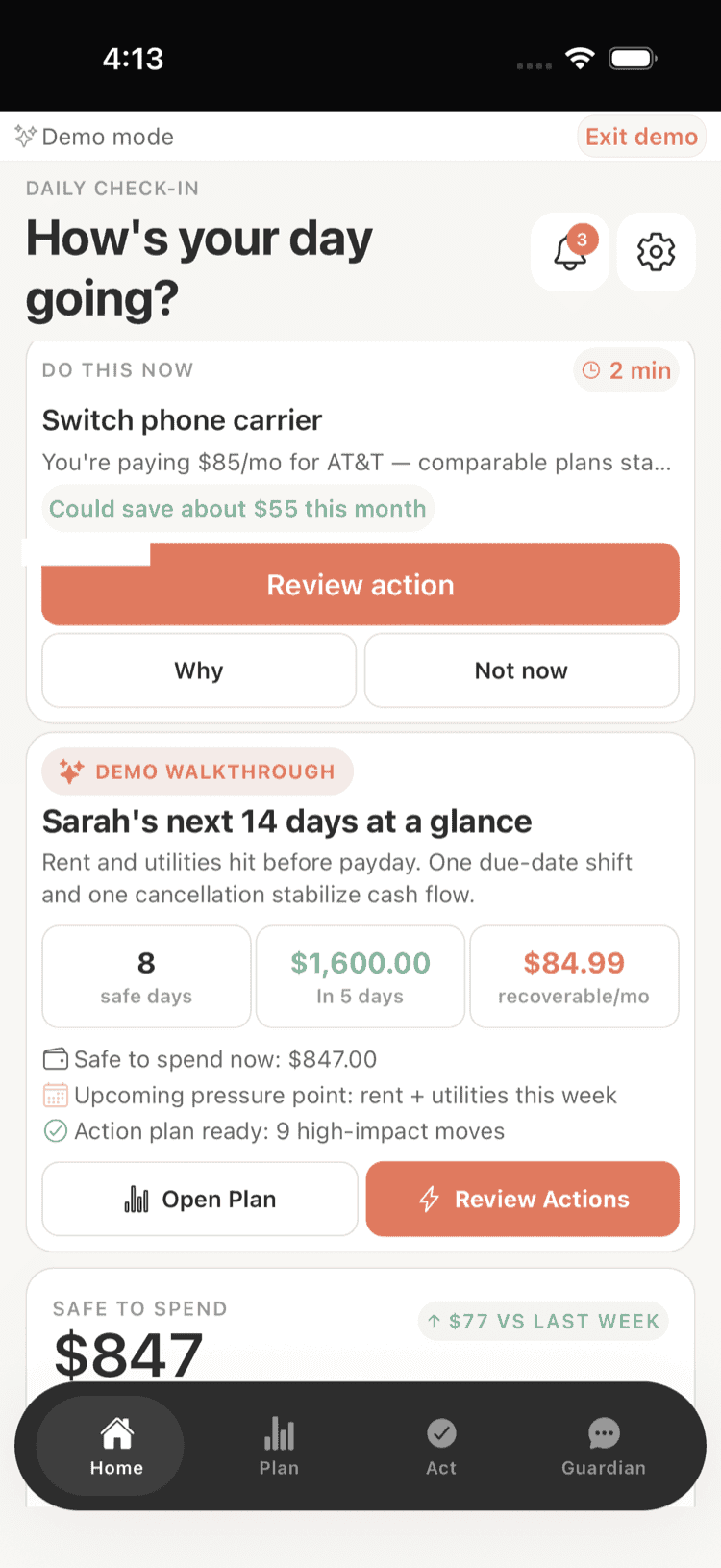
You can try Shelter's demo to see what this looks like in practice -- a clear, judgment-free view of where your money stands and where it is headed. Sometimes just having visibility is enough to start breaking the avoidance pattern.
Step 2: Identify One Thing You Can Control
You cannot control the economy, your employer's decisions, or the price of groceries. But you can almost always find one thing within your control. Maybe it is canceling a subscription you do not use. Maybe it is setting up autopay for a bill you keep forgetting. Maybe it is moving $10 to a savings account.
The specific action matters less than the feeling of agency it creates. Financial stress thrives on helplessness. Any action, no matter how small, pushes back against that helplessness.
Step 3: Separate the Financial Problem from the Health Problem
If financial stress is causing sleep problems, treat the sleep problems. If it is causing anxiety that interferes with daily life, address the anxiety. You do not have to wait until your finances are perfect to take care of your health. In fact, taking care of your health first often gives you the cognitive resources and emotional stability to deal with your finances more effectively.
This might mean establishing a nighttime routine that helps you sleep. It might mean exercise, meditation, or breathing techniques. It might mean therapy. None of these things require money problems to be solved first.
Step 4: Talk to Someone
The isolation that comes with financial stress is one of its most harmful features. Telling one person -- a friend, a partner, a family member, a counselor -- what you are going through breaks that isolation. You do not need advice. You just need someone to know.
If you do not have someone in your life you feel comfortable talking to about money, consider a financial counselor. Nonprofit credit counseling agencies offer free or low-cost sessions. A good counselor will not judge your situation. They will help you see options you might be missing.
Step 5: Build Visibility, Not Just Willpower
One of the reasons financial stress is so persistent is that most people operate with very little forward-looking information about their money. You know what happened yesterday, but you do not know what is coming next week. That uncertainty is inherently stressful.
Tools that show you what is ahead -- even just 30 days ahead -- replace uncertainty with information. When you can see that your balance will dip on the 15th but recover on the 20th, that is a manageable fact, not a vague threat. Shelter provides exactly this kind of forward visibility by analyzing your real transaction patterns and projecting your balance into the future. For more on building a healthier overall relationship with money, the guide on financial wellness tips covers small, practical steps.
When to Seek Professional Help
Financial stress crosses the line into a clinical concern when it persistently interferes with your ability to function. Warning signs include:
- Inability to sleep most nights due to money worries
- Panic attacks triggered by financial situations (opening mail, checking accounts, paying bills)
- Depression that makes it hard to get through the day
- Using alcohol or substances to cope with financial stress
- Relationship breakdown due to money-related conflict
- Physical health problems that your doctor cannot explain
If you recognize these signs, consider reaching out to a mental health professional. Many therapists offer sliding-scale fees, and some specialize in the intersection of money and mental health. Employee assistance programs through your employer often provide free sessions.
You do not need to have your finances figured out before you get help for the stress. In fact, getting help with the stress often makes it possible to figure out the finances.
Your Health Is Not Separate from Your Finances
The traditional personal finance world treats money as a purely rational domain. Spreadsheets, interest rates, optimization strategies. But money is deeply emotional, and the stress it creates has real, measurable effects on your health.
Taking care of your financial health means taking care of your actual health too. Sometimes the best financial decision you can make is not a financial decision at all -- it is getting enough sleep, talking to a friend, or simply looking at your accounts instead of avoiding them.
Small steps, taken consistently, break the cycle. You do not need to solve everything today. You just need to start.
Take control of your cash flow
Shelter connects to your bank, forecasts your balance 30 days out, and alerts you before problems happen.