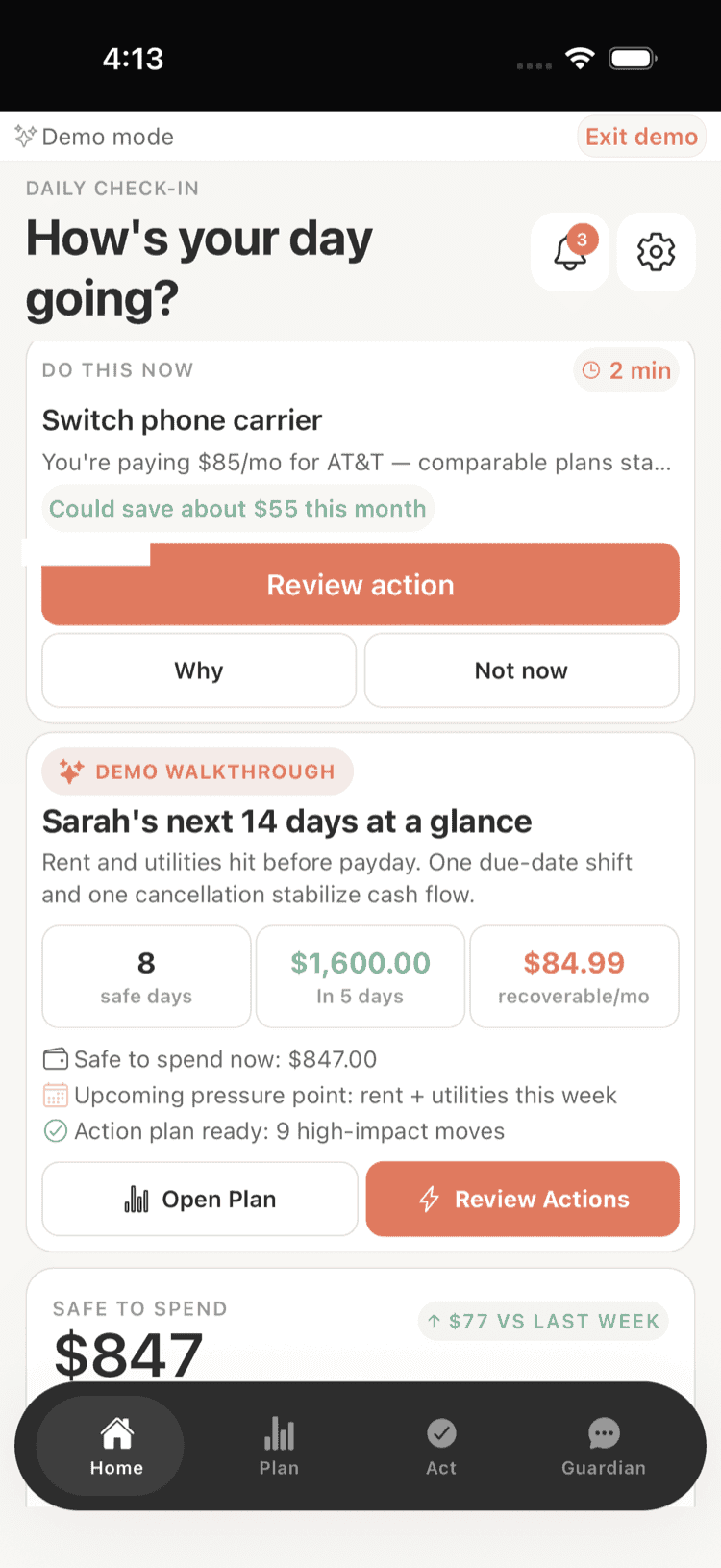
Managing finances as a young professional or gig worker requires more than just checking your account balance. With irregular income streams and the constant threat of overdraft fees, you need a systematic approach to achieving true financial wellness that goes beyond basic budgeting.
Cash Flow Management & Forecasting
-
Set up automated income tracking across all gig platforms -- Connect all your income sources (Uber, DoorDash, freelance clients) to get real-time visibility into earnings patterns and predict cash flow gaps.
-
Create a 30-day rolling cash flow forecast -- Map out expected income and fixed expenses for the next month to identify potential shortfalls before they happen.
-
Establish minimum account balance triggers -- Set alerts when your checking account drops below your calculated minimum needed for upcoming bills plus a 20% buffer.
-
Track income timing patterns for gig work -- Document when different platforms pay out to predict your actual available cash versus pending payments.
-
Build a same-day expense approval system -- Before any non-essential purchase, check your real-time balance against upcoming bills to avoid overdraft timing issues.
-
Separate clearing account for irregular income -- Funnel all gig payments into a dedicated account, then transfer predictable amounts to your main checking weekly.
-
Calculate your true hourly rate including expenses -- Factor in gas, car maintenance, phone bills, and taxes to understand your real earning potential per platform.
-
Set up income smoothing transfers -- During high-earning weeks, automatically transfer excess to savings to cover low-income periods without stress.
-
Monitor bank processing delays for deposits -- Track how long each income source takes to clear and factor these delays into your cash flow planning.
-
Create weekend cash flow buffers -- Since many gig payments process slower on weekends, maintain extra funds to cover Friday-Sunday expenses.
-
Implement the 3-day rule for large purchases -- Wait three days before any purchase over $100 to ensure it won't conflict with upcoming bill payments.
-
Track seasonal income variations -- Document how your gig income changes throughout the year to prepare for slower months in advance.
-
Set up emergency cash access methods -- Have multiple ways to access funds quickly (different ATM networks, mobile deposits) for urgent cash needs.
-
Calculate your personal cash conversion cycle -- Understand the time between earning money and having it available to spend, then plan purchases accordingly.
-
Automate surplus allocation during good weeks -- When income exceeds your weekly average by 25%, automatically save the excess for leaner periods.
Overdraft Prevention & Banking Optimization
-
Audit all bank fees and find fee-free alternatives -- Review your last 3 months of bank statements for fees and switch to accounts with no overdraft fees or monthly maintenance charges.
-
Set up intelligent overdraft alerts -- Configure alerts that trigger when pending transactions would cause overdrafts, not just when they've already occurred.
-
Negotiate overdraft fee reversals for timing issues -- Contact your bank to reverse fees caused by deposit processing delays, not actual insufficient funds.
-
Use micro-savings for overdraft protection -- Link a savings account with just $100-200 as overdraft protection instead of expensive bank overdraft services.
-
Time large purchases with deposit schedules -- Make significant purchases only after confirming deposits have fully cleared, not just appeared as pending.
-
Switch to banks with real-time balance updates -- Choose banks that show pending transactions immediately rather than those with 2-3 day delays in balance updates.
-
Set up balance threshold spending limits -- Use debit card controls to prevent transactions when your account drops below a preset minimum.
-
Create a manual transaction log for same-day tracking -- Record purchases immediately in your phone to track spending before transactions appear in your bank account.
-
Use split banking for bill payments and spending -- Keep bill money in one account and spending money in another to prevent accidental overdrafts on essential payments.
-
Schedule bill payments for optimal timing -- Align due dates with your income schedule and set payments to process 2-3 days after guaranteed fund availability.
-
Monitor merchant authorization holds -- Track how much merchants pre-authorize (especially gas stations and hotels) to avoid surprise account holds.
-
Establish backup payment methods for bills -- Have credit cards or alternative accounts ready for critical bills if your main account faces unexpected issues.
-
Use mobile deposits strategically -- Deposit checks early in the day and on weekdays to minimize clearing time and reduce cash flow gaps.
-
Track recurring payment timing patterns -- Document when subscriptions and bills actually process (vs. due dates) to predict exact cash outflow timing.
-
Implement the envelope method digitally -- Use multiple checking accounts or savings buckets to segregate money for bills, spending, and emergencies.
Subscription & Bill Management
-
Conduct monthly subscription audits using bank statements -- Review all recurring charges and cancel any services you haven't used in the past 30 days or forgot you had.
-
Move all subscriptions to one payment date -- Contact providers to align billing cycles to one day per month, making cash flow planning much simpler.
-
Set up subscription spending limits -- Cap total monthly subscriptions at 10% of your average monthly income to prevent subscription creep.
-
Use annual payments for essential subscriptions -- Pay annually for services you definitely need to get discounts and eliminate monthly cash flow uncertainty.
-
Create a subscription decision matrix -- Rate each subscription on usage frequency, cost per use, and replaceability before committing to renewals.
-
Negotiate bill due dates with service providers -- Ask utilities and loan companies to move due dates to align with your income schedule for better cash flow.
-
Bundle services strategically to reduce costs -- Combine phone, internet, and streaming services where it genuinely saves money, not just for convenience.
-
Set up low-balance subscription pausing -- Pause non-essential subscriptions automatically when your account drops below predetermined thresholds.
-
Track price increases across all services -- Monitor subscription price changes and immediately evaluate whether increased costs still justify the service value.
-
Use family plans and group accounts efficiently -- Split costs with trusted friends or family for services like Netflix, Spotify, or cloud storage to reduce individual expenses.
-
Implement seasonal subscription management -- Cancel or pause subscriptions during months when you typically earn less or have higher expenses.
-
Set up bill payment automation with balance checks -- Automate bill payments only after confirming sufficient funds are available, not blindly on due dates.
-
Create subscription value tracking spreadsheets -- Calculate cost per use for each service monthly to identify which subscriptions provide poor value.
-
Use free trial periods strategically -- Schedule free trials during low-income periods and set reminders to cancel before billing if you don't need the service.
-
Establish subscription emergency protocols -- Have a plan to quickly cancel non-essential subscriptions during financial emergencies without losing important data.
Financial Health Monitoring & Apps
-
Use read-only financial apps for safe account monitoring -- Connect bank accounts to apps that only read data, never move money, to track spending without security risks.
-
Monitor your financial health score weekly -- Track key metrics like cash flow stability, emergency fund days, and debt-to-income ratio to measure progress.
-
Set up spending category alerts -- Get notified when you exceed normal spending in categories like dining out or entertainment to prevent overspending.
-
Track your emergency fund in days, not dollars -- Calculate how many days your savings would cover essential expenses, aiming for 30 days as a starting goal.
-
Use apps with clear security controls for financial data -- Only connect accounts to apps with read-only access, encryption in transit and at rest, and no ability to initiate transactions.
-
Monitor credit score changes monthly -- Use free credit monitoring to track score improvements from better cash flow management and on-time payments.
-
Set up automated financial wellness reports -- Generate monthly reports showing cash flow trends, spending patterns, and progress toward financial goals.
-
Track spending velocity and pattern changes -- Monitor how quickly you spend money after receiving it to identify and correct problematic spending habits.
-
Use apps that predict upcoming financial stress -- Choose tools that forecast potential cash flow problems based on your spending patterns and upcoming bills.
-
Monitor app permissions and data access regularly -- Review which apps can access your financial data and revoke permissions for any unused or suspicious applications.
-
Set up multi-account financial health tracking -- Monitor checking, savings, and credit accounts together to get a complete picture of your financial wellness.
-
Use predictive spending analysis tools -- Leverage apps that predict future spending based on historical patterns to better plan for upcoming expenses.
-
Track financial stress indicators automatically -- Monitor metrics like overdraft frequency, late payment instances, and account balance volatility as stress signals.
-
Set up financial goal progress tracking -- Use apps to monitor progress toward specific goals like building emergency funds or reducing subscription costs.
-
Create financial wellness dashboard views -- Customize app interfaces to show the most important metrics for your situation at a glance.
Take Control of Your Finances
Shelter gives you a clear picture of your cash flow, tracks your bills and subscriptions, and helps you avoid overdraft fees -- all without the stress of traditional budgeting. Connect your accounts in minutes and let Shelter do the heavy lifting.
Download Shelter and start managing your money smarter today.
Take control of your cash flow
Shelter connects to your bank, forecasts your balance 30 days out, and alerts you before problems happen.