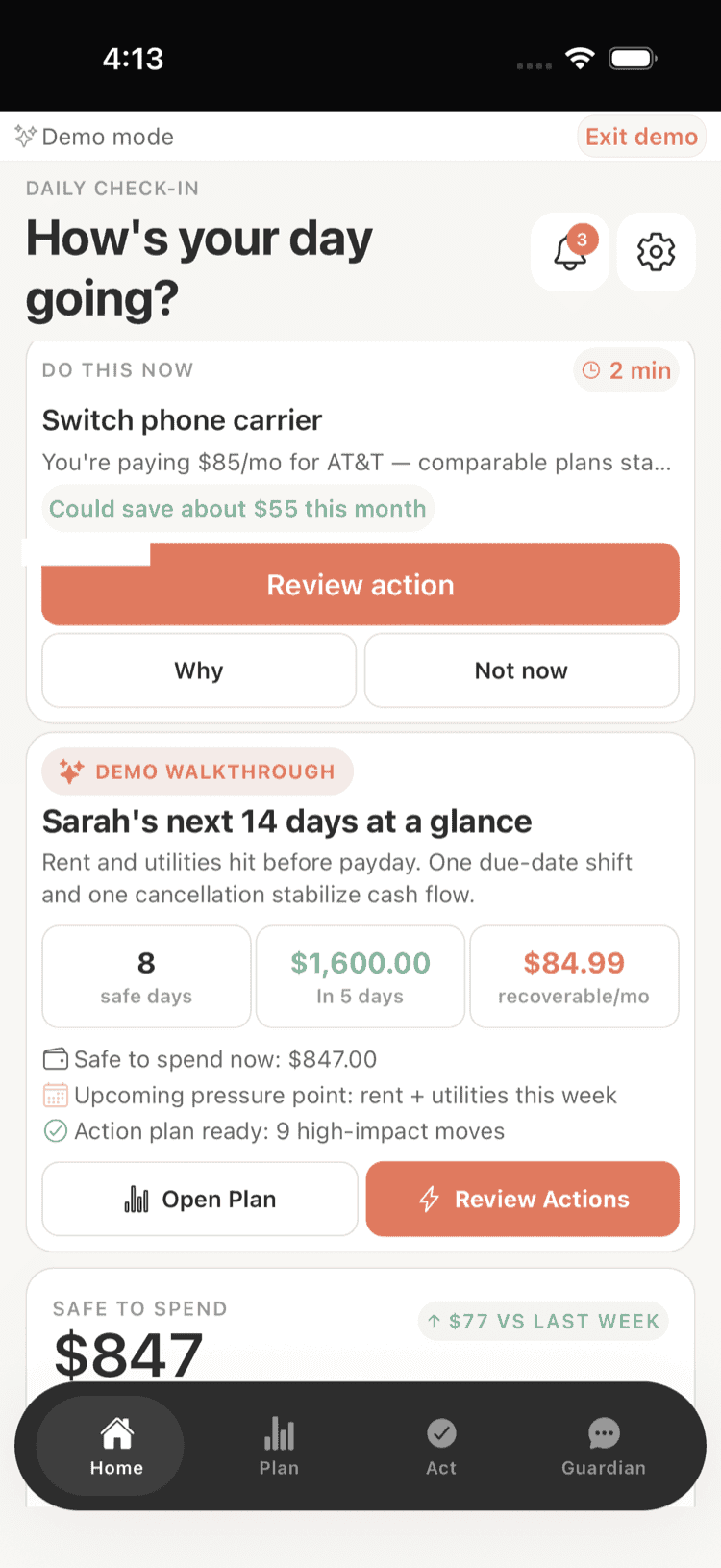
Managing your finances as a young professional or gig worker doesn't have to mean constant stress about overdrafts and surprise bills. These 100 proven financial wellness tips are specifically designed for Shelter users who want to gain control over their cash flow, prevent costly banking mistakes, and build sustainable money habits without the complexity of traditional budgeting apps.
Cash Flow Forecasting & Timing
Set up automatic bill date alerts 5 days before due dates
Use Shelter's bill tracking to get early warnings before money leaves your account, preventing timing surprises.
Map your irregular income patterns to identify low-cash periods
Track 3 months of gig work payments to spot seasonal dips and prepare cash reserves accordingly.
Create a 'bill calendar' showing all monthly obligations
Visualize when money goes out versus when it comes in to avoid overdraft timing mismatches.
Use the 'available after bills' calculation before any purchase
Always check your true available balance after upcoming bills before spending money.
Set up automatic transfers to a 'bill buffer' account
Move money for upcoming bills into a separate account immediately when income arrives.
Track the exact day your paycheck typically clears
Know whether your direct deposit hits Wednesday night or Thursday morning to time bill payments.
Create 'cash flow emergency' alerts for balances under $100
Set up notifications when your available balance gets dangerously low after upcoming bills.
Use Shelter's forecasting to plan major purchases 30 days ahead
Input planned expenses to see exactly when you can afford them without overdrafting.
Schedule bill payments 2 days after guaranteed income arrival
Never schedule automatic payments before you're certain the money will be there.
Track seasonal income variations for gig work
Note how your Uber, DoorDash, or freelance income changes with holidays and weather patterns.
Set up 'payday routines' for immediate bill allocation
Within 24 hours of income, allocate money to upcoming bills using Shelter's categorization.
Create separate sinking funds for irregular expenses
Set aside money monthly for car repairs, medical bills, and other unpredictable costs.
Use weekend income projections for Monday bill planning
If you earn weekend gig money, factor this into Monday-Tuesday bill payment decisions.
Track minimum daily spending requirements
Know your absolute minimum daily costs (food, gas, etc.) to avoid dipping below survival money.
Set up automatic bill pay only after 6 months of stable income
Wait until your cash flow is predictable before automating any payments.
Use Shelter's upcoming bills widget as your purchase decision tool
Check the widget before every non-essential purchase to see true available funds.
Create monthly 'cash flow meetings' with yourself
Review Shelter's forecasting monthly to adjust payment timing and identify problem weeks.
Build a 3-day cash buffer for payment processing delays
Always maintain $50-100 extra for when payments process faster than expected.
Track your personal 'danger days' each month
Identify specific dates when you're most likely to overdraft based on your patterns.
Use multiple income streams tracking to balance irregular pay
When one gig is slow, increase hours on others to maintain steady cash flow.
Overdraft Prevention & Banking Safety
Turn off overdraft protection to force declined transactions
A declined card is better than a $35 overdraft fee - disable overdraft coverage entirely.
Link Shelter to a separate checking account for bill tracking
Use a dedicated account for fixed bills to prevent accidental overdrafts from daily spending.
Set up real-time balance notifications at $25, $10, and $5
Get immediate text alerts as your balance approaches zero to prevent overdraft surprises.
Use only debit cards with daily spending limits
Set a $50-100 daily limit to prevent large accidental purchases that cause overdrafts.
Schedule all automatic payments for the same day each month
Concentrate fixed bills on one day when you know money is available, reducing timing errors.
Keep a $20 emergency cash stash at home
Physical cash prevents overdrafts when your account balance is uncertain but you need essentials.
Use Shelter's 'pending transaction' alerts to catch processing delays
Know when charges are pending but haven't hit your account yet to avoid double-spending.
Create a separate 'overdraft buffer' account with $50
Link a small savings account as overdraft protection instead of using the bank's expensive coverage.
Track weekend spending patterns to avoid Monday overdrafts
Weekend purchases often process Monday morning - plan accordingly with Shelter's timing data.
Use mobile check deposit timing strategically
Deposit checks early in the day and know your bank's processing schedule to time bill payments.
Set up 'gas money' as a separate tracked category
Never let your gas money get mixed with bill money - track it separately in Shelter.
Use only one checking account for all automatic bills
Consolidate all recurring payments to one account to simplify tracking and prevent overdrafts.
Create 'no-spend' days before major bill due dates
Stop all discretionary spending 2 days before big bills are due to ensure money is available.
Use Shelter to identify your highest overdraft risk transactions
Find patterns in what types of purchases most often cause you to overdraft.
Switch to a credit union with lower overdraft fees
Many credit unions charge $15-20 instead of $35 for overdrafts - research local options.
Use prepaid cards for discretionary spending
Load a specific amount weekly onto a prepaid card for entertainment, preventing checking account overdrafts.
Create 'overdraft recovery' fund of $100
When you do overdraft, have a dedicated fund to immediately restore your buffer.
Track subscription renewal dates in Shelter's calendar
Annual subscriptions often cause overdrafts - mark all renewal dates to prepare.
Use 'available balance' not 'current balance' for all decisions
Always base spending decisions on money that's actually available, not including pending deposits.
Set up automatic text alerts for any transaction over $20
Get immediate notification of larger purchases to stay aware of your balance throughout the day.
Subscription Management & Hidden Costs
Conduct monthly subscription audits using Shelter's categorization
Review all recurring charges monthly to catch forgotten subscriptions before they drain your account.
Cancel all free trial subscriptions immediately after signing up
Set calendar reminders to cancel trials before they auto-renew into paid subscriptions.
Use virtual credit card numbers for all subscription services
Many banks offer virtual numbers that you can easily cancel without affecting your main card.
Group all subscriptions to bill on the same date
Contact services to change billing dates so all subscriptions hit when you have money available.
Track the true hourly cost of entertainment subscriptions
Calculate how much you actually use Netflix, Spotify, etc. per hour to determine value.
Set up subscription alerts in Shelter 3 days before renewal
Get advance warning of upcoming subscription charges to ensure sufficient funds.
Use family plans and split costs with friends
Share Spotify Family, Netflix, or other plans to reduce individual subscription costs.
Create a dedicated 'subscription account' with limited funds
Use a separate account with only enough money for subscriptions to prevent overdrafts.
Switch to annual payments for 20%+ discounts
Pay yearly instead of monthly for services you definitely use to save money long-term.
Use Shelter to track subscription price increases
Monitor when services raise prices and evaluate whether to keep or cancel each subscription.
Cancel gym memberships and use free alternatives
Replace expensive gym subscriptions with YouTube workouts, running, or community center access.
Negotiate with subscription services before canceling
Call to cancel and often get offered discounted rates or free months to stay.
Use library access for free digital subscriptions
Many libraries offer free access to magazines, audiobooks, and streaming services.
Track seasonal subscription usage patterns
Cancel subscriptions during months when you historically don't use them (like gym memberships in summer).
Set subscription spending limits in Shelter
Cap total monthly subscription spending at a specific dollar amount and stick to it.
Use ad-supported versions instead of premium subscriptions
Choose free tiers with ads for services like YouTube, Spotify, and Hulu to save money.
Create a 'subscription wishlist' for future upgrades
List desired subscriptions to add only when your income increases, not impulsively.
Track which subscriptions you haven't used in 30 days
Use Shelter's data to identify unused subscriptions and cancel them immediately.
Set up subscription 'pause' periods during tight money months
Many services allow temporary suspension - use this during financially difficult periods.
Use student discounts for all eligible subscriptions
Even part-time students can often get 50% discounts on major subscription services.
Spending Analysis & Purchase Psychology
Use Shelter's spending categorization to identify emotional spending triggers
Track when and why you make impulse purchases to develop better spending awareness.
Implement the '24-hour rule' for purchases over $25
Wait a full day before buying anything non-essential over $25 to reduce impulse spending.
Calculate the 'hourly wage' cost of each purchase
Before buying anything, calculate how many hours you need to work to afford it.
Track your spending by mood using Shelter's notes feature
Note your emotional state with purchases to identify stress spending patterns.
Use the 'cost per use' calculation for all purchases
Divide item cost by expected uses to determine true value before buying.
Set up weekly spending check-ins with Shelter's dashboard
Review your spending every Friday to stay aware and make weekend adjustments.
Create 'spending guilt' categories to track regrettable purchases
Mark purchases you regret to identify patterns and reduce future similar spending.
Use cash-only for your biggest spending weakness category
If you overspend on food, clothes, etc., use only cash for that category.
Track 'convenience spending' separately from necessities
Monitor how much you spend on convenience items like takeout, delivery fees, and quick purchases.
Set up automatic 'cooling off' periods for online shopping
Use browser extensions that delay online purchases by 24 hours automatically.
Calculate your true 'disposable income' weekly
After bills and necessities, know exactly how much you can safely spend each week.
Use Shelter to identify your most expensive spending days
Find patterns in which days of the week or month you tend to overspend.
Create spending 'speed bumps' by removing saved payment methods
Delete saved credit cards from shopping apps to add friction to impulse purchases.
Track social spending separately to understand peer pressure costs
Monitor how much you spend when out with friends vs. alone to identify social spending pressure.
Use the 'replacement cost' method for clothing purchases
Only buy new clothes when something wears out, not for fashion or emotional reasons.
Set up location-based spending alerts for problem areas
Get notifications when you're near stores where you tend to overspend impulsively.
Track the time of day for your biggest spending mistakes
Notice if you overspend when tired, hungry, or stressed at specific times.
Use Shelter's merchant tracking to identify spending habit patterns
See which stores or restaurants you visit most frequently and evaluate the costs.
Create 'spending mantras' for different purchase situations
Develop specific phrases to repeat before spending: 'Do I need this or want this?'
Track purchases made while on your phone vs. in-person
Identify whether you spend more through mobile apps or physical stores and adjust accordingly.
Building Emergency Funds & Financial Resilience
Start with a $25 emergency fund and build by $5 weekly
Begin with tiny amounts that won't strain your budget, gradually building financial resilience.
Use Shelter's round-up feature to automate micro-savings
Round up purchases to the nearest dollar and automatically save the difference.
Save all $1 and $5 bills in a physical jar at home
Create a tangible emergency fund by collecting small bills for unexpected expenses.
Set up automatic $10 weekly transfers to a separate savings account
Small, consistent savings build emergency funds without impacting daily spending significantly.
Use tax refunds entirely for emergency fund building
Resist the urge to spend tax refunds - put the entire amount directly into emergency savings.
Track 'found money' and save 100% of unexpected income
Save all gifts, cashback rewards, or bonus payments instead of spending them.
Create separate emergency funds for different types of crises
Have different savings for car repairs, medical bills, and job loss emergencies.
Use Shelter to identify your average monthly unexpected expenses
Track irregular expenses over 6 months to determine appropriate emergency fund size.
Save the money from every canceled subscription
When you cancel a service, immediately transfer that monthly amount to emergency savings.
Build an 'overdraft prevention' fund as your first emergency priority
Before building larger emergency funds, save enough to prevent costly overdraft fees.
Use a high-yield savings account for emergency funds
Earn interest on emergency savings with online banks offering 4-5% annual returns.
Save loose change in a physical container daily
Empty pockets of coins every day - small amounts add up to meaningful emergency funds.
Track your 'survival number' - minimum monthly living costs
Know the absolute minimum you need monthly so you can build appropriate emergency reserves.
Use gig work bonuses exclusively for emergency fund building
When you have good earning days or bonuses, save the extra instead of increasing lifestyle spending.
Create a 'bill shock' fund for utility overage months
Save extra during low utility months to handle high summer/winter bills without stress.
Use cashback credit cards strategically and save all rewards
If you use credit responsibly, save 100% of cashback rewards for emergencies.
Build a 'car repair' fund based on your vehicle's age and mileage
Older cars need more repairs - save specifically for this predictable expense category.
Use Shelter's safe-to-spend view to protect emergency-fund progress
Watch whether upcoming bills, subscriptions, and spending patterns leave room to keep your buffer intact.
Save 50% of any raise or income increase immediately
Before lifestyle inflation hits, automatically save half of any income improvements.
Create 'emergency fund only' days where all found money gets saved
Designate specific days where any extra money (tips, gifts, etc.) goes directly to savings.
Take Control of Your Finances
Shelter gives you a clear picture of your cash flow, tracks your bills and subscriptions, and helps you avoid overdraft fees -- all without the stress of traditional budgeting. Connect your accounts in minutes and let Shelter do the heavy lifting.
Download Shelter and start managing your money smarter today.
Take control of your cash flow
Shelter connects to your bank, forecasts your balance 30 days out, and alerts you before problems happen.