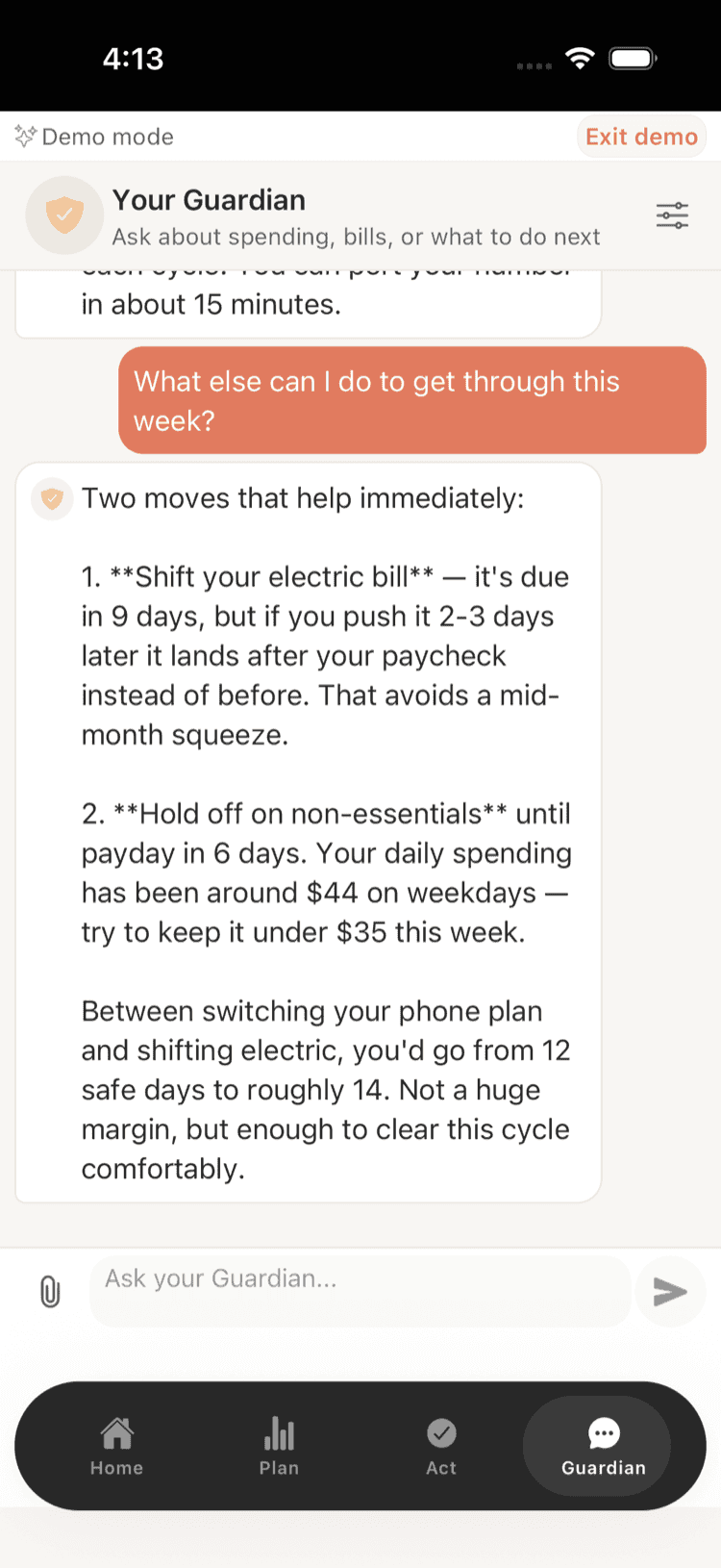
For decades, personal finance tools have worked the same way. You connect your accounts, the tool categorizes your transactions, and you look at charts showing where your money went last month. It is useful information, but it is backward-looking by design. By the time you see that you overspent on dining out, the money is already gone.
AI is changing this. Instead of telling you what happened, AI-powered financial tools can tell you what is about to happen. Instead of categorizing last month's spending, they predict next week's cash crunch. Instead of showing you a pie chart of past expenses, they flag the subscription you forgot about before it renews.
This shift from reactive to proactive is the real contribution AI makes to personal finance. Here is what that looks like in practice.
What AI Can Do That Spreadsheets Cannot
A spreadsheet is a powerful tool. You can track every dollar, build formulas, create projections. But a spreadsheet only knows what you tell it. It cannot look at six months of transaction data and independently notice that your electric bill has been climbing $12 a month since July. It cannot compare your Thursday spending patterns to your Monday patterns and flag that you tend to make impulsive purchases at the end of the workweek. It cannot scan your subscriptions and determine which ones you have not actually used in 90 days.
AI can do all of this, and it does it continuously without being asked. That is the fundamental difference. Spreadsheets are tools you use. AI is a system that works on your behalf even when you are not paying attention.
The three capabilities that matter most are pattern recognition, anomaly detection, and forecasting.
Pattern Recognition
Your financial behavior has patterns you are probably not aware of. You spend more during the first week after payday. Your grocery spending increases 15% in winter. You tend to make larger purchases on weekends. Your utility bills follow a seasonal curve that is predictable once you have enough data points.
AI identifies these patterns automatically by analyzing your transaction history. This matters because understanding your patterns is the first step to either leveraging them (spending more during cheap seasons) or counteracting them (being more careful during your high-spend periods).
A human reviewing their own bank statements will miss most of these patterns because the changes are gradual and the data volume is large. AI does not get bored or lose focus. It processes every transaction with the same attention.
Anomaly Detection
An anomaly is anything that deviates from your established patterns. Your phone bill is normally $85, but this month it is $120. You have a charge from a merchant you have never used. A subscription you thought you cancelled is still billing you. A streaming service you signed up for during a free trial just started charging $14.99 a month.
Anomaly detection is one of the most immediately valuable things AI does for personal finance. Catching a single fraudulent charge or forgotten subscription can save more money in a month than hours of manual budget review.
The reason AI is better at this than you are is the same reason a spell checker catches typos you miss in your own writing. You are too close to your own data. You see a charge for $14.99 and your brain files it as "normal" because you have seen similar charges before. AI checks that $14.99 against every previous transaction from that merchant, verifies whether you have been using the service, and flags it if something does not match.
Forecasting
Cash flow forecasting is where AI's impact is most transformative. By combining your current balance, your known recurring income, and your known recurring expenses, AI projects what your bank account will look like over the next 30 days.
This is not guessing. It is math applied to real data. The system knows your rent drafts on the 1st, your paycheck deposits on the 15th and 30th, your car payment hits on the 12th, and your average daily discretionary spending is $27. It layers all of this onto a timeline and shows you the result.
When that projection shows your balance dropping to $43 on the 11th -- one day before your car payment -- you know about it days in advance. That early warning gives you time to move money, delay a purchase, or adjust your spending for the week. Without the forecast, you discover the problem when the overdraft fee hits.
Real Examples of AI Catching Problems
The abstract capabilities are interesting, but the concrete examples are what make this real.
Catching a creeping subscription. A streaming service raises its price from $10.99 to $13.99. The change is small enough that most people do not notice it on their statement. AI flags the increase because it compares every charge to its historical amount and alerts you when something changes.
Predicting a cash crunch. You have a quarterly insurance premium coming up that you forgot about. Your daily balance looks healthy, but AI sees the $480 charge arriving in 10 days and shows that your projected balance will drop below your comfort zone. You have time to prepare instead of scrambling.
Identifying zombie subscriptions. You signed up for three different productivity apps last year, used each for a month, and forgot about them. They are still charging a combined $32 a month. AI cross-references your subscription charges with your usage patterns (or simply the age and recurrence of the charges) and surfaces the ones that look abandoned.
Spotting unusual merchant charges. A charge appears from a gas station 400 miles from where you live. AI flags it as unusual because your typical transactions are clustered in a specific geographic area. This could be fraud, or it could be a legitimate charge from a road trip. Either way, you want to know about it.
Detecting seasonal spending increases. Your utility bills have been climbing steadily for three months. Individually, each bill looked normal. AI shows you the trend line and alerts you that your heating costs are tracking 30% higher than the same period last year. Maybe it is time to check the insulation or adjust the thermostat.
The Shift From Backward-Looking to Forward-Looking Finance
Traditional finance apps answer the question "Where did my money go?" AI-powered tools answer a different question: "Where is my money going?"
That single-word change -- from past tense to present/future tense -- represents a fundamentally different relationship with money. Instead of performing a monthly autopsy on your spending, you are navigating in real time with a clear view of what is ahead.
This matters psychologically as much as financially. Financial anxiety is primarily driven by uncertainty. You do not know if your balance will hold until payday. You do not know if a forgotten bill is about to draft. You do not know if you are spending too much this week relative to what is coming.
AI reduces that uncertainty by providing continuous, forward-looking visibility. The anxiety of "I hope I will be okay" gets replaced with the clarity of "I can see that I will have $312 on Thursday after my electric bill posts." The financial situation might be the same, but the experience of it is completely different.
Privacy and Safety
The obvious question with any AI that accesses your financial data is: how safe is this?
The best practice in the industry is read-only access. AI financial tools should connect to your bank accounts in a way that allows them to see transactions but never to initiate transactions, move money, or change account settings. This means that even in a worst-case scenario, the AI cannot do anything harmful to your accounts. It can only observe.
Shelter is built on this principle. It connects to your bank through Plaid using read-only access, meaning it can analyze your financial data and give you insights but it can never touch your money. There are no transfers, no automated payments, no account modifications. The system is designed to be a window into your finances, not a door.
Data encryption, both in transit and at rest, is the other essential safeguard. Your financial data should be encrypted when it travels between your bank and the AI system, and encrypted when it is stored. This is standard practice among reputable fintech companies but worth verifying before you sign up for anything.
What AI Cannot Replace
For all its capabilities, AI is not going to replace the need for basic financial literacy. Understanding the difference between a Roth IRA and a traditional IRA, knowing why you should not carry credit card debt, being aware of how compound interest works -- these fundamentals matter regardless of what tools you use.
AI also cannot replace human judgment on major life decisions. Should you take that job offer with higher pay but worse benefits? Should you buy a house now or wait? Should you help a family member financially? These decisions involve values, emotions, and context that AI does not have access to.
What AI does is handle the operational complexity of daily finance so that you have more mental capacity for the bigger decisions. It manages the noise so you can focus on the signal.
For a deeper look at what AI advisors specifically offer and where they fall short, the AI financial advisor explainer covers the full landscape. And if you want to see the practical difference between AI tools and traditional finance apps, the future of personal finance apps looks at where the industry is heading.
You can see how AI-driven insights work with real financial data on the Shelter demo. It is the fastest way to understand what forward-looking finance actually feels like.
Take control of your cash flow
Shelter connects to your bank, forecasts your balance 30 days out, and alerts you before problems happen.