TL;DR
AI financial advisors analyze your bank data to provide personalized spending insights, cash flow predictions, and real-time alerts. They differ from robo-advisors (which manage investments) and human advisors (which handle complex planning). They are most valuable for people without enough assets for a human advisor, anyone with variable income, or those who want low-maintenance financial guidance.
The term "AI financial advisor" gets thrown around a lot, and it means different things depending on who is using it. Some companies use it to describe a glorified chatbot that regurgitates generic financial tips. Others use it for sophisticated systems that analyze your actual financial data and give you personalized, timely guidance.
The difference matters. Understanding what AI financial advisors actually do -- and what they do not do -- helps you decide whether one belongs in your financial toolkit.
What AI Financial Advisors Do
At their best, AI financial advisors analyze your financial data and provide personalized insights that would take hours to figure out manually. They look at your income patterns, spending habits, bill timing, and account balances to identify things you might not notice on your own.
Here is what a good AI financial advisor can do:
Pattern recognition. Humans are terrible at spotting gradual changes in their own spending. Your grocery bill creeping up $15 a month does not feel like a big deal in any given week, but over a year it is $180 extra. AI is built to catch these slow-moving trends because it compares your current behavior against your historical baseline continuously.
Real-time alerts. Instead of waiting until the end of the month to discover you overspent, an AI advisor can flag unusual charges the day they happen. A subscription you forgot about renewing, a bill that came in higher than usual, a duplicate charge from a merchant -- these get surfaced immediately.
Cash flow prediction. By analyzing your recurring income and expenses, AI can project what your bank balance will look like in the coming weeks. This is arguably the most valuable capability because it turns personal finance from a backward-looking activity into a forward-looking one.
Personalized recommendations. Generic advice like "save more and spend less" is useless. An AI advisor that has access to your actual financial data can make specific recommendations: "Your electric bill has increased 25% over the last three months -- you may want to check for an issue" or "You have three subscriptions totaling $47 that you have not used in 60 days."
How They Differ From Robo-Advisors
People often confuse AI financial advisors with robo-advisors, but they serve different purposes.
Robo-advisors (like Betterment or Wealthfront) focus on investment management. They build and rebalance a portfolio based on your risk tolerance and timeline. They are excellent at what they do, but their scope is narrow. They do not look at your checking account, do not know when your bills are due, and do not care whether you are about to overdraft.
AI financial advisors focus on day-to-day money management. They look at your cash flow, spending patterns, bills, and subscriptions. They help with the operational side of personal finance -- making sure you have enough money when you need it, catching wasteful spending, and giving you a clear picture of your financial trajectory.
| AI Financial Advisor | Robo-Advisor | Human Advisor | |
|---|---|---|---|
| Focus | Day-to-day cash flow | Investment portfolios | Comprehensive planning |
| Availability | 24/7, instant | 24/7, automated | Business hours, scheduled |
| Cost | $5–$15/month | 0.25%–0.50% of assets | 1% of assets or $150–$300/hr |
| Minimum assets | None | $0–$500 | $100,000+ typical |
| Personalization | High (from your bank data) | Medium (risk profile) | Highest (1:1 relationship) |
| Best for | Daily spending decisions | Long-term investing | Complex financial situations |
The two are complementary, not competing. A robo-advisor manages your investments. An AI financial advisor manages everything else.
How They Differ From Human Advisors
Human financial advisors bring experience, judgment, and emotional intelligence that AI cannot replicate. They are essential for complex situations like estate planning, tax strategy across multiple entities, navigating a divorce or inheritance, or making high-stakes decisions where the emotional weight matters as much as the numbers.
But human advisors have practical limitations. They are expensive (typically 1% of assets under management or $150 to $300 per hour for fee-only advisors). They are not available at 11 PM when you are lying awake wondering if you can afford to replace your transmission. And they do not have the capacity to monitor your daily transactions and alert you to every anomaly.
AI advisors fill the gap between what you can manage on your own and what warrants paying a human professional. The daily financial questions -- "Can I afford this?" "Is this charge normal?" "Am I on track this month?" -- are exactly the kind of repetitive, data-intensive tasks that AI handles well.
Capabilities That Actually Help
Not all AI advisor features are equally useful. Based on what actually moves the needle for people's finances, here are the capabilities worth looking for:
Anomaly detection. The ability to spot charges that do not fit your normal pattern. This catches fraud, billing errors, and forgotten subscriptions.
Forward-looking forecasts. Any system that only tells you what already happened is a reporting tool, not an advisor. Look for the ability to project your future balance and warn you about upcoming shortfalls.
Conversational interaction. Being able to ask plain-language questions about your finances ("How much did I spend on food this month?" or "Can I afford a $200 purchase right now?") and get answers based on your real data is far more useful than clicking through charts.
Proactive alerts. The best AI advisor is one you do not have to open to benefit from. Push notifications about upcoming cash crunches, unusual charges, or bills that increased in amount -- these are the insights that prevent problems rather than just documenting them.
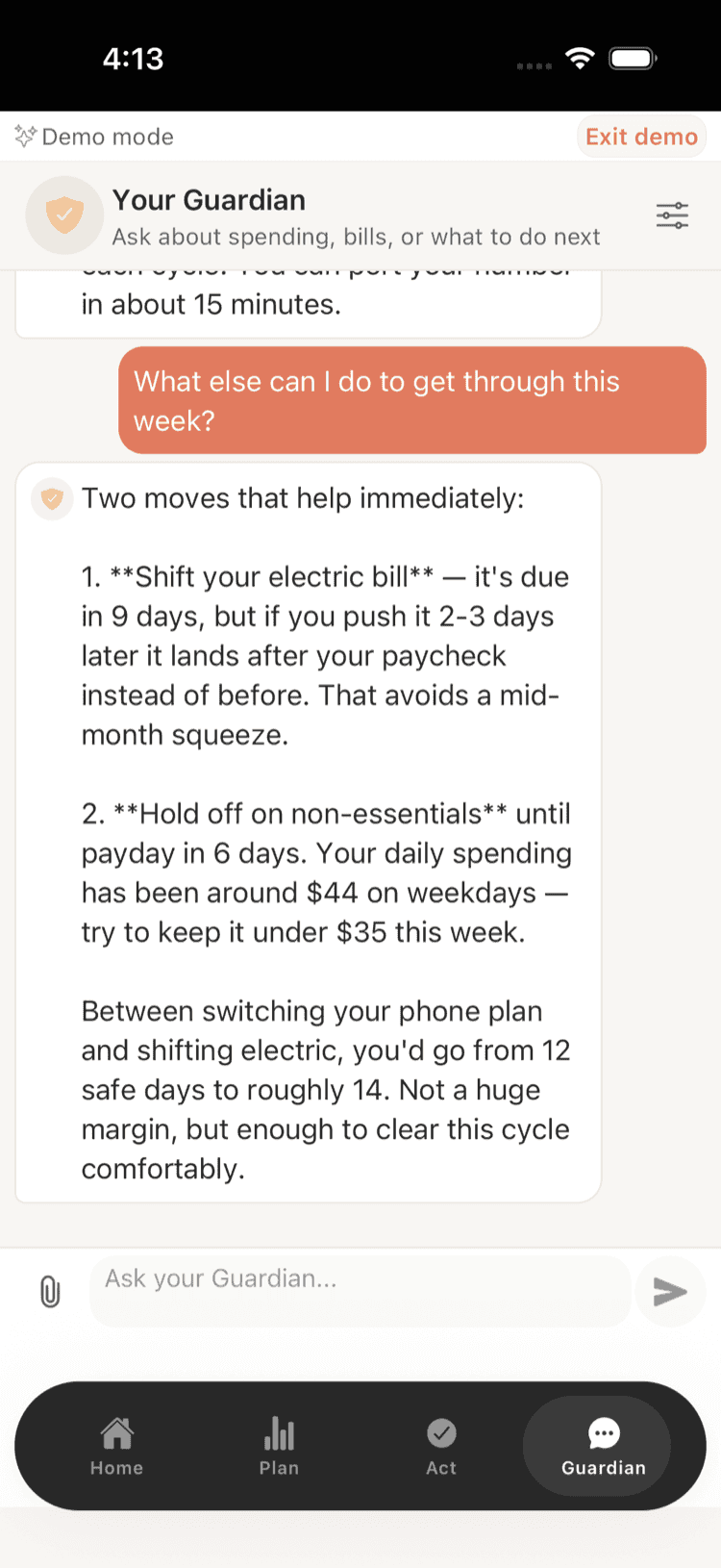
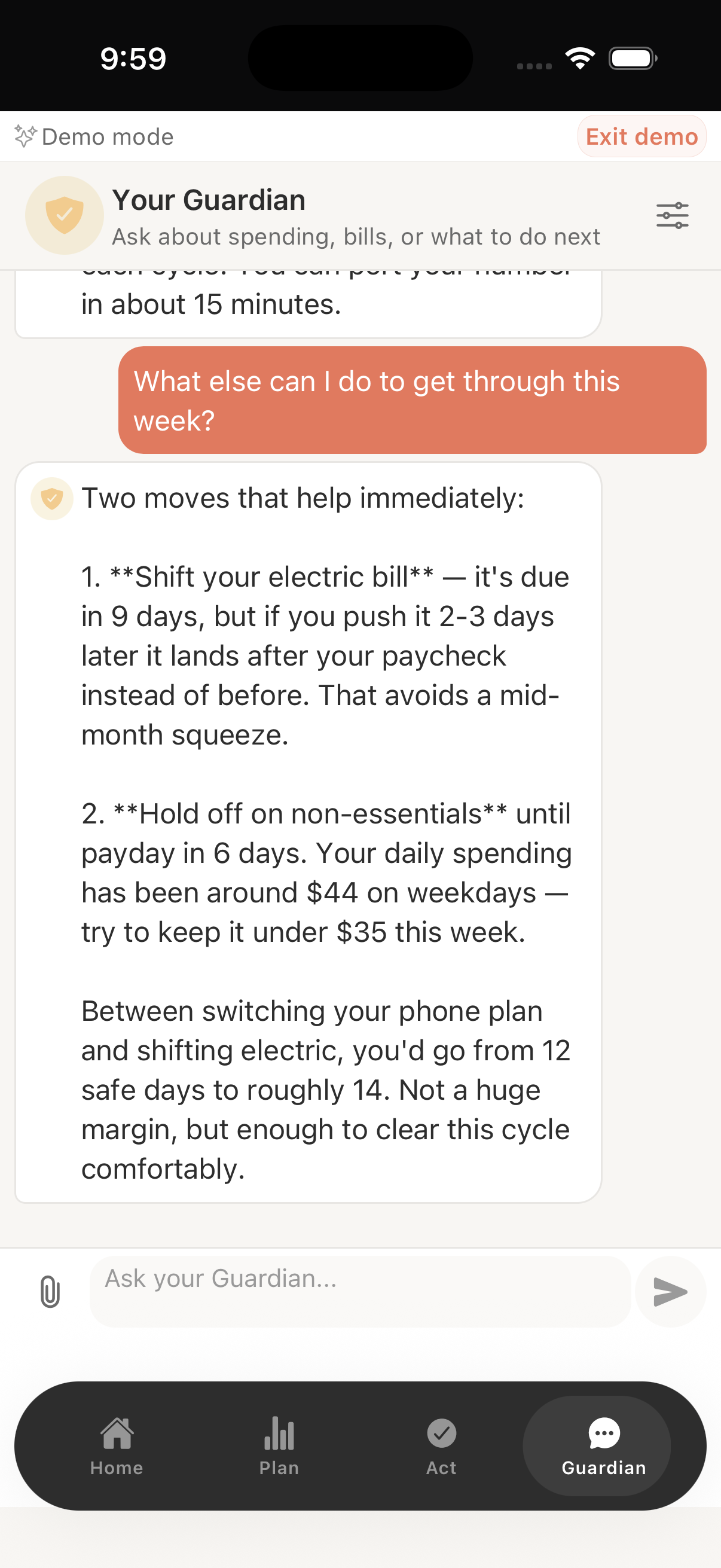
Shelter is built around these capabilities. Its AI financial guardian, called Guardian, connects to your bank data and provides conversational financial guidance based on your actual spending, income, and bill patterns. It does not manage investments or sell financial products. It focuses on the practical, day-to-day decisions that shape your financial health. You can explore what Guardian does on the features page.
Limitations to Be Honest About
AI financial advisors have real limitations, and any product that pretends otherwise should make you skeptical.
No emotional intelligence. AI cannot read the room. It does not know that you just lost your job and need compassion, not a notification about your spending going up. It cannot help you work through the emotional side of financial decisions like a human advisor or therapist can.
No complex planning. Tax optimization across multiple income sources, structuring a business sale, setting up trusts for estate planning -- these require human expertise and judgment that AI is not equipped to provide.
No regulatory accountability. A human financial advisor (specifically, a fiduciary) is legally obligated to act in your best interest. AI tools have no such obligation. The quality of advice depends entirely on how the product was designed and what incentives the company behind it has.
Data dependency. AI advisors are only as good as the data they can access. If you have accounts at multiple banks, cash transactions, or income sources the system cannot see, the picture it creates will be incomplete.
Who Benefits Most
AI financial advisors are particularly valuable for certain groups:
People who do not have enough assets for a human advisor. Most human financial advisors want clients with $100,000 or more in investable assets. If you are earlier in your financial journey, AI tools provide guidance that would otherwise be inaccessible.
People with busy lives who need low-maintenance tools. If you do not have time to review spreadsheets or track spending manually, an AI system that monitors your finances and only surfaces what matters saves significant time and mental energy.
People with variable income. Freelancers and gig workers benefit enormously from cash flow prediction because their income is too irregular for traditional budgeting. AI that adapts to changing income patterns is much more useful than a static monthly budget.
People who are anxious about money. Financial anxiety often comes from uncertainty. An AI advisor that provides clear, data-driven answers to "Am I okay?" can reduce that anxiety in a way that checking your bank balance cannot, because it looks forward instead of just showing you where you stand right now.
Privacy Considerations
Giving an AI access to your financial data is a legitimate concern. Before using any AI financial advisor, consider a few things.
How is data accessed? Tools that connect through Plaid or similar bank aggregators use read-only connections. They can see your transactions but cannot move money, make payments, or change anything in your accounts. This read-only approach, which is how Shelter works, is the safest model.
Where is data stored? Look for tools that encrypt data at rest and in transit, and that do not sell your financial data to third parties.
What is the business model? If the product is free, you are likely the product. Subscription-based AI advisors tend to have cleaner incentives because they make money from you being a happy customer, not from selling your data or pushing financial products.
The Bottom Line
AI financial advisors are not a replacement for human financial planners, and they are not magic. They are a new category of tool that fills a genuine gap: affordable, always-available, data-driven guidance for the daily financial decisions that collectively determine whether you end up in good shape or bad.
If you are curious about how an AI advisor interacts with your actual financial picture, the comparison between AI chatbots and human advisors goes deeper on when each makes sense. And for a broader look at how AI is changing money management, how AI helps manage money covers the practical applications beyond just getting advice.
Take control of your cash flow
Shelter connects to your bank, forecasts your balance 30 days out, and alerts you before problems happen.