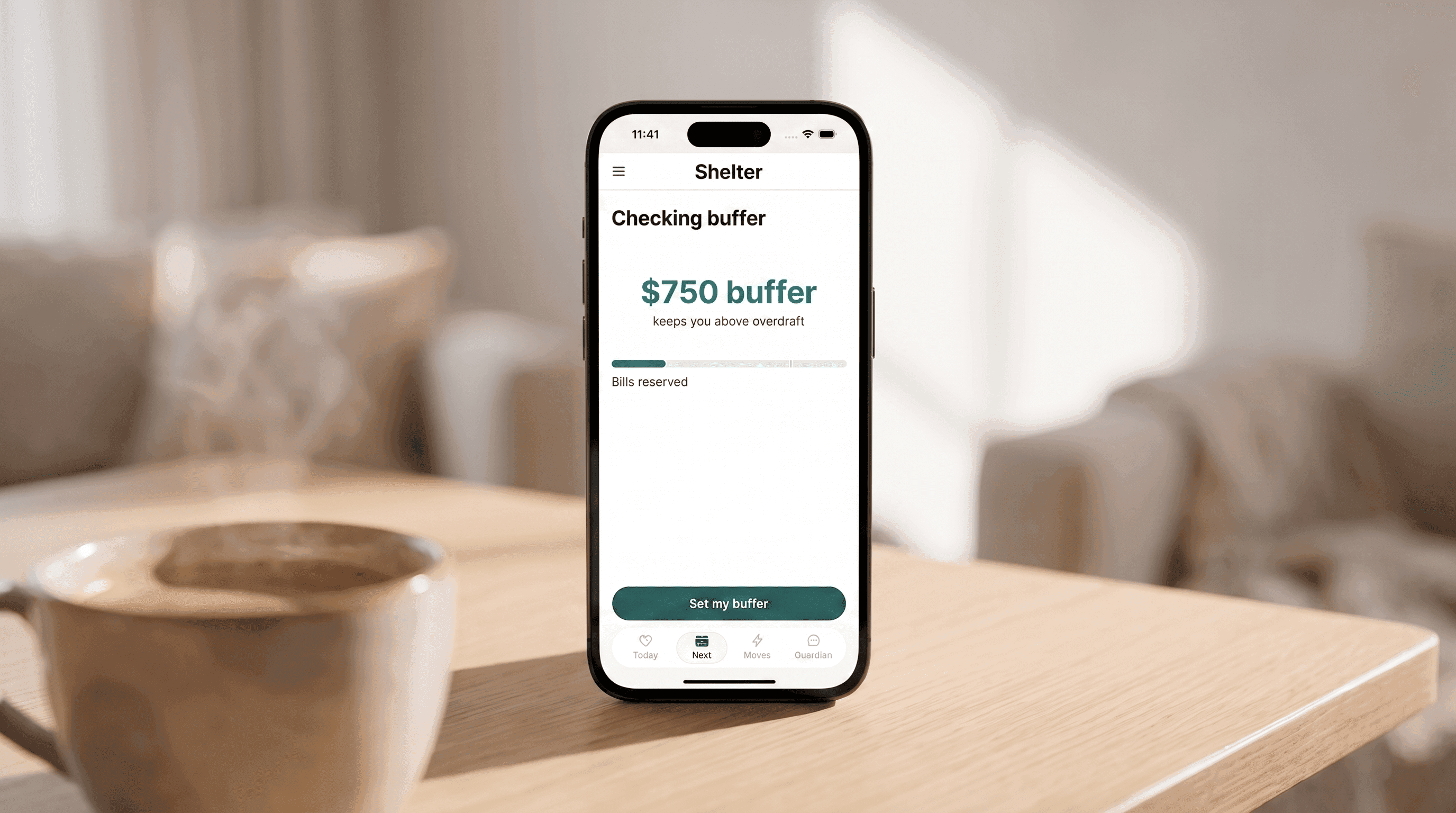
There is no perfect checking-account balance that works for everyone. But there is a practical number that makes overdrafts far less likely for you.
That distinction matters. A lot of people ask how much money they should keep in checking as if there is one magic threshold: $100, $500, $1,000. In reality, the right buffer depends on your bill timing, your income timing, how variable your spending is, and how often small surprise charges show up.
The goal is not to keep as much cash as possible sitting in checking forever. The goal is to keep enough there that a normal timing mistake does not turn into a $35 fee, a declined payment, or a stressful Thursday before payday.
The Real Job of a Checking Buffer
Your checking buffer is not an emergency fund. It is not long-term savings. It is a timing cushion.
Its job is to absorb the normal friction of day-to-day money management:
- A bill posting one day earlier than expected
- A paycheck clearing one day later than expected
- A forgotten subscription renewal
- A grocery trip that costs $28 more than usual
- A pending charge that settles higher than the original amount
Most overdrafts are not caused by one dramatic financial disaster. They are caused by a small gap. The account only needs to be off by a little for the fee to trigger. That is why even a modest checking buffer can prevent a surprising number of problems.
Why One Person Needs $100 and Another Needs $600
The right number changes based on how your cash actually moves.
1. How close you live to payday
If your balance regularly drops near zero in the last few days before payday, you need a larger buffer than someone whose account never gets tight between deposits. The shorter your breathing room, the more useful a dedicated cushion becomes.
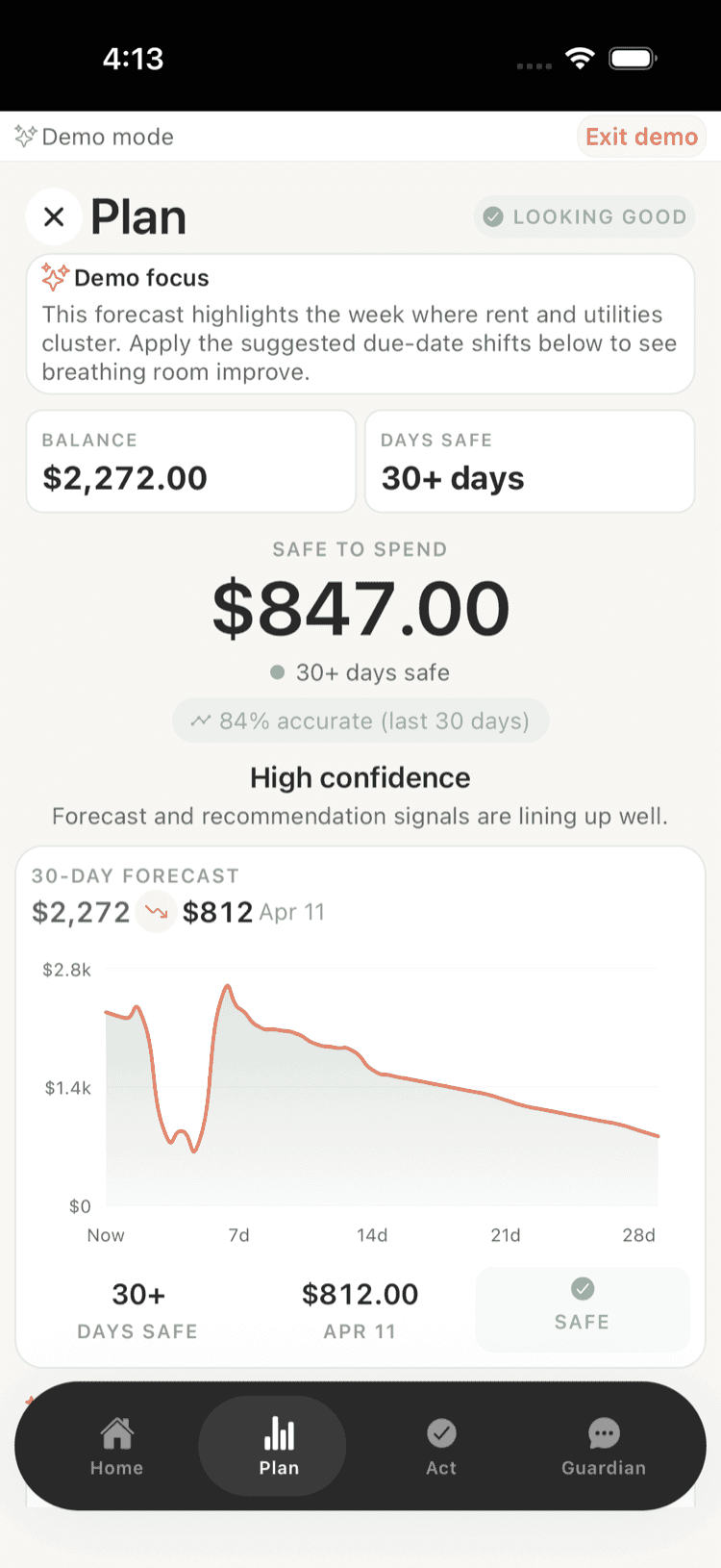
If you need help seeing those tight windows earlier, Shelter's paycheck planning app is built around that exact question: will your balance hold until the next deposit?
2. How clustered your bills are
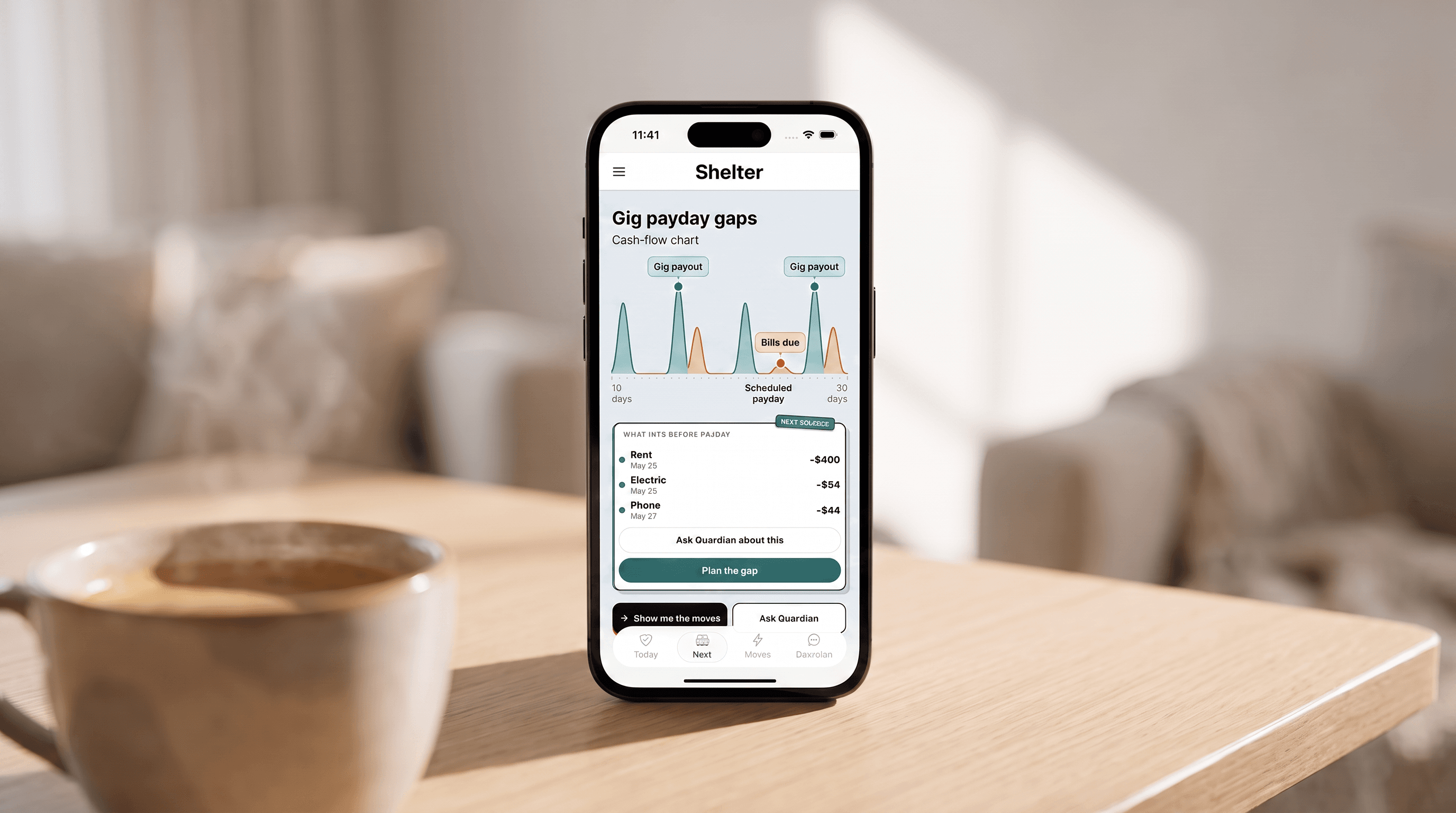
Some households have perfectly spread-out due dates. Others get hit with rent, insurance, utilities, and a handful of subscriptions in the same five-day span. The more your bills cluster, the more checking cushion you usually need.
Our guide to the bill calendar strategy explains how changing due dates can reduce the size of the buffer you need.
3. How variable your spending is
If your weekly spending is predictable, your checking buffer can be smaller. If groceries, gas, childcare, or gig-work expenses swing up and down, you need more margin for noise.
4. How many small autopays you have forgotten about
This is where people get tripped up. It is not always the rent payment that causes the overdraft. Sometimes it is the streaming renewal, cloud storage plan, or annual membership fee that lands when the account is already thin.
That is one reason forecast-based low balance alerts are more useful than a simple threshold alert. The problem is not just the balance. It is the stack of charges behind it.
A Practical Starting Range
If you want a starting point instead of theory, use this as a rough framework:
- If your income is steady, your bills are fairly aligned with payday, and you rarely get close to zero, a $100 to $250 checking buffer is often enough.
- If you regularly feel squeezed before payday or you have several autopays hitting the same week, a $250 to $500 buffer is usually more realistic.
- If your income is irregular or you have a history of overdrafts, aim for at least one week of essential expenses in checking or in a linked timing buffer you can access immediately.
Those are not hard rules. They are starting ranges. The right number is the one that covers your normal volatility without leaving you anxious every time a charge clears.
How to Calculate Your Own Number
The best way to set a buffer is to work backward from your actual pattern.
Step 1: Find your lowest point between paychecks
Look at the last two or three months of account history. Identify the lowest balance you typically hit before income arrives again.
If your account usually falls to $42 before payday, your current system already tells you that your margin is dangerously thin.
Step 2: Add your most common surprise amount
Think about the type of charge that usually pushes you over the edge: a slightly higher grocery run, a forgotten subscription, an annual fee, a gas fill-up, a takeout order on a stressful day. For many people, this surprise zone is only $25 to $75.
Add that amount to your lowest balance. That gets you closer to the minimum buffer that would have prevented recent near-misses.
Step 3: Add a timing cushion
Then add a bit more for timing noise. Deposits do not always clear exactly when you expect. Pending charges sometimes settle later. Banks process transactions in ways that are not always intuitive.
Even an extra $50 to $100 of timing cushion can make the difference between a stable week and an overdraft spiral.
Step 4: Pressure-test against your bill calendar
Now compare that buffer against the week when your bills are most stacked. If your insurance, utilities, and several subscriptions all hit in the same narrow window, your minimum number may still be too low.
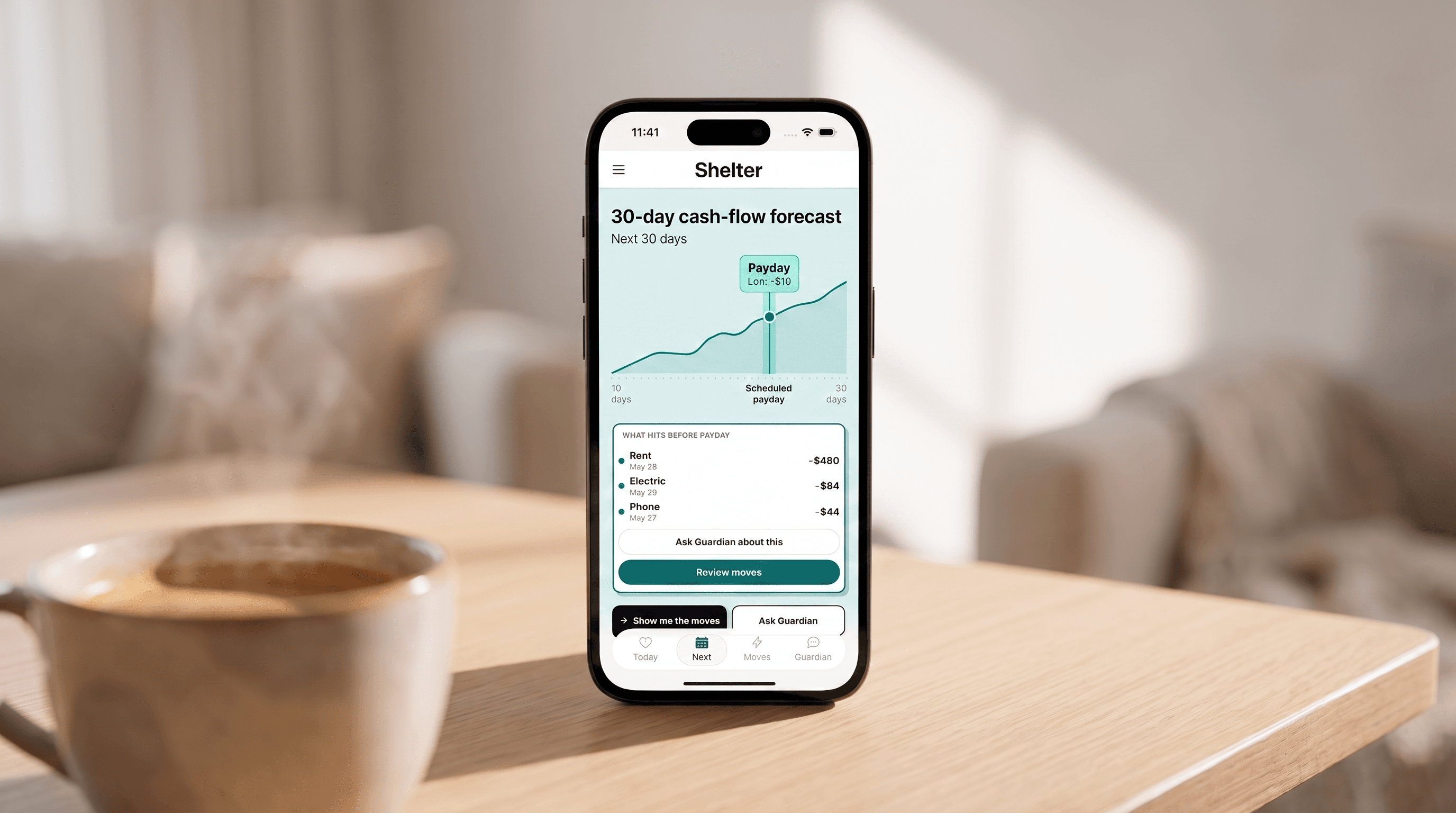
This is where a tool like Shelter helps. Its cash flow forecasting app projects your balance forward around real bill timing so you can see whether your chosen cushion actually survives the next two weeks.
Signs Your Buffer Is Too Small
Your checking buffer is probably too small if any of these sound familiar:
- You check your balance multiple times a day near payday.
- One forgotten subscription can trigger a problem.
- A slightly expensive grocery trip creates anxiety.
- You often transfer small amounts from savings just to get through the week.
- You have paid overdraft or NSF fees more than once in the last year.
If that pattern sounds familiar, your goal should not just be "watch the account more closely." It should be "increase the amount of ordinary friction the account can absorb."
How to Build the Buffer Without Feeling Like You Are Saving for Forever
This part matters because a lot of buffer advice sounds unrealistic. Telling someone to keep $1,000 in checking when they are fighting to make it to payday is not helpful.
A better approach is to build the cushion in layers:
- Start with the first $50.
- Then get to $100.
- Then build toward one average day of essential spending.
- Then build toward the full number your account actually needs.
This works better psychologically because every layer reduces risk. You do not have to wait until some distant finish line to feel the benefit.
If you want help stopping the fees while you build the cushion, start with the best app to avoid overdraft fees page and the overdraft fee calculator. Preventing even one or two fees can free up part of the buffer faster.
The Better Question
Instead of asking "How much should I keep in checking?" ask:
"How much cushion does my account need to survive a normal tight week?"
That is the number that matters. It is practical, personal, and grounded in how your money actually moves.
For some people the answer is $150. For others it is $400. For anyone dealing with irregular income or frequent bill clustering, it may be higher. What matters is that the number is based on your real cash-flow pattern, not an arbitrary rule from the internet.
And if you do not want to estimate by hand, Shelter can help you spot those tight windows earlier. The low balance alert app page covers how forecast-based warnings work, and the paycheck planning app page shows how to think about the stretch between today and the next deposit.
Take control of your cash flow
Shelter connects to your bank, forecasts your balance 30 days out, and alerts you before problems happen.